So here’s the thing nobody warned me about when we started building this house. You don’t pick out wardrobes at the end. You pick them out in this weird middle stage where the drywall is up but the floors aren’t in yet and you’re standing there with a tape measure trying to imagine what your life will look like in two years and how many sweaters you’re going to own and whether you’ll still be doing your makeup in this room or if it’ll move to the bathroom and… anyway.
I’ve been agonizing about this. For weeks. Like, embarrassingly long. And the funny thing is, when I finally sat down and made the call, the whole thing took about ten minutes once I asked myself the right question (which I’ll get to).
The answer, for us, is both. Built-ins in the master closet and 2nd bedroom (upstairs). Freestanding in the 3rd bedroom. Done. But getting to “both” took longer than it should have because I kept reading articles online that were like “FREESTANDING IS BETTER!” or “FITTED WARDROBES ARE THE ONLY ANSWER!” and I’d nod along and then read the next article and nod along to the opposite thing. So.
Let me back up.
What’s Actually the Difference
If you already know this part skip ahead, but in case you don’t:
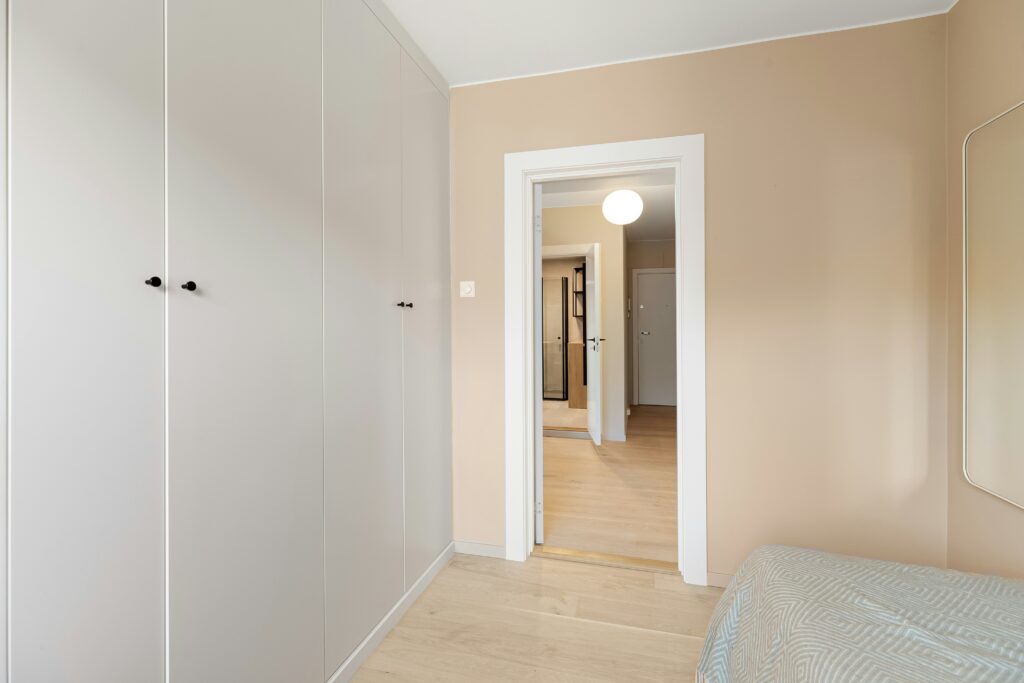
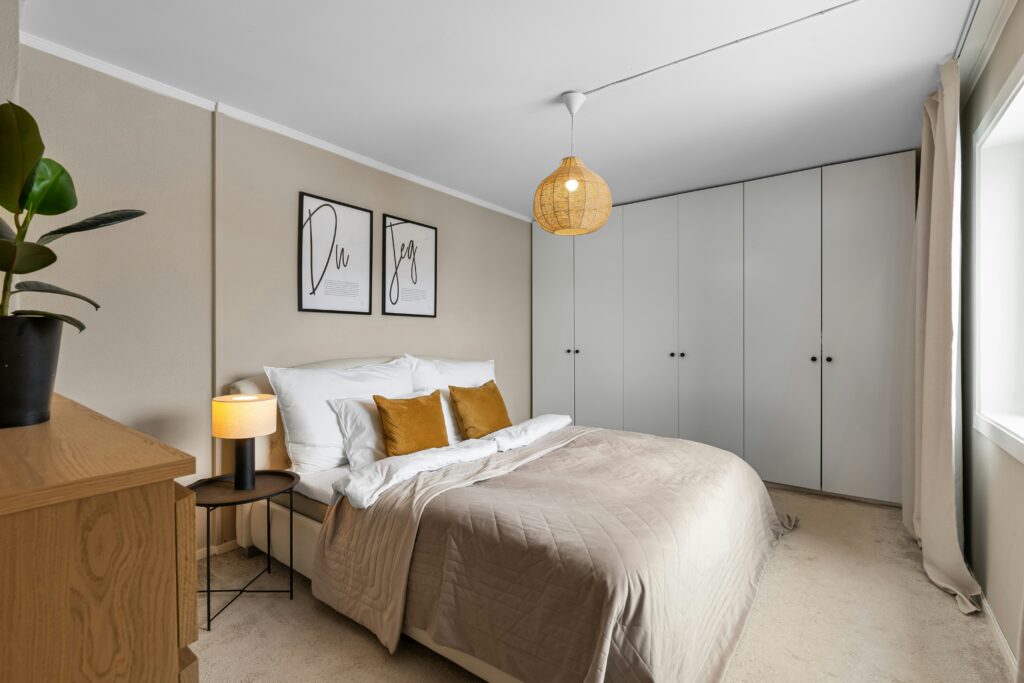
Built-in wardrobes are basically joinery. They’re built into the room. Floor to ceiling, wall to wall, designed for your specific space and your specific quirks (and every room has quirks – that wonky corner, the bit where the wall isn’t really straight). They become part of the house. They are not going anywhere ever again.
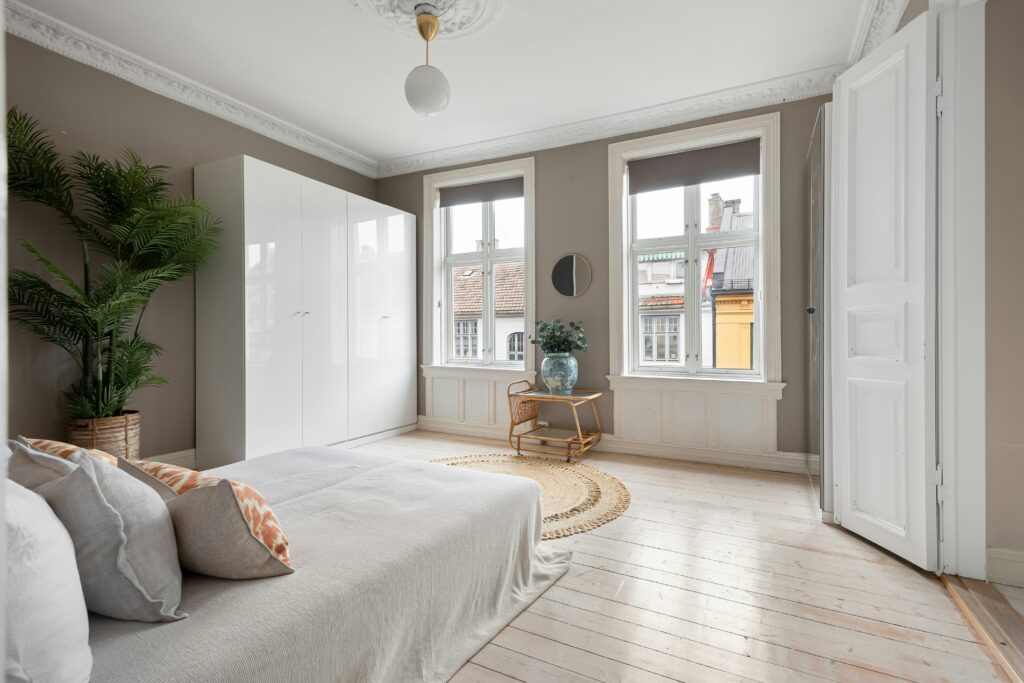
Freestanding wardrobes are furniture. You buy them, you put them somewhere, and if you ever decide they should be somewhere else you can move them. They come in regular sizes which means they almost never quite fit your room perfectly – there’s always some weird gap on the side or that depressing 30cm of dead space at the top that becomes a dust shelf forever. (The dust shelf is real. I cannot stress this enough. Anyone who’s lived with a freestanding wardrobe knows the dust shelf.)
Both work! Both are valid! It’s just that they’re good at completely different things.
Here’s the Quick Cheat Sheet If You’re in a Hurry
Because honestly sometimes you just want to know the answer:
| Built-In | Freestanding | |
|---|---|---|
| Cost | Way more upfront | Way less |
| Storage | Maximum, no wasted space | Standard, with dust shelf |
| Permanence | Stays forever | Comes with you if you move |
| Install time | Months. Months and months. | Usually a day, maybe an afternoon |
| Best for | Forever rooms, dedicated closets | Guest rooms, anywhere flexible |
| Looks like | Architecture | Furniture |
| Resale value | Adds value | Doesn’t really matter, it leaves with you |
If you’re in a forever home, built-in for sure. If you’re renting or moving in a few years, freestanding without question. If you’re somewhere in between (which is most of us)… keep reading.
Okay So Why We’d Do Both
Our master bedroom is connected to a closet which is connected to the full bathroom. So when I say “built-in wardrobes in the master” what I actually mean is built-ins inside the closet room. There’s a difference. A built-in lining the wall of your bedroom is a different conversation than fitting out a dedicated closet room and I think a lot of articles conflate the two.
The closet room was always going to have built-ins. Honestly there was never a real debate about this part. You don’t put freestanding wardrobes inside a room whose entire job is to be storage. That’s like… buying a fridge and then putting a separate cooler inside the fridge. The room IS the storage. Build it out. Use the walls.
The 2nd bedroom on second floor is again with closet and the 3rd bedroom will actually be the one with freestanding wardrobe.
And here’s where I went back and forth for actually weeks. Because part of me wanted everything to be built-in. I had this vision of every room being seamless, every wardrobe disappearing into the wall, the whole house feeling like one designed thing. Very magazine.
But the more I sat with it the more I realized that house would feel… cold? Showroom-y? Like nobody actually lived there? Some of my favorite homes I’ve been in have had real furniture in them. Pieces with stories. An armoire someone’s grandmother had. A wardrobe they bought on a trip. The houses that feel most alive are the ones that have a mix.
So the freestanding pieces will be furniture. Real furniture. The kind you can take with you if you ever sell, or move to a different room, or pass down.
The Mirrored Fronts Thing
Sidebar, because this took me so long to land on.
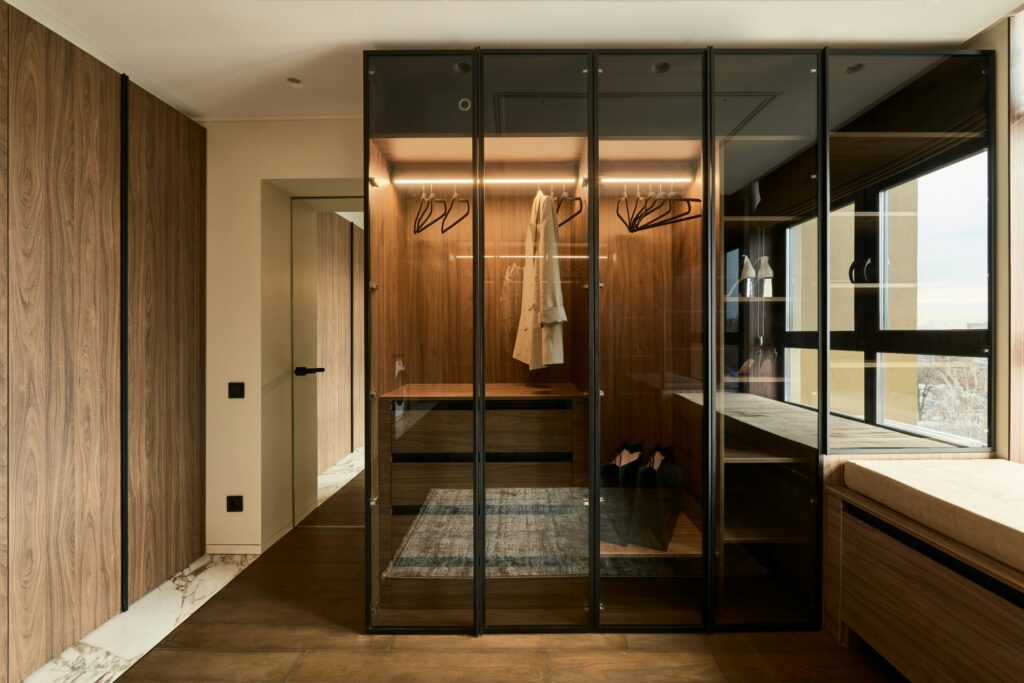
I want mirrored fronts on the built-ins in the closet room. My partner thought I was insane when I first said it. “Mirrored wardrobes? Like… 80s mirrored?”
NOT LIKE 80s MIRRORED.
There is a HUGE difference between bad mirrored wardrobes (cheap mirror, gold trim, bevelled edges, your aunt Linda’s vanity, no offense to aunt Lindas) and good mirrored wardrobes (clean panels, floor to ceiling, minimal hardware, you can barely tell where the doors are). The closet doesn’t have huge windows so it tends toward feeling cave-y, and mirror is the easiest way to bounce light around and make it feel double the size. Also one important thing I should say – if you want LED light in the built-ins, you’d better install the cables before drywall. Plus you need a full-length mirror in there anyway because you’re getting dressed in there. So why not have the wardrobe BE the mirror.
I won. He’s on board now. He’ll thank me later.
Hinged doors though, not sliding. I was going to do sliding because they look cleaner and they’re more space-efficient but then I realized sliding only ever gives you access to half your closet at any given time and that’s just bad design when you’re trying to actually find things. Hinged opens the whole thing up. You can see everything. The minor visual concession is worth the functional gain.
Why Built-Ins for the Master, Specifically
Okay so the real reasons:
We have an actual closet ROOM. Already covered this. Built-ins are basically required.
The master is our forever room. We’re not moving. (Famous last words I know but I genuinely cannot imagine doing this build twice in one lifetime.) So the investment-into-permanent-fixture math actually works out. You amortize the cost over a long time and it stops feeling crazy.
We have a lot of stuff. I’m not going to pretend otherwise. Two adults, all four seasons of clothing, linens, the random “where do we put this” stuff that accumulates over years. I went down a rabbit hole reading about this on Sharps’ site (they’re a UK fitted furniture company), and one thing they kept hammering on really stuck with me – fitted wardrobes can give you up to twice the storage of freestanding ones, basically because they actually use all those weird awkward bits of your room. Sloped ceilings, alcoves, that wonky corner nobody knows what to do with. Standard furniture just gives up on that space. Built-ins eat it for breakfast.
And here’s the small one that I’m a little embarrassed to admit. My mom had built-in wardrobes. There’s something about that just feels like home to me, in this weirdly nostalgic way I can’t quite articulate. Some of the choices we make about our houses are functional and some are emotional and pretending the emotional ones don’t count is silly.
The Cost Question (I Don’t Have a Clean Answer)
Real talk. I haven’t done the full math yet because we don’t have final quotes on the built-ins. Built-in wardrobes are typically 2-3x more expensive upfront than freestanding. That’s the standard line and it tracks with what I’m seeing.
BUT.
A nice freestanding wardrobe (real wood, real construction, not flatpack) is also genuinely expensive. You start adding up two or three of those across multiple bedrooms and the gap closes faster than you’d think. And freestanding pieces don’t last forever – you’re probably replacing or re-buying within 10-15 years. Built-ins are a 30-year purchase. Maybe more.
So the upfront math says built-ins are way more. The lifetime math is closer to a wash. Depends how you want to think about it.
The honest version is that for us, the master built-in is the splurge. The freestanding piece in the other room keeps the overall budget reasonable + for now we won’t do the 2nd floor (because of budget). We’re putting the money where it’ll matter most and not over-investing in rooms that might change function.
The Thing That’s Actually Keeping Me Up at Night
Build time.
This is the worry. Not the permanence (we’re staying). Just the timing. Built-in wardrobes have to be measured AFTER the room is essentially finished – drywall, painted, floor in. THEN designed. THEN manufactured. THEN installed.
That’s months. Months of waiting. And in our case the closet is connected to the bathroom so the bathroom finish work is partially gated on the closet timeline. If the wardrobes get delayed, our move-in date gets pushed.
I would tell anyone starting a build right now: start the wardrobe design process WAY earlier than seems necessary. Like, talk to your closet/joinery person before they even ask you to.
When Built-In Is the Obvious Move
Look, I’m going to skip the perfectly balanced “here are 5 reasons for X and 5 reasons for Y” thing because real people don’t think in lists.
Built-in is the right call if you have a dedicated closet room. Or any awkward corner / alcove / sloped ceiling situation that freestanding will never handle gracefully. Or if you genuinely have so much stuff that maximum storage is the priority. Or if you’re planning to be in this house for a long time. Or if you want the room to feel architectural – like, designed – rather than just furnished.
Mostly though, the dedicated-closet-room thing is the dealbreaker. If you have one, do built-ins. Don’t even think about it.
When You Should Just Buy a Freestanding Wardrobe
Other side. Don’t do built-ins if:
You might move. Even a little chance. The money is gone the day you sign the deed.
The room’s purpose might change. Guest rooms, kid rooms, “we’ll figure it out” rooms.
You found a piece of furniture you genuinely love. Some freestanding wardrobes are gorgeous – vintage armoires, mid-century pieces, real designer stuff. They become focal points in a way built-ins literally cannot, because built-ins are designed to disappear.
The walls of your room are clean and rectangular. Built-ins solve problems. If your room has no problems, you don’t need the solution.
Your budget is tight and you’d rather put the money somewhere else. There’s no shame in this and frankly a great freestanding wardrobe + great lighting + great bedding will beat a built-in plus IKEA-everything-else every single time.
The Question That Actually Helped Me
I said I’d come back to this.
The question I should have asked from the beginning, and the question that finally got us out of our stuck place, was: what does this room want?
Not what do I want. Not what’s better in general. Not what would look most impressive to a hypothetical guest. What does the master closet need from us, given what it is and what it’s going to be? (Built-in.) What does the guest room need? (Flexibility, because who knows what it’ll become.)
Once you ask the question that way, the answer is right there. You stop trying to apply one blanket rule across the whole house and you start treating each room as its own little decision.
Stuff People Keep Asking
Are built-in wardrobes worth it? In your forever rooms, yes. In your “we’ll figure out what this room is later” rooms, no.
Do they add value when you sell? Yeah, especially in masters. Buyers see fitted closets as a feature, not a problem.
How much more do they cost? 2-3x upfront, but the long-term math is a lot closer than that suggests because freestanding doesn’t last forever.
Can I mix both in the same house? YES. Please do. Honestly the house will be more interesting because of it.
Are mirrored built-ins dated? Bad ones yes. Good ones no. The difference is in the execution – clean panels, no decorative trim, floor-to-ceiling, minimal hardware.
What size room do I need? Built-ins actually work BETTER in small rooms because they use the height. You want at least 1.8-2 meters of uninterrupted wall to make it worth doing custom.
Should I install LED lighting in built-in wardrobes? Yes, but plan for it BEFORE drywall goes up. Running cables after the fact is a nightmare
So that’s where we are. Master gets built-ins (mirrored, hinged, floor to ceiling, all the things). 3rd room gets freestanding piece, probably from European furniture brands because we keep gravitating that direction.
I’ll share photos once it’s all installed. That’s still a few months out at LEAST and I’m trying to not think about it too much because the moment I do I spiral about hinge mechanisms again.
If you’ve made this decision and have thoughts, please tell me in the comments. I always read them. Especially if you regret your choice – the regret stories are the most useful ones, weirdly. We learn more from “I wish I had done X” than from “I’m so happy I did Y.”
Anyway. That’s wardrobes. Wish me luck.