There’s a very specific kind of sadness that happens when an office tries to be “professional” and accidentally becomes… fluorescent and echo-y. Like your brain can hear itself thinking, and not in a cute way.
If you’re trying to level up your professional office decor ideas, I’m going to make this simple: the most refined offices don’t feel empty. They feel edited. They feel intentional.
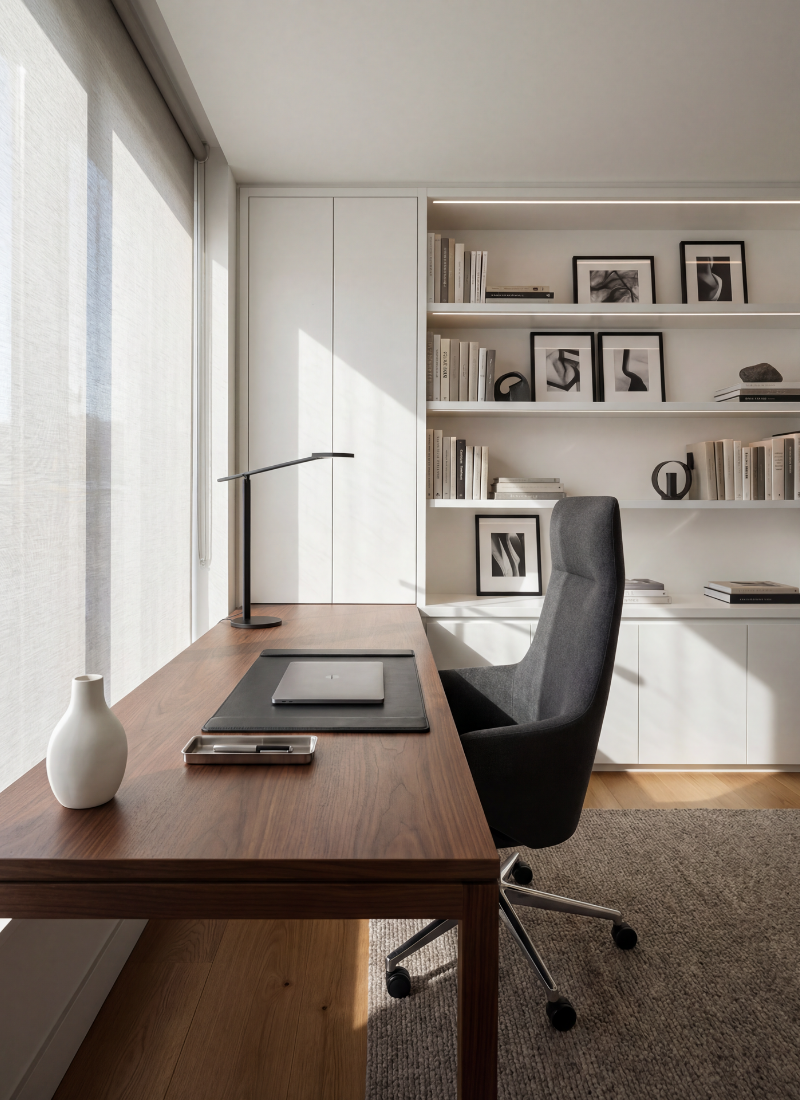
This is not a full redesign manifesto. This is a real-life plan for a space that looks pulled together and helps you work.
I’m going to walk you through clean color schemes, storage that doesn’t look like a supply closet exploded, art that feels refined, and all the little upgrades that make a space feel calmer. Think of it as office decorating ideas that are quietly grown-up, with enough warmth that it still feels like humans work there.
The vibe goal: refined, calm, and actually usable
I always start with the feeling, because the feeling tells you what to edit. Do you want the room to feel focused? Welcoming? Quiet? Energizing but not loud?
A polished office usually lands somewhere between “calm and capable.” That’s where the best office ambiance lives, the kind where people walk in and immediately feel like the place has a plan, and your workspace aesthetics look quietly intentional instead of improvised.
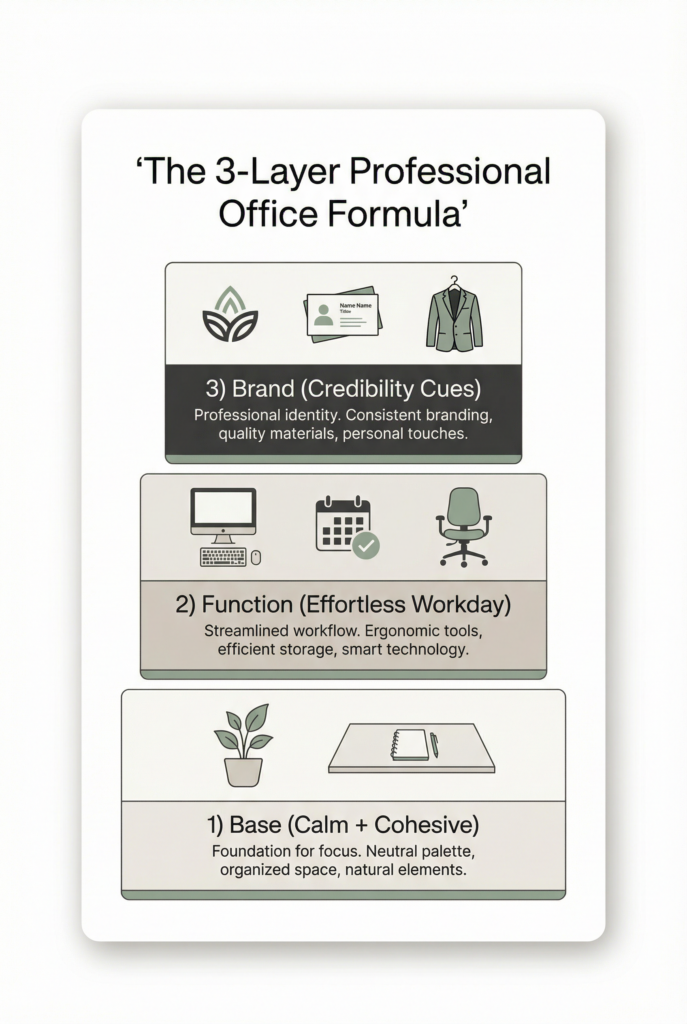
What helps is thinking in layers:
- the backdrop (color, big surfaces)
- the function (how things are stored and accessed)
- the details (lighting, texture, art, plants)
- the comfort (seating, acoustics, privacy)
And yes, I said comfort. Because if the chair hurts your back, no amount of pretty accessories will save you.
Clean Color Schemes: Professional Office Decor Ideas That Look Expensive
Color is the fastest way to make an office look intentional. It’s also the fastest way to make it look chaotic if you wing it.
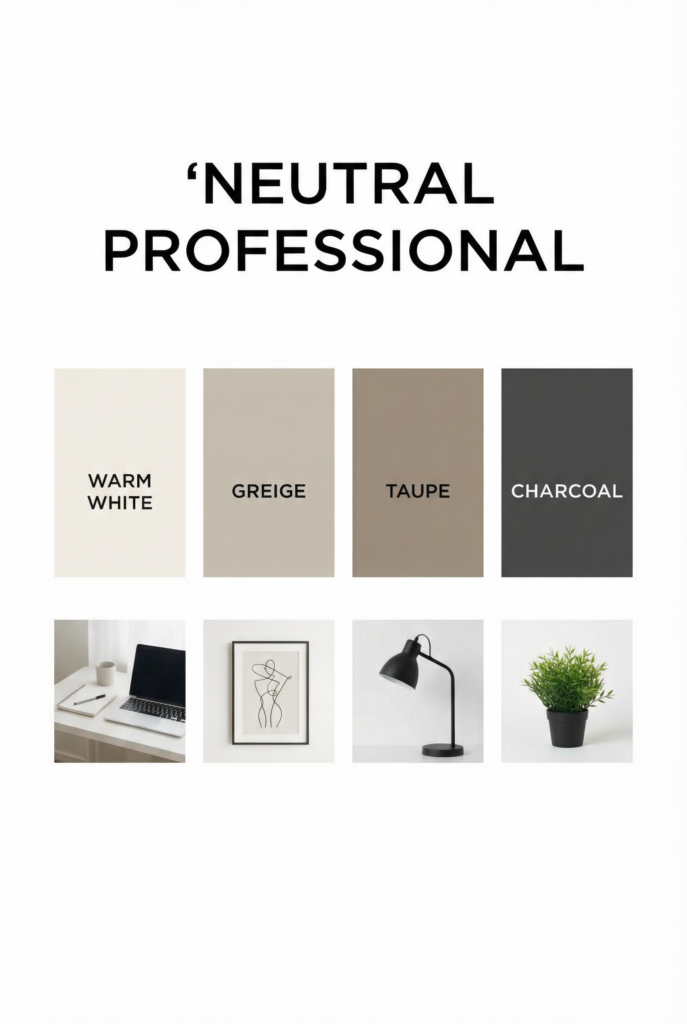
A clean palette doesn’t mean no color. It means a controlled palette, where your eyes can rest and you don’t have ten competing tones fighting on the same wall.
A cohesive palette, and how to add color professionally
Here’s my favorite approach: choose a calm base, then add one color in a very planned way. This is where color psychology in office spaces becomes useful, not as a magic spell, but as a reality check. Soft blues and greens tend to feel steady. Warm neutrals feel welcoming. Highly saturated colors can be fun, but they get loud fast.
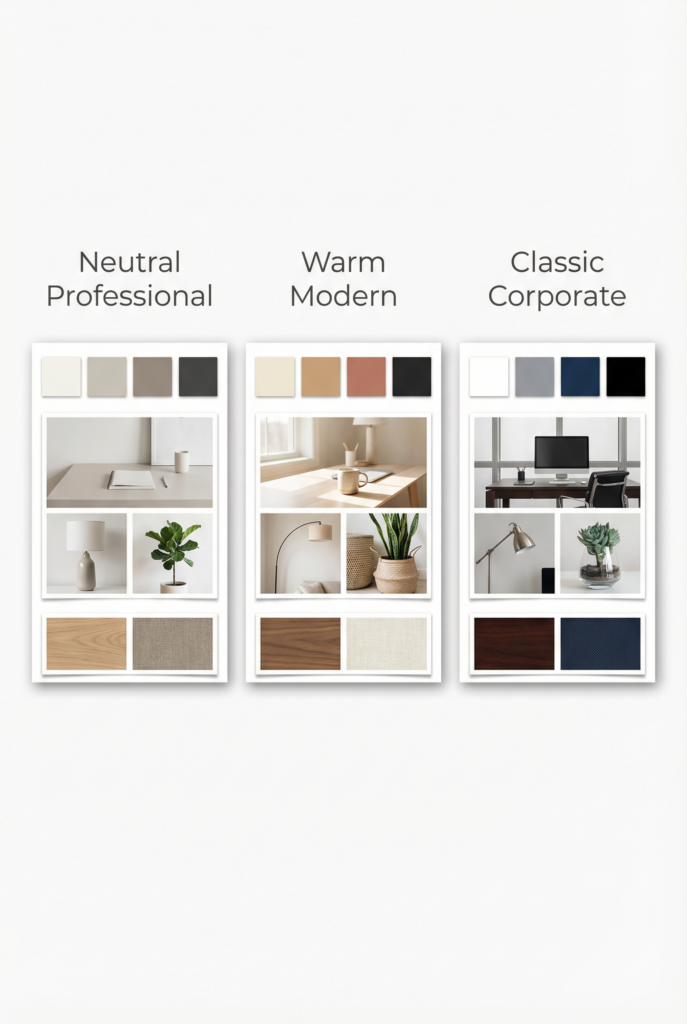
If you’re adding color, do it in “touch points” you can swap later:
- a desk mat
- a rug
- a couple frames
- storage pieces
- one accent chair
In client-facing rooms, I love a base of warm white, soft taupe, or gentle greige, then a muted accent like deep olive, ink blue, or clay. It reads intentional, not trendy, and it doesn’t compete with people’s faces on video calls.
And if your brand colors are bright? Use them like seasoning. A little goes a long way.
Sleek storage and organization that still looks good
This is where a space moves from “pretty photo” to “we can actually work here.”
I want your desk to feel clear, but I also want you to have what you need. So the trick is not owning less, it’s storing smarter.
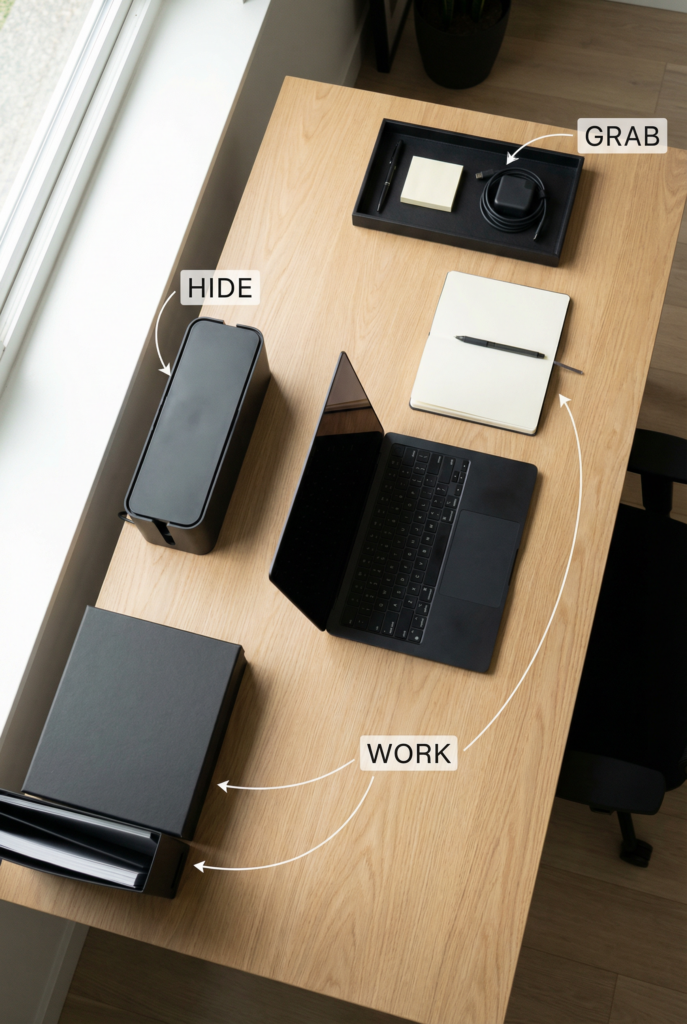
The difference between a calm office and a frantic office is usually workspace organization that is easy to maintain. If the system is annoying, it will not happen. Ask me how I know.
Desk and cubicle storage that stays refined
When a desk looks polished, it’s because the messy necessities are tucked away. Think functional office storage that hides the weird stuff while keeping it easy to reach.
If you’re dealing with open shelves, go for fewer, larger containers instead of lots of tiny bins. It looks calmer and it’s faster to reset.
And if you’re in a cubicle, your life is basically a constant experiment in cubicle organization. My favorite cubicle move is the “contained surface” rule: one tray or one desktop caddy, and everything visible has to live inside it. It keeps the sprawl from happening. Also yes, I’m a tray person. It’s my thing. It keeps me from setting seventeen objects directly on the desk and calling it “fine.”
Paper that doesn’t become an emotional burden
Paper is where offices go to die. You get one stack of forms, then you have a second stack “for later,” then you blink and you’re living inside a paper sandwich.
A polished office needs a paper plan. I like decorative filing systems that look like they belong on the desk, not under it. A sleek vertical file, a lidded magazine box, or a matching set of binders that actually stays together.
My unresolved annoyance: I have never met a printer that didn’t try to ruin the vibe. The best solution I’ve found is hiding it in a cabinet or under a console, then pretending it’s not there until it attacks me again.
Art and decor that feels refined, not random
This is where offices get weird. People either leave the walls completely blank, or they hang one tiny print in the middle of a huge wall like it’s lost. There is no middle ground.
You want wall moments that feel intentional and a little elevated. Think calm, clear, and scaled correctly.
Wall decor that works hard and looks good
If you’re choosing wall art for office areas, keep it simple: abstract, landscapes, soft photography, or graphic line art. Framing matters more than people think. Matching frames can make even budget prints feel expensive.
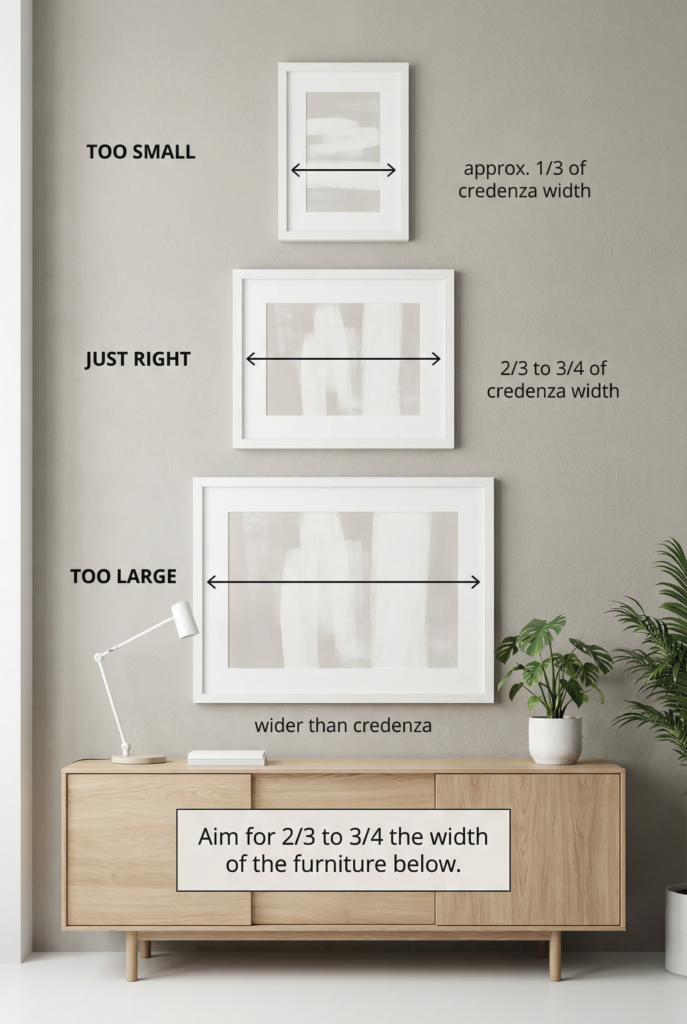
If you need function, go for ledges or slim shelves so you can rotate pieces without committing forever. I also love a pegboard moment in a workroom, but only when it’s styled with some restraint. Functional and pretty is the dream.
This is where I lean on office styling ideas that treat the wall like a composition, not a dumping ground. A couple of larger pieces with breathing room often looks more refined than a busy gallery wall.
The tasteful personalization line
Personal touches are great. Uncurated personal touches can look like a dorm room.
If you’re doing personalized cubicle decor, choose one photo in a good frame, one small object that makes you happy, and one useful thing that’s pretty. That’s it. Leave the rest for your phone background.
I know, I know. This is hard. I say this as someone who once tried to “just keep a couple things out” and ended up with four mugs, two candles, and a tiny tape dispenser shaped like a cat. The cat did not help the professional vibe.
Natural touches: plants and biophilic moments that don’t feel fussy
A little nature makes an office feel calmer immediately. It softens hard lines, it adds life, and it helps a space feel less corporate in the bad way.
This is a big part of natural office design: materials, texture, and living elements that make the room feel grounded.
Indoor plants, including low-light options
If you want indoor plants for office life, but you don’t have great light, do not fight nature. Choose plants that tolerate it: snake plant, ZZ plant, pothos, peace lily.
I like one plant at eye level near the desk, and one larger plant in a corner if you have the space. It adds softness without cluttering your work surface.
And if you kill plants? Use a faux plant that looks decent and call it a day. Your nervous system does not care if it’s real. Your guilt does.
Lighting upgrades that change the whole mood
Lighting is the sneaky hero of a polished office. The same room can look cold and harsh, or warm and refined, just by changing the light sources.
If you only do one upgrade, do lighting. It makes everything look better, including you.
Task plus ambient, with one mood-setting lamp
I think of office lighting ideas in layers. You need a solid task light for actual work, and you also need softer light that makes the room feel human.
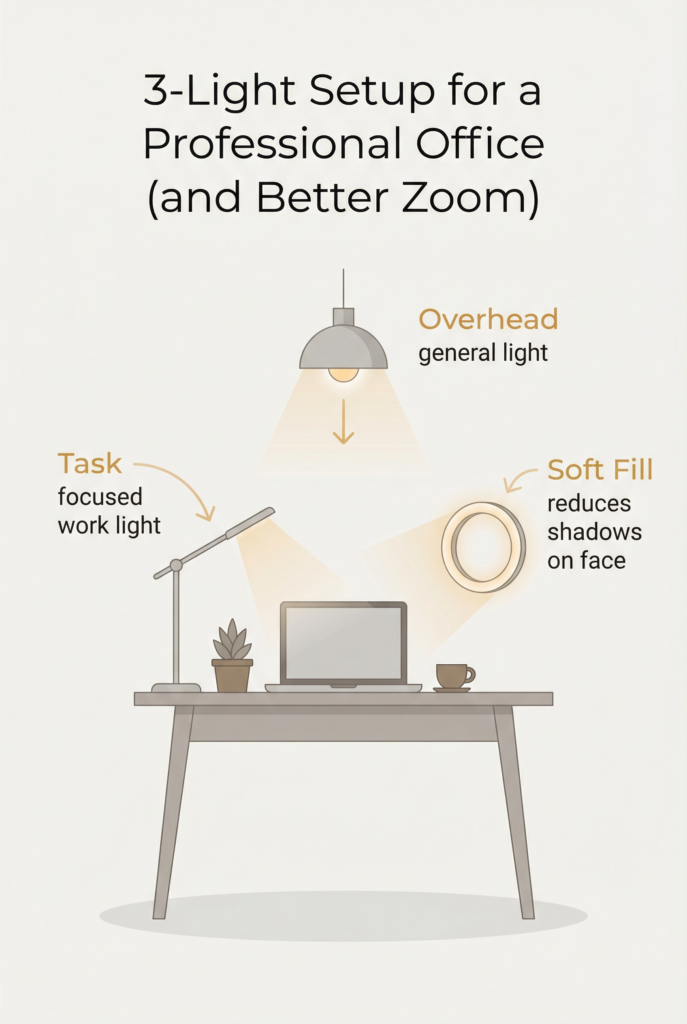
This is where layered lighting for office spaces is magic: a desk lamp for focus, plus a floor lamp or small table lamp for glow. If overhead lights are harsh, the ambient lamp gives your eyes a place to rest.
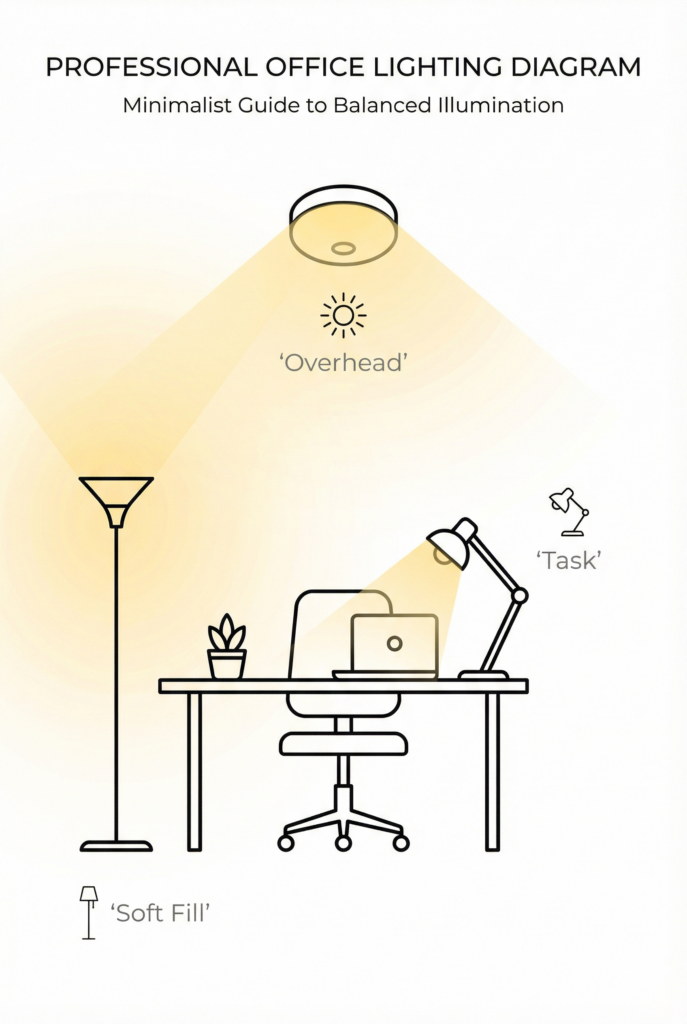
I’m obsessed with a “mood-setting lamp” in an office. It’s such a small thing, but it makes the space feel intentional, like you’re not working in a cave.
Mundane detail moment: I once bought a lamp that looked perfect online, and when it arrived it was the size of a toddler. It lived on the floor for a week while I tried to pretend it was fine.
Rugs and textiles for warmth, acoustics, and that softer feel
Offices can sound sharp. Hard floors, hard walls, lots of echo. It’s not just annoying, it’s tiring.
A rug does two things: it warms up the palette and it helps with sound, especially in open spaces.
This is where I like to bring in acoustic office solutions in a very normal-person way. You don’t need a recording studio. You need softness: rugs, upholstered seating, curtains, fabric panels, even a big textile art piece.
If you’re choosing a rug for a work area, pick something low-pile and easy to clean. You want calm, not a maintenance hobby.
Mirrors: the underrated trick (when it makes sense)
Mirrors can feel odd in some offices, so I’m picky about where they go. But in the right spot, they add light and make a smaller office feel bigger.
I like mirrors in hallways, reception areas, or corners that feel dark. If a mirror reflects clutter, though, it doubles the mess, so place it where it reflects something calm.
Seating that looks good and supports your actual body
A polished office needs a chair that feels intentional. You can tell when a space has an amazing chair. It signals, “We care about comfort.”
This is where ergonomic office furniture matters, because a beautiful office that hurts to sit in is not the win.
If you’re buying chairs, look for high-quality task chairs in a clean silhouette. You don’t have to go ultra-futuristic. You just want a chair that supports you and doesn’t look like it belongs in a basement.
If you have a larger private office, this is where executive office furniture can show up without feeling intimidating. I like mixing one statement desk or credenza with softer materials so it doesn’t feel like a movie villain’s office.
Also, if your office layout shifts or your team flexes, modular office furniture can save you. Pieces that reconfigure easily keep the space from feeling stuck.
Privacy and quiet in open offices
Open offices can be great, until you need to think. Or take a call. Or exist as a human who does not want to be perceived for five minutes.
There are two things that help most: visual boundaries and sound control.
For visual boundaries, privacy panels for offices can be a clean, professional solution that doesn’t feel like you built a wall. I also love plant dividers or shelving that creates separation while still feeling open.
For sound, keep it simple: rugs, upholstered chairs, curtains where possible, and soft surfaces that break up echo. Even small changes improve focus, and that is where workspace productivity quietly improves without you having to “try harder.”
The refined details that make an office feel finished
This is where the grown-up polish happens. The little things that feel subtle but make the whole room read more intentional.
If you want modern office decor that still feels warm, focus on finish and repetition: matching metals, consistent wood tones, and a limited set of materials.
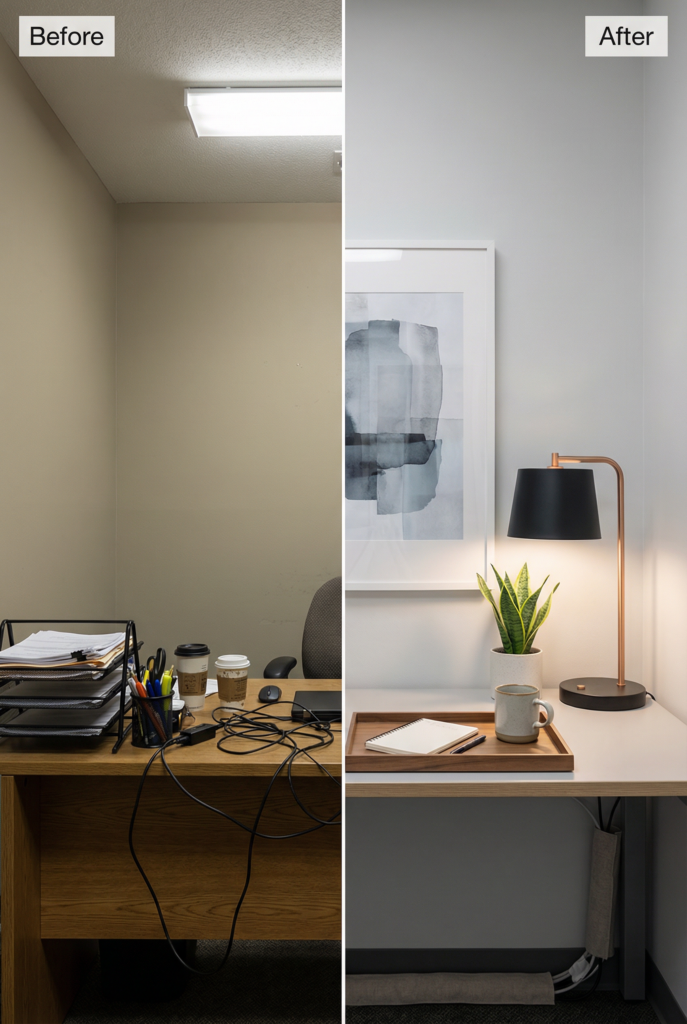
I also like a few “quietly nice” items that live out in the open:
- a good pen cup
- a tray for keys and badges
- a clean cable solution
- a filing box that doesn’t look like it came free with a printer
That’s the line between “functional” and “styled.”
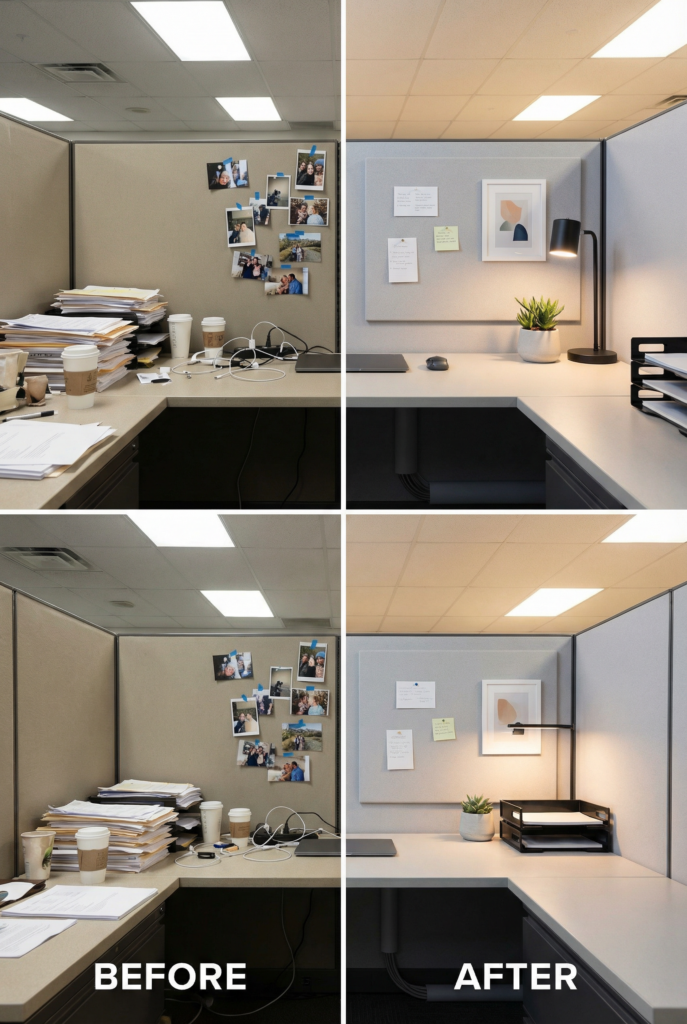
This is also where office decor tips can get annoying if they’re too generic, so I’ll say it my way: repeat a few materials, hide the messy stuff, and let the room breathe.
Dividers, zones, and the team spaces people forget
If you’re styling a whole office, not just one room, the shared zones matter. They set the tone for the whole workplace.
A lounge or meal area can be the difference between “we work here” and “we live here.” And I don’t mean bean bags and neon signs unless that’s truly your vibe.
What I’m seeing in office design trends lately is more zoning: places to focus, places to collaborate, places to decompress, and places to take a call without feeling like you’re on display.
If you want a more interactive office design without it feeling gimmicky, add flexible seating, movable tables, and surfaces people can actually use, like a whiteboard wall in a meeting nook. The goal is to support how teams work now, not to decorate for a brochure.
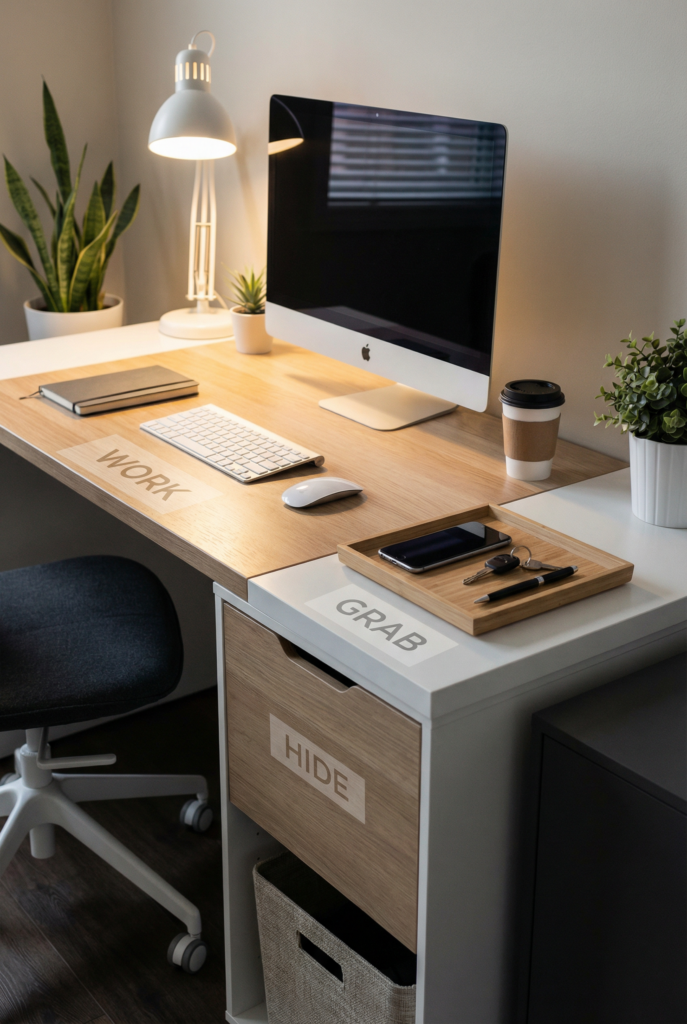
Also, snack zones matter. A clean little coffee station with real mugs and a place to put the inevitable tea boxes can make the office feel cared for. Mundane detail: I once labeled the tea drawers and felt like I had my life together for exactly 36 hours.
Putting it all together: my professional office decor ideas checklist in human language
If you’re staring at your space and feeling overwhelmed, this is the order I would tackle it:
Start by reducing clutter and building a simple system. Get storage in place. Then set the palette. Then layer in lighting. Then add texture. Then finish with art and a little nature.
That’s the path to office decor inspiration that lasts longer than a week, because it’s built on function, not just looks.
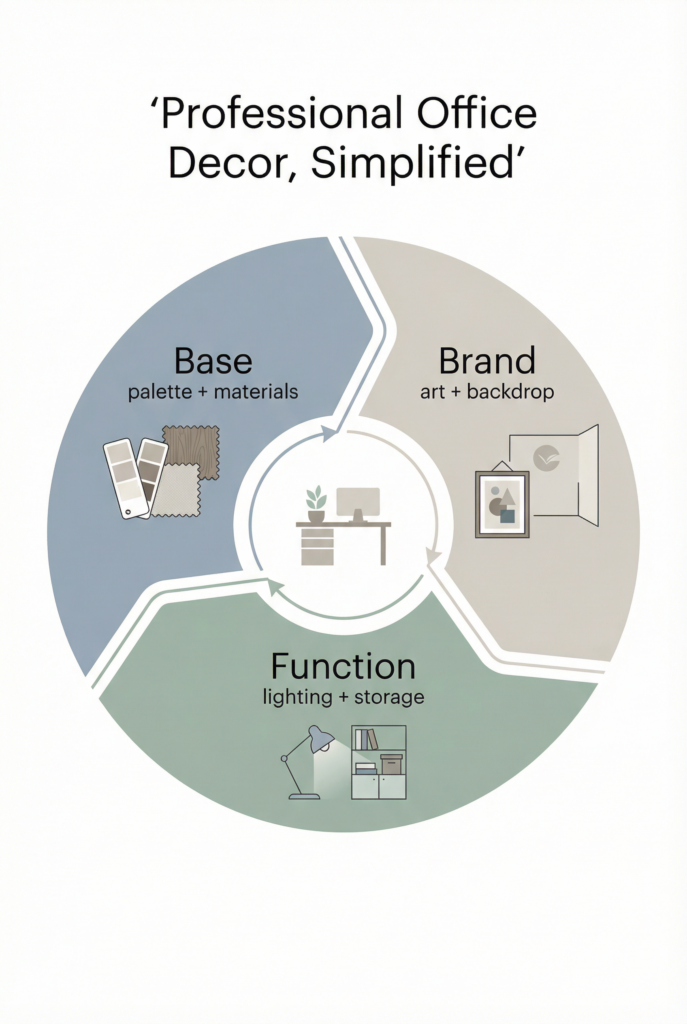
And if you’re doing this in a smaller workspace or a cubicle, the same rules apply. Keep the surface edited, corral the chaos, and choose one or two upgrades that signal intention.
Chaotic tangent moment: I once tried to “quickly” hang a shelf in an office, and I hit a stud I swear moved while I was drilling. I ended up with three holes, one crooked bracket, and a new respect for painters tape as a temporary “shelf” while I regrouped. It worked. Kind of.
15 Professional office decor ideas to choose from
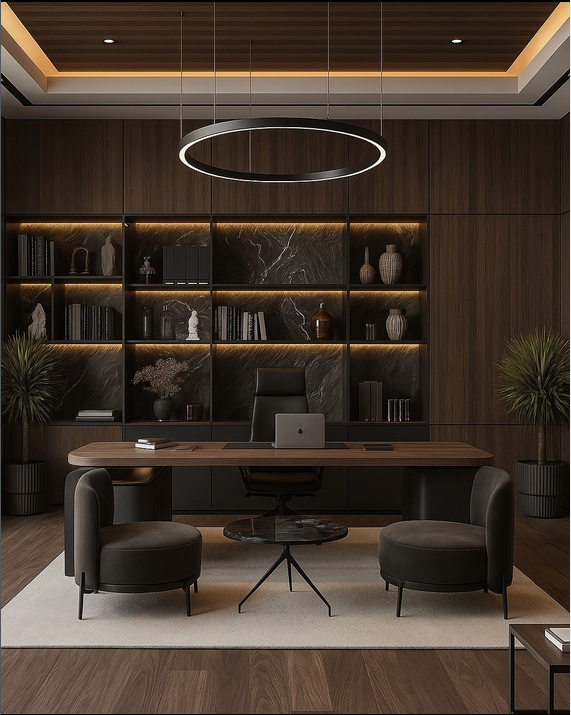
Deep walnut + matte stone veining + that floating ring light… it’s giving boardroom-cinematic (in the best way). The symmetry is so controlled it almost feels like a breathing exercise, and every object lands like it was measured twice. I first saw this via @increationint and immediately thought: OK, this is “executive calm,” but make it LUXE.
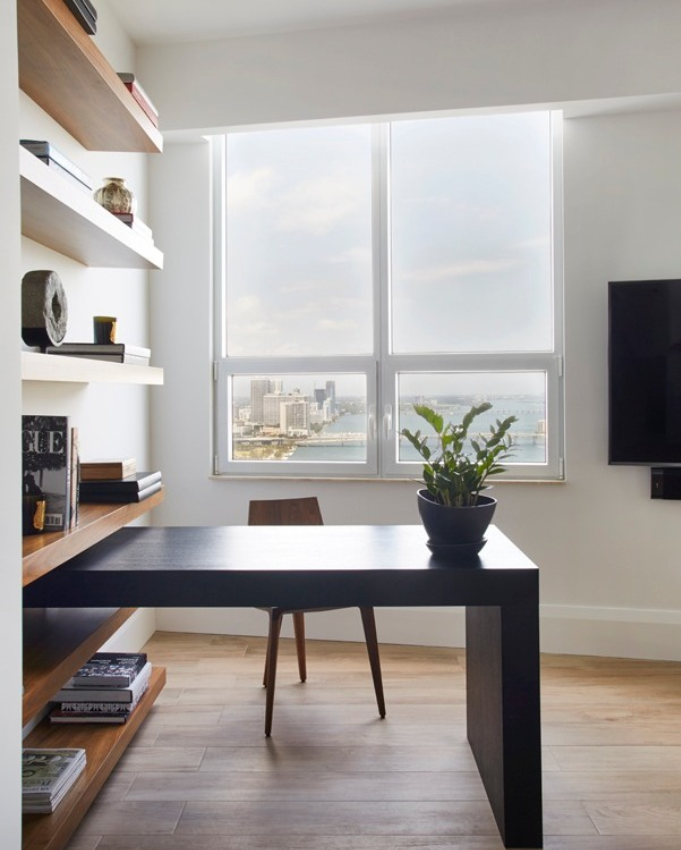
A black desk in front of a giant window is such a power move, but it’s also weirdly calming because there’s nothing competing with the view. The open shelving stays styled, not cluttered, and the single plant is doing quiet biophilic magic. This popped up on @hlsinteriordesign and it’s the kind of setup that makes you want to finish your work just to earn it.
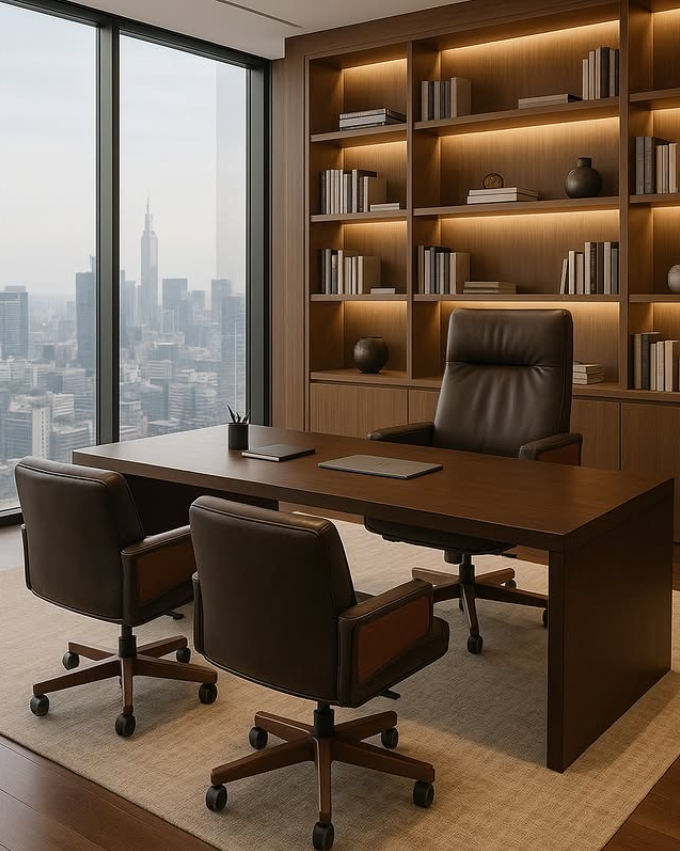
This one is pure “decisions will be made here” energy, but in the nicest way. The warm wood built-ins + backlighting make the whole room feel expensive without screaming about it (quiet flex), and the leather chairs look like they’d support an actual spine. I saw this through hocindia.in and now I’m annoyed at every sad overhead-only office I’ve ever sat in.
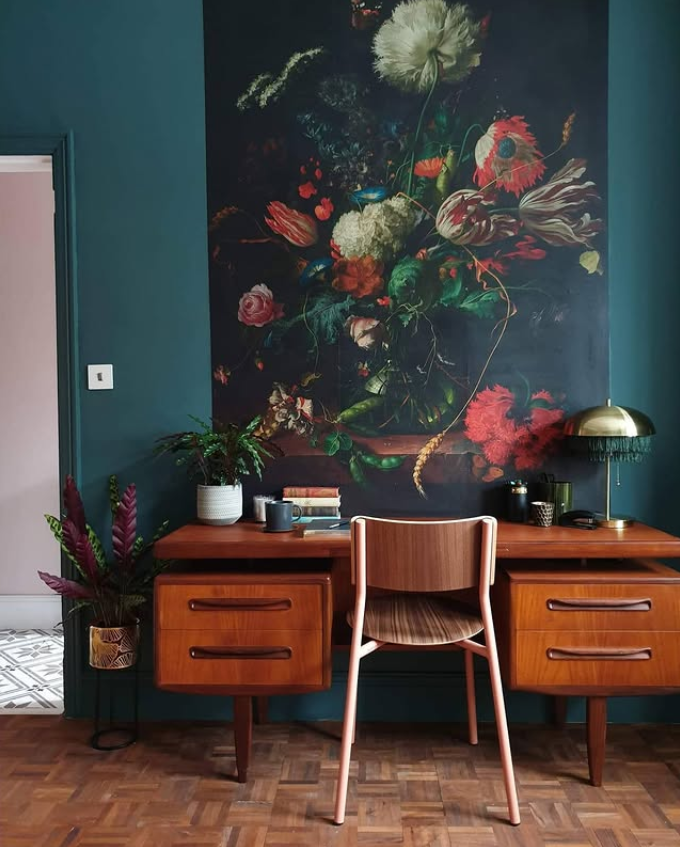
Ok, moody teal walls plus a massive floral mural is not the timid choice, and I love that. The mid-century desk keeps it grounded, the brass lamp adds that soft little glow, and the whole thing feels like a creative brain lives here (with strong opinions). I first saw this on @homeonthegrove, and I’d steal the idea of one dramatic wall, then keep everything else calmer so the room doesn’t get loud.
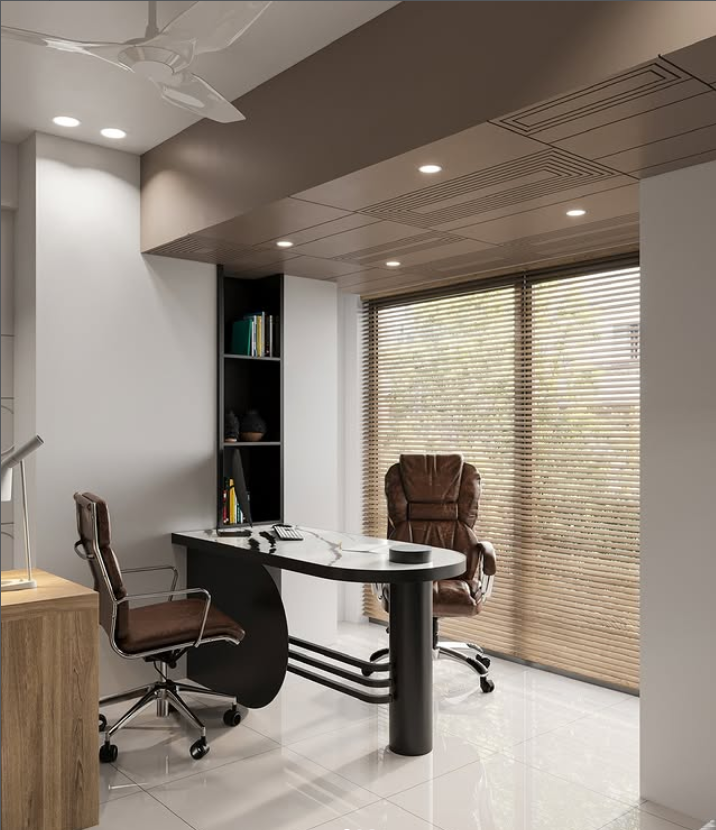
This is the “I’m organized and I drink water” office, and I mean that as a compliment. The curved desk shape keeps the room from feeling too boxy, and the blinds diffuse the light so it doesn’t turn your laptop into a mirror (bless). I saw it via integrity_design_studio and it’s a great reminder that sleek can still feel calm when you add warmth through wood and texture.
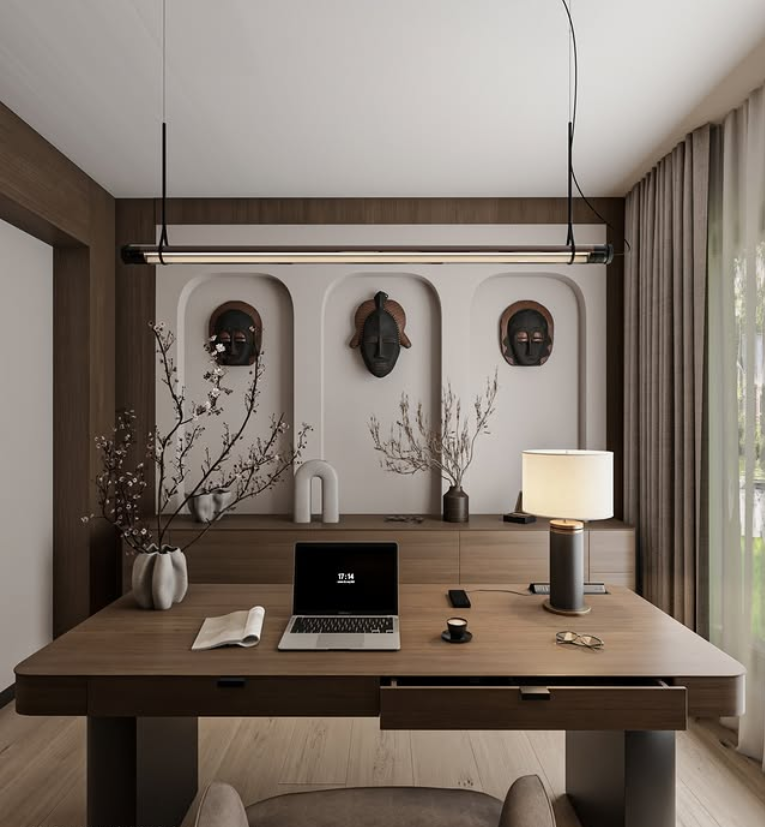
The palette is so gentle it practically whispers, and the styling is minimal without feeling cold, which is a very specific magic trick. Those wall niches with the masks create a focal moment that feels curated, not cluttery, and the long linear pendant keeps it crisp. You can totally tell this is a VOXX Design vibe, I first spotted it via arh.int_eduard_nastasoiu and yep… I stared for a while.
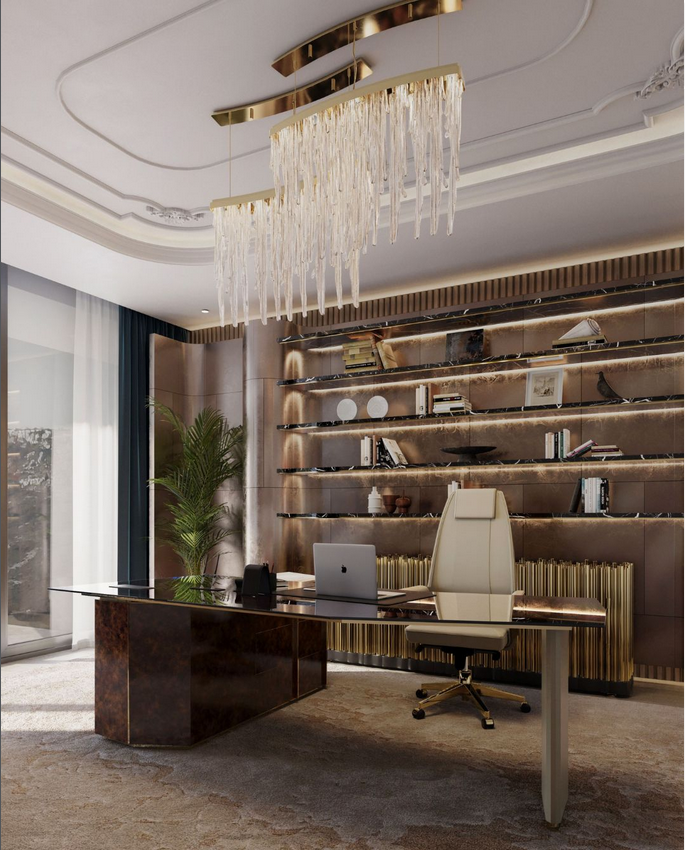
This is executive office furniture energy, but make it warm and cinematic. The backlit shelving turns books into decor, and the chandelier is dramatic without feeling chaotic (a rare talent). Spotted via @luxxmodernlighting and now I’m convinced lighting is basically the shortcut to “polished” when everything else is still in progress.
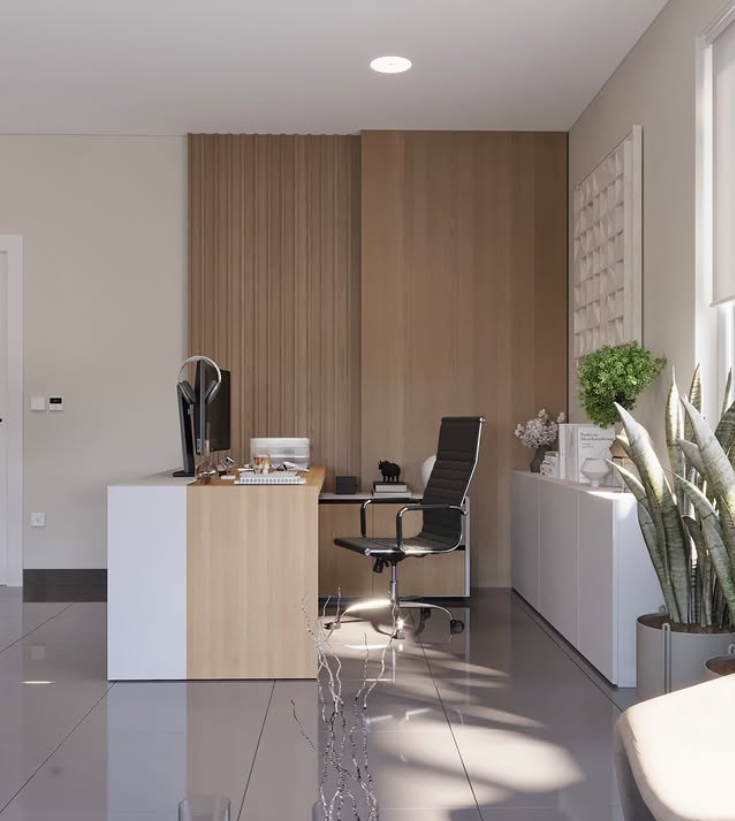
This one is so tidy it almost dares you to set down a rogue sticky note… and I respect it. The vertical wood slats add texture, the white volumes keep it crisp, and that plant is exactly the right amount of life. I saw it through @grafik_e_studio and it’s a great reminder that minimal can still feel warm when the light is good.
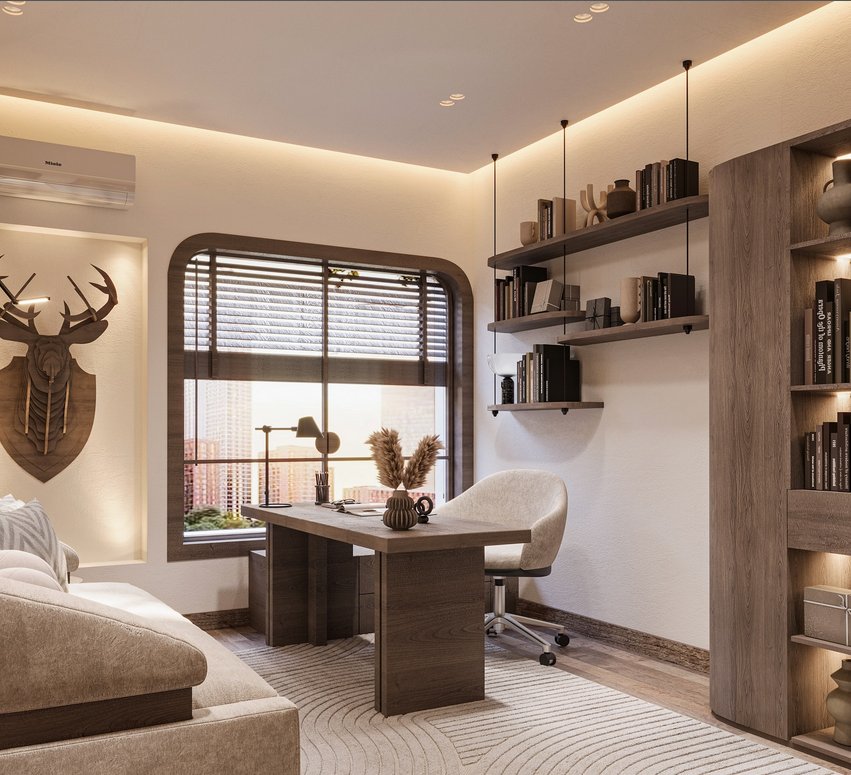
Soft neutrals + rich wood + that perimeter cove lighting is doing the quiet luxury thing so well… like the room is gently exhaling for you. The floating shelves feel styled but not precious (aka, you could actually live here), and the curved window trim is the kind of detail that makes everything look custom. I first saw this on @ag_conceptdesigns and yep, it’s been living rent-free in my brain.
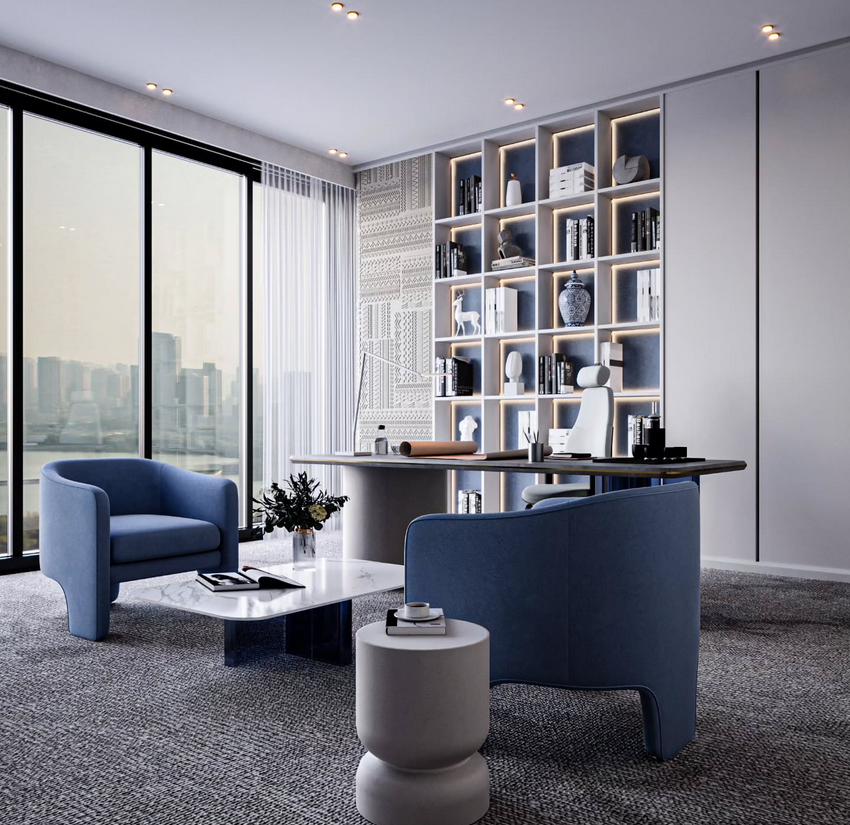
Ok, the blue seating makes this feel like a real space for talking, not just a place where meetings go to suffer. The built-in shelving wall is giving “styled, but not precious,” and the daylight does a lot of heavy lifting for the whole mood. I came across this on marzieh_househmand and immediately wanted to add a little lounge corner to every office ever.
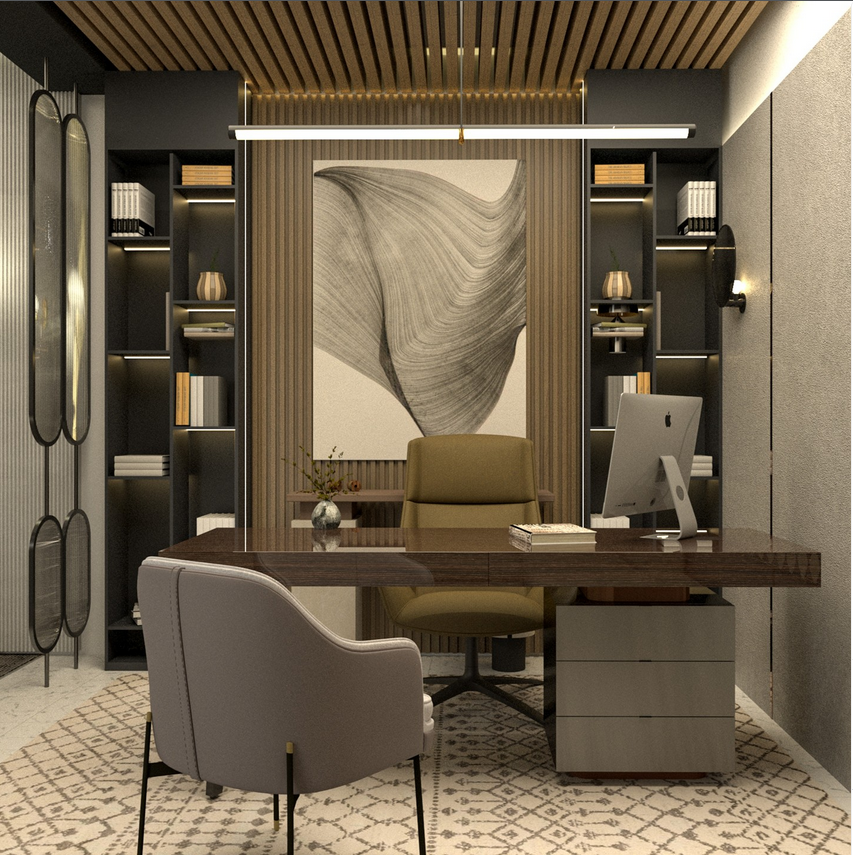
This one is moody in a polished way, not a “why is it so dark in here” way, and the symmetry is so satisfying my brain did a tiny happy dance. The slatted ceiling and layered lighting add depth, and the big abstract art piece makes the whole room feel intentional, like it had a plan from day one. I saw it via deen.architecture and I would absolutely steal the idea of matching shelf lighting on both sides for instant refinement.
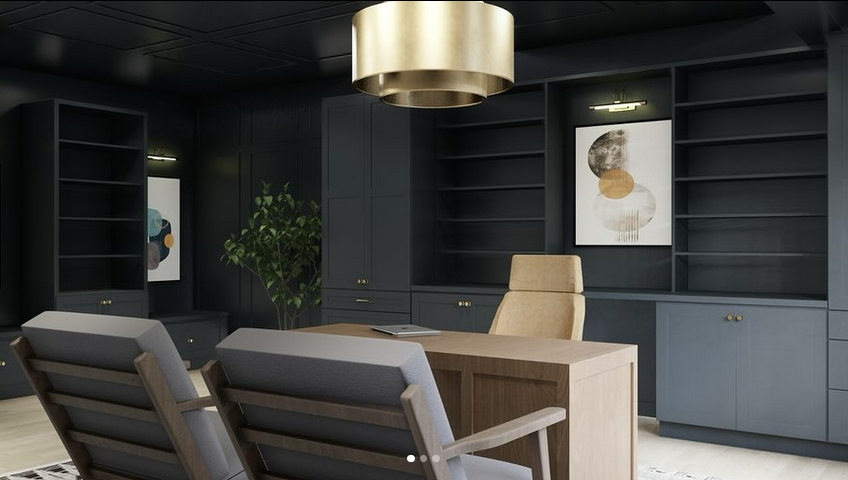
Those inky built-ins do the heavy lifting, then the brushed gold fixture swoops in like jewelry for the ceiling (hello, polish). Minimal art, clean styling, zero noise… yet it still feels warm enough to actually sit down and think. Spotted on @ora.designs and honestly, the tonal restraint here is the whole flex.
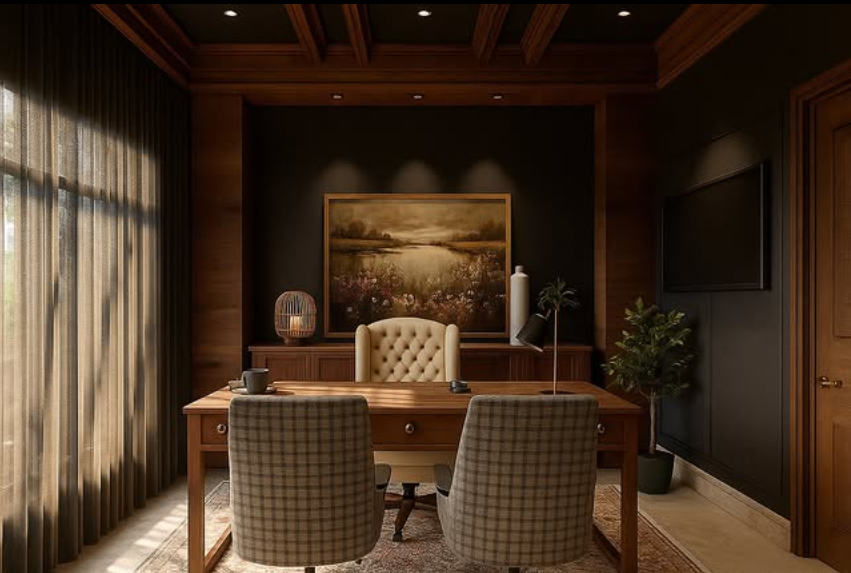
Filtered daylight, layered wood tones, and guest chairs that look tailored like a great blazer… this is comfort with credentials. The tufted leather moment reads timeless, but not museum-y (you can exhale in here). From @bahami.designspace, and it’s a reminder that “classic” can still feel quietly modern.
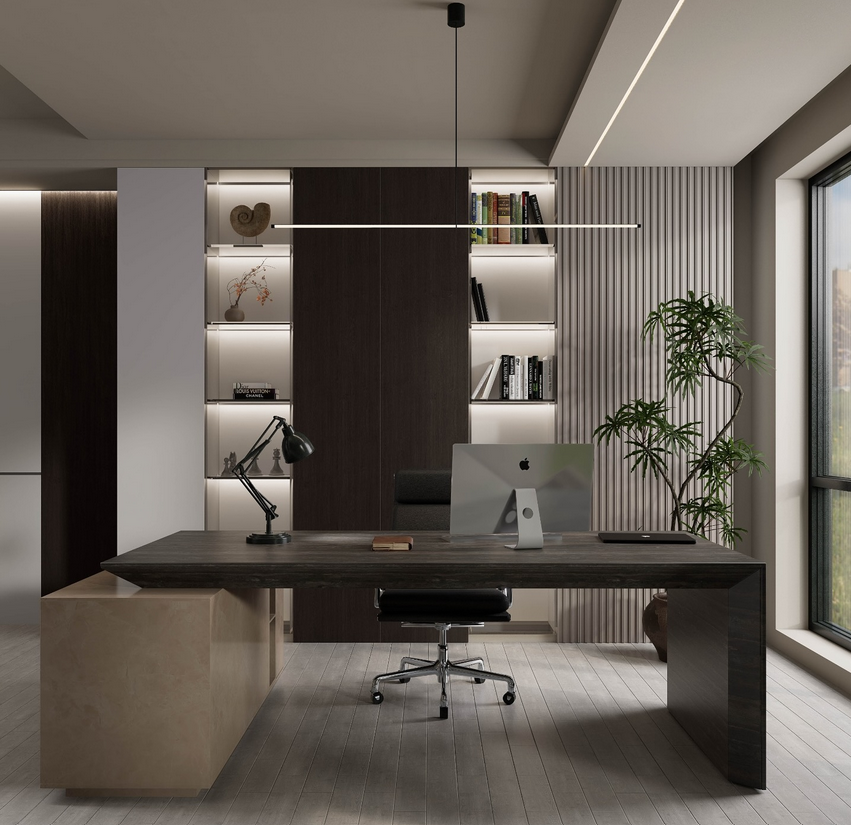
The proportions are so right it’s almost suspicious… floating shelves, ribbed texture, and that crisp linear pendant slicing through the scene with intent. A little greenery keeps it from feeling too perfect, which I love (because real life). I caught this on @arch.sevvalyalniz and it’s minimal office decor done properly, no notes.
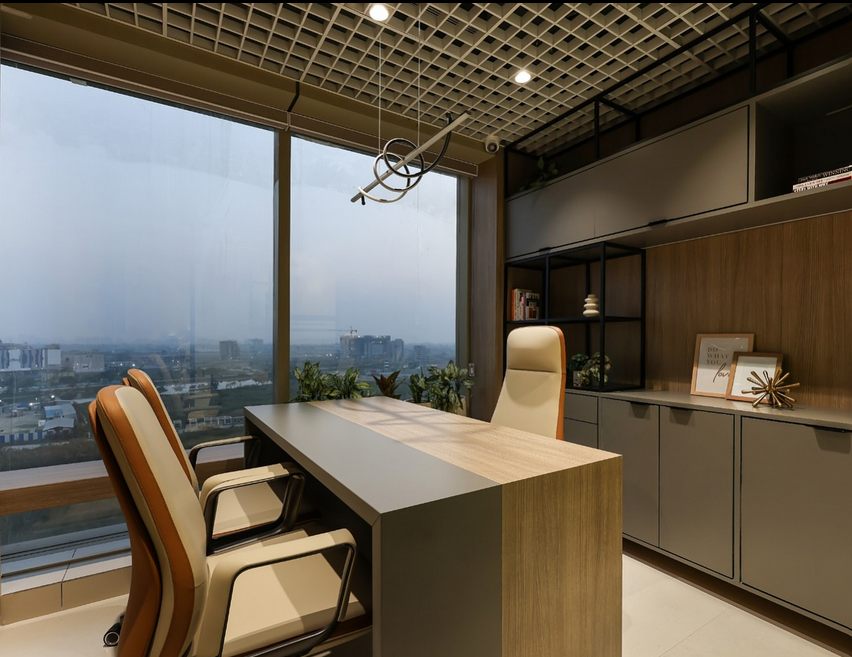
Soft neutrals, structured shelving, and seating that matches tone-for-tone like it planned the outfit weeks ago. The ceiling grid adds rhythm, the view adds breathing room, and suddenly the whole room feels aspirational but still usable. Seen via @design1stbymegha and it’s the tidy-warm sweet spot for serious workdays.
Conclusion
At the end of the day, your professional office decor ideas should support your work and your nervous system. The prettiest office in the world is useless if it makes you tense.
What makes office decor look professional and polished?
A professional office looks polished when the palette is consistent, surfaces are mostly clear, and storage hides the messy necessities. Choose a few upgraded touchpoints, like art and lighting, and keep accessories edited so the room feels intentional.
How do I choose colours for a professional workspace?
Pick a calm neutral base, then add one accent color in small, repeatable spots like a rug, art, or storage. Keep saturated colors limited, and choose tones that match the kind of work the space supports.
How do lighting choices affect a professional office aesthetic?
Lighting changes everything: it affects comfort, mood, and how refined the room feels. Use task lighting for work, then add softer ambient light so the space doesn’t rely on harsh overheads.
What wall art styles suit a professional office?
Abstract, nature-inspired, and simple graphic art usually feels professional because it’s calming and not too personal. Keep frames consistent and scale art appropriately so it looks intentional.
How can I make a workplace feel refined without overspending?
Spend on a few high-impact basics like a good chair and lighting, then use cohesive storage, a rug, and simple art to finish the space. Refinement comes from editing and consistency more than price.
Can minimalist decor still look polished in an office setting?
Yes. Minimal looks polished when it’s warm and functional: fewer items on display, consistent materials, hidden storage, and soft lighting. Add one or two textures, like wood and a rug, so it doesn’t feel sterile.
How do I refresh an office decor scheme without a full redesign?
Start with decluttering and storage, then swap in new art, refresh lighting, and add one textile layer like a rug or curtain. Small changes that improve comfort and organization make the whole office feel new.
How can I decorate my office and keep professional?
Start with a clean color palette and keep the visual noise low. Choose a few upgraded basics — art, lighting, and a plant — instead of piling on decor. The trick is balance: everything visible should feel intentional, not busy. A few professional office decor ideas that work in almost every space are warm neutrals, natural textures, and storage that hides clutter.
What is the 3-5-7 rule in decorating interior design?
It’s a styling rule that helps things look balanced. Odd numbers feel more natural to the eye, so designers group decor in threes, fives, or sevens. In a professional setting, that might mean three art pieces on a wall, five small objects on open shelves, or seven total visible accents in a larger room. It’s structure disguised as effortless style.
What are some unique office decor ideas?
Think small-scale texture and detail: a sculptural lamp instead of a generic desk light, a woven storage basket instead of plastic bins, or a custom art print that quietly matches your brand colors. Even simple swaps like ceramic trays, textured planters, or curved shelving can make your workspace feel one-of-a-kind. The best professional office decor ideas are the ones that surprise you a little but still look cohesive.
What are the current office decor trends?
Right now it’s all about comfort and authenticity — soft seating, layered lighting, biophilic touches, and warmer materials replacing the cold gray office look. Modern office decorating ideas lean toward organic shapes, natural light, and personalized art. You’ll see more offices mixing productivity with calm: muted palettes, modular furniture, and fewer “statement” pieces that distract.