You’re trying to make sense of master bathroom layouts that actually work with real mornings, real mess, and real people. I’m walking you through my favorite ways to place the shower, tub, vanity, and toilet so your space finally feels calm instead of chaotic.
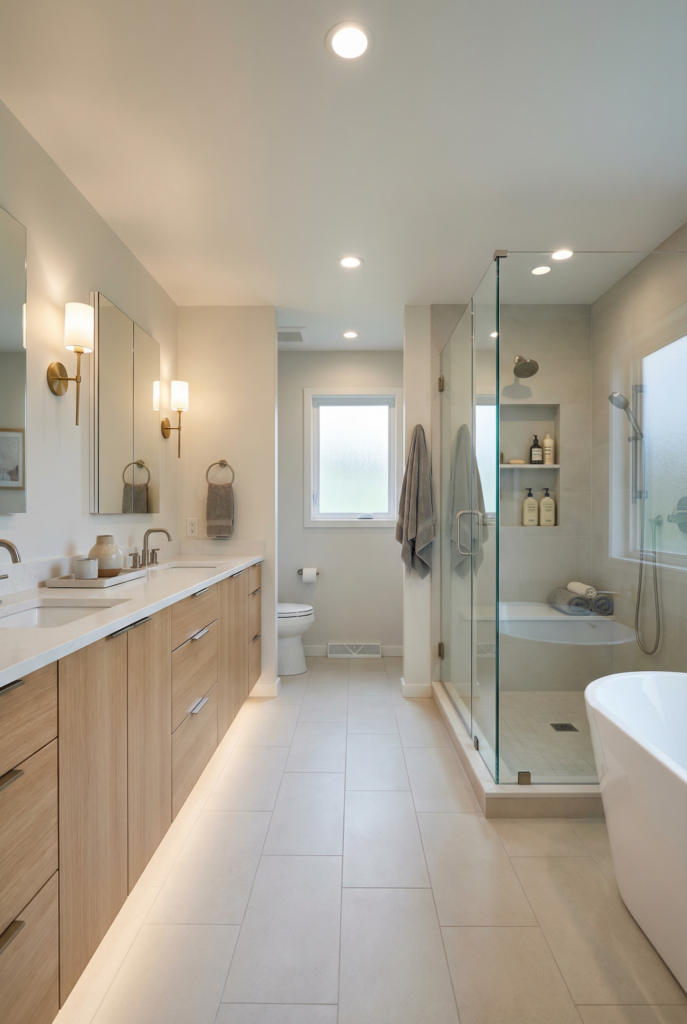
You’re here because you want a layout that works, not just pretty pictures.
You want to know where the toilet actually goes, whether that giant shower is worth it, and if you’re secretly ruining resale by ditching the tub. You also probably have fourteen screenshots on your phone and zero clarity. Same.
In this post I want to do three things for you:
- Walk through real master bathroom layouts with “best for” notes, pros and cons, and where they shine.
- Give you the actual spacing rules and clearances so your plan is not just vibes.
- Help you quickly pick a direction so you can stop obsessing and start planning.
Think of this as sitting on my slightly stained bathroom rug together (kids’ toothpaste is forever) while we sketch your future space on the back of a junk-mail envelope.
Pick Your Layout In 60 Seconds
Before we go deep, I want you to be able to say “I’m probably this layout person” in under a minute.
1. Your size bucket
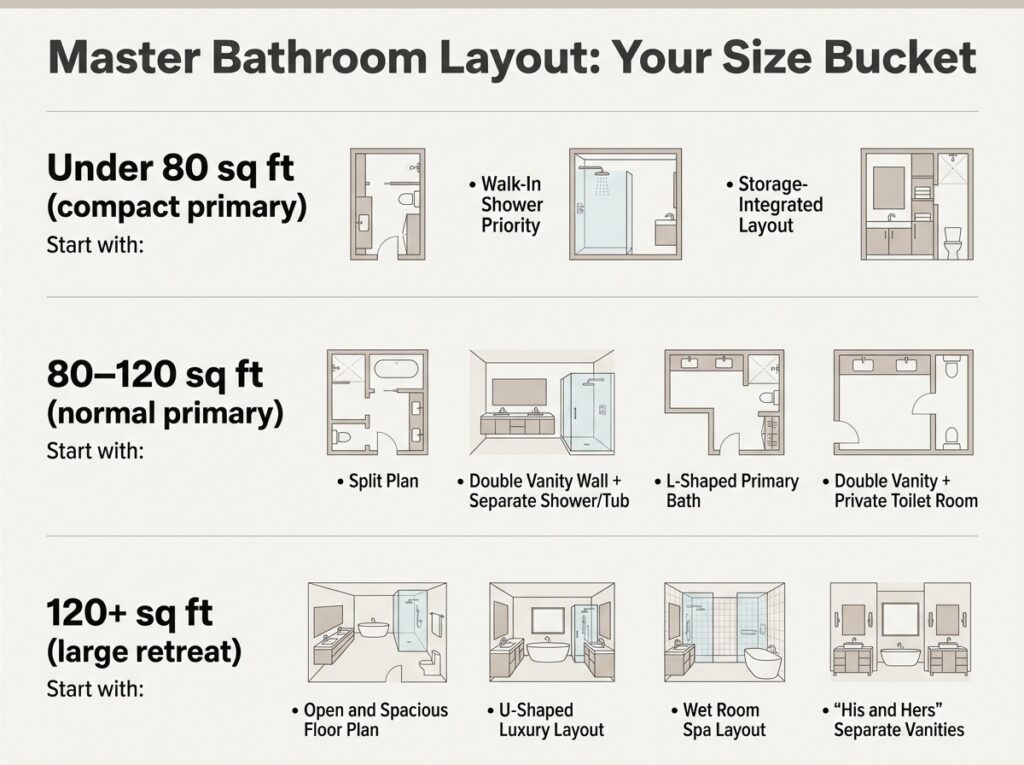
- Under 80 sq ft (compact primary)
Start with: Hotel Corridor Layout, Walk-In Shower Priority, Storage-Integrated Layout. - 80–120 sq ft (normal primary)
Start with: Split Plan, Double Vanity Wall + Separate Shower/Tub, L-Shaped Primary Bath, Double Vanity + Private Toilet Room. - 120+ sq ft (large retreat)
Start with: Open and Spacious Floor Plan, U-Shaped Luxury Layout, Wet Room Spa Layout, “His and Hers” Separate Vanities.
2. Must-haves
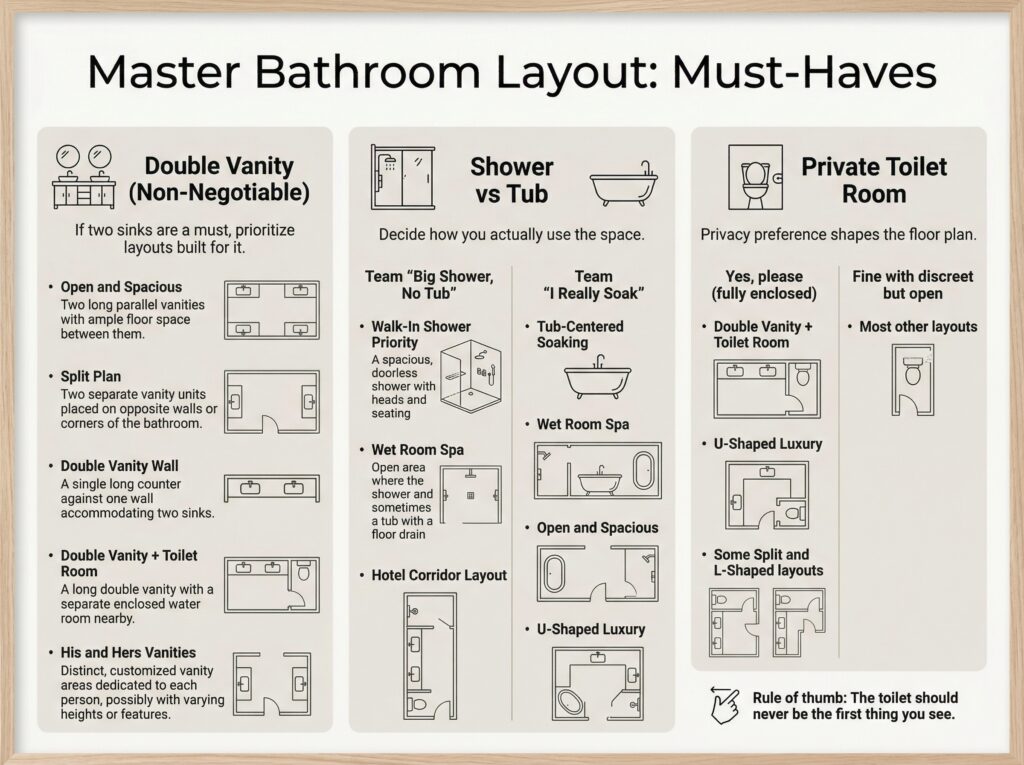
- Double vanity is non-negotiable
Focus on: Open and Spacious, Split Plan, Double Vanity Wall, Double Vanity + Toilet Room, His and Hers Vanities. - Shower vs tub
- Team “big shower, no tub here” → Walk-In Shower Priority, Wet Room Spa, Hotel Corridor.
- Team “I really soak” → Tub-Centered Soaking, Wet Room Spa, Open and Spacious, U-Shaped Luxury.
- Private toilet room
- Yes please → Double Vanity + Toilet Room, U-Shaped Luxury, some Split and L-Shaped versions.
- Fine with discreet but open → Almost any other layout, as long as the toilet isn’t the first thing you see.
Circle your bucket + your must-haves. That’s your short list. Everything else is “nice to read, but not for my house.”
Get Honest About What You Really Need From This Bathroom
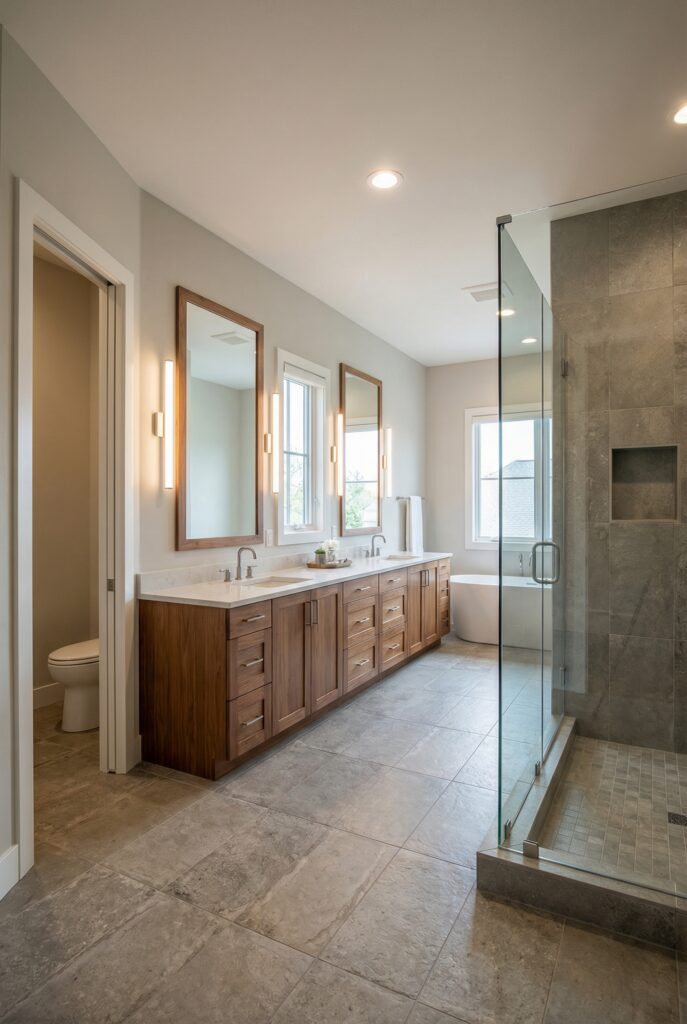
Before we talk layouts, picture one normal weekday morning in this space. Not the fantasy “I’m on a spa retreat” version. The “it’s 7:12, someone is yelling about socks, and you just want to wash your face” version.
A good master bath layout starts with three things: size, must-haves, and plumbing reality. If you skip this, every floor plan looks tempting and you end up changing your mind 47 times.
Start with size
Roughly measure the room and note which bucket you’re in:
- Under ~80 sq ft: compact primary bath. Every inch has a job.
- Around 80–120 sq ft: “normal” for many homes. You can usually fit double sinks, a comfortable shower, and maybe a tub.
- 120+ sq ft: larger bathroom floor plan territory. You can think about separate zones, bigger shower, maybe a seated vanity, extra storage.
Then list your must-haves
Circle your non-negotiables:
- Double sinks or is one okay?
- Shower only, or shower plus tub?
- Private toilet room or open to the space?
- Linen storage inside the bathroom or nearby is fine?
- Bench in the shower, yes or no?
- Do you want that “luxury master bath” feeling or just “not chaotic at 6 a.m.”?
Be a little ruthless. Everything cannot be a must-have.
Finally, check your plumbing reality
Moving plumbing is where costs jump. Keeping fixtures generally in the same wall area is cheaper than flipping the entire room. Sometimes worth it, sometimes not.
Ask yourself:
- Are you open to a full gut, or mostly working with the current fixture wall?
- Are there exterior walls that might make windows or niches tricky?
- Is there another bath above or below that affects drains and vent stacks?
3 Sample Floor Plans With Real Dimensions
Let’s ground this in a few simple bathroom floor plans, just so “8×10” means something in your head besides “maybe big enough.”
8×10 (about 80 sq ft)
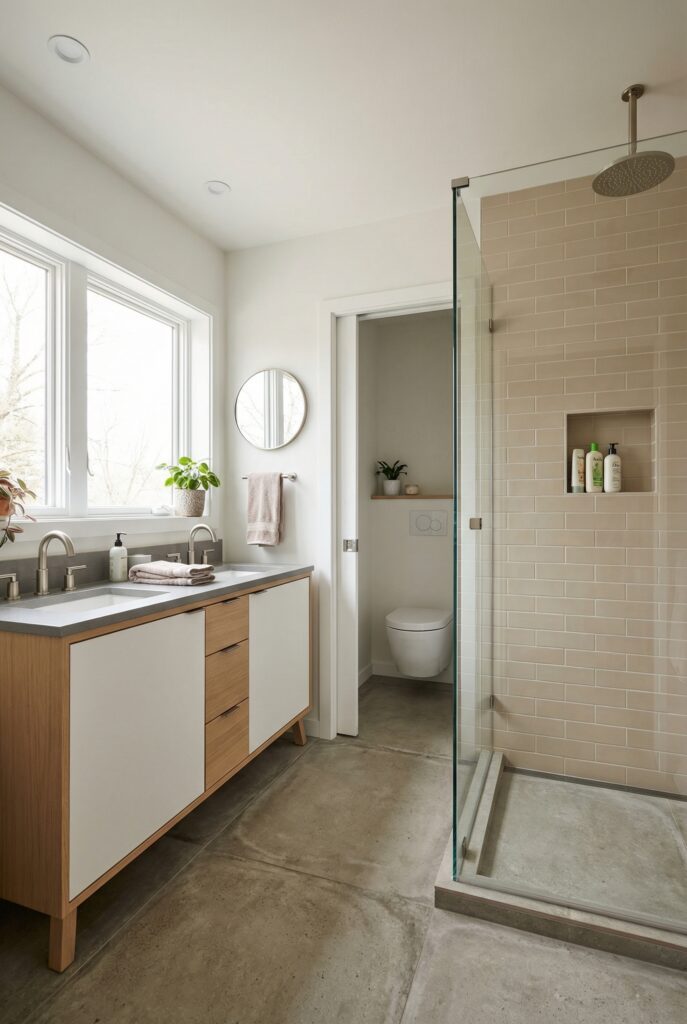
- Usually fits: single or compact double vanity (48–60″), shower around 36×48 to 36×60″, and a toilet zone with about 30″ width.
- Best for: people who want one really functional space, likely choosing between tub or generous shower, not both.
10×10 (about 100 sq ft)
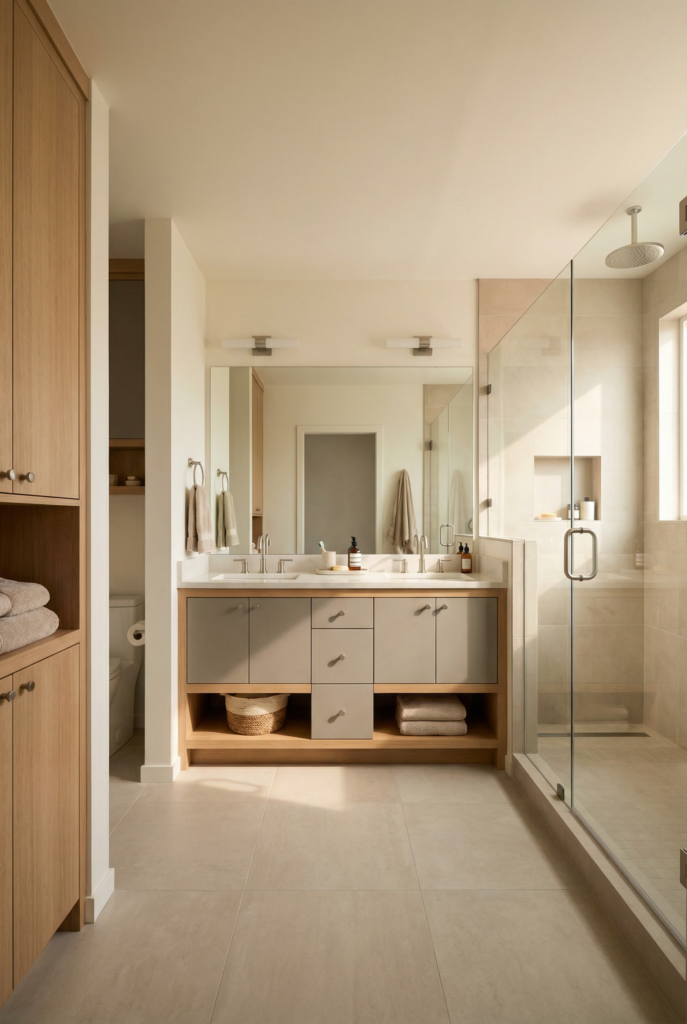
- Usually fits: comfortable double vanity (60–72″), separate shower around 42×60″, plus either a compact tub or tall storage.
- Best for: “normal” primary baths where two people share mornings and you want zones but not a full spa.
10×12 (about 120 sq ft)
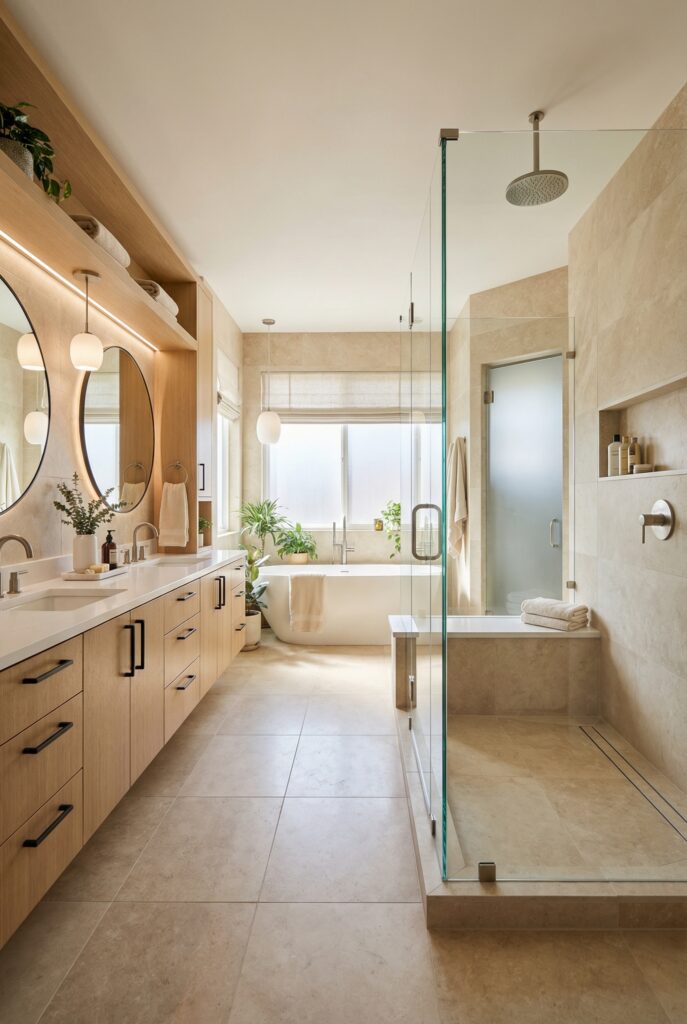
- Usually fits: larger double vanity (72″+), big walk-in shower, soaking tub, and a toilet nook or full water closet.
- Best for: true retreat vibes where you can play with U-shapes, L-shapes, or a wet room without everything feeling jammed.
Golden Rules And Spacing For A Layout That Actually Feels Good
You don’t need to memorize code, but you do need a few solid spacing rules so your bathroom feels comfortable and safe, not like a tiny airplane lavatory.
Here’s the cheat sheet:
| Area / fixture | Comfortable target | Typical minimum often used* |
|---|---|---|
| Clear space in front of sink | 30 in or more | ~21–24 in |
| Clear space in front of toilet | 30 in or more | ~21–24 in |
| Clear space in front of tub | 30 in or more | ~21–24 in |
| Shower entry clear space | 30 in or more | ~24 in |
| Toilet centerline to side wall | 18 in recommended | 15 in minimum |
| Separate toilet room size | 36×66 in recommended | 30×60 in minimum |
*Always check your local building codes and inspector. These are common planning standards, not legal advice.
Quick win: when you sketch, draw a “bubble” of 30 inches in front of each major fixture. If the bubbles overlap like crazy, that layout is going to feel tight in real life.
Master Bath Layout Personalities (Pick The One That Feels Like You)
This is where we peek at real bathroom floor plans and talk through what they’re good at in normal-person language.
1. Open And Spacious Floor Plan
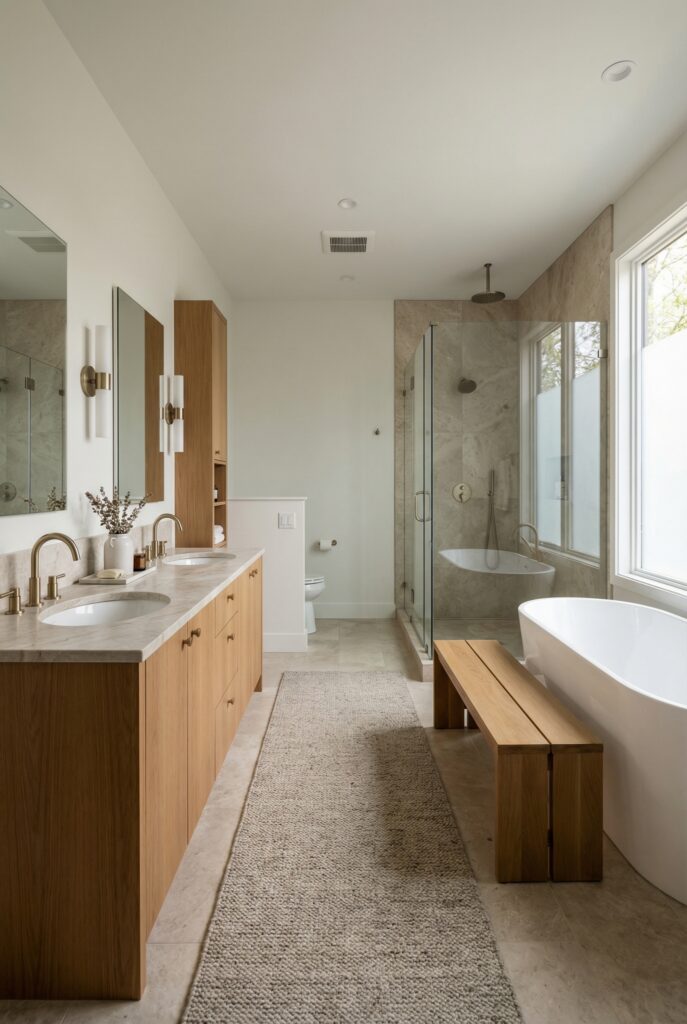
Best for: Larger rectangles, roughly 100–140 sq ft, where you want calm, hotel-ish energy.
What goes where: Double vanity along one long wall; shower and tub share the opposite wall; toilet tucks at one end behind a half wall or pocket door so your first view is open floor.
Why it works: Circulation is simple and everything feels generous, so even rushed mornings don’t feel chaotic.
Common mistake + fix: Spacing fixtures too far apart makes it feel empty; use a runner, bench, or storage tower to visually connect the zones.
Upgrade idea: Add in-floor heat and a big window with privacy film so it actually feels like a boutique hotel, not just a big white room.
2. The Split Plan (Dry Zone / Wet Zone)
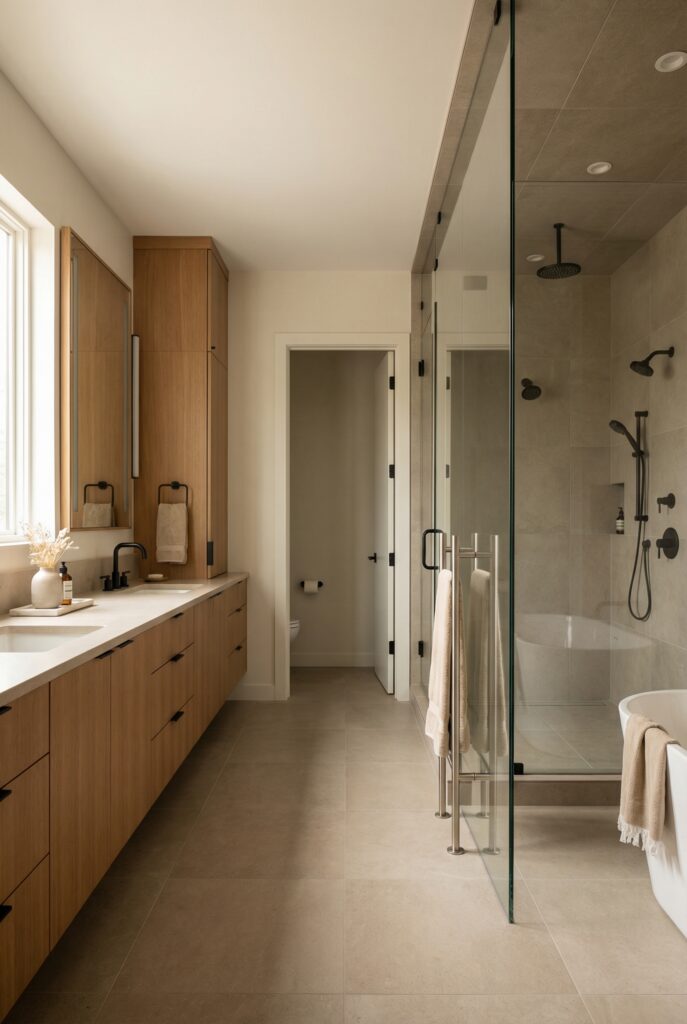
Best for: 80–120 sq ft rooms, especially for couples who genuinely share the space.
What goes where: You enter into the dry zone with vanity and storage. A partial wall or glass separates a wet zone where shower and tub live together, with the toilet either in there or in a tiny water closet.
Why it works: One person can get ready while the other showers without steam and splash taking over the whole room.
Common mistake + fix: Making the dry zone too narrow; steal a bit of space from the wet zone so you can actually move around the vanity.
Upgrade idea: A heated towel rack right at the wet zone threshold and a door or full glass wall if you want serious noise and moisture control.
3. The Hotel Corridor Layout
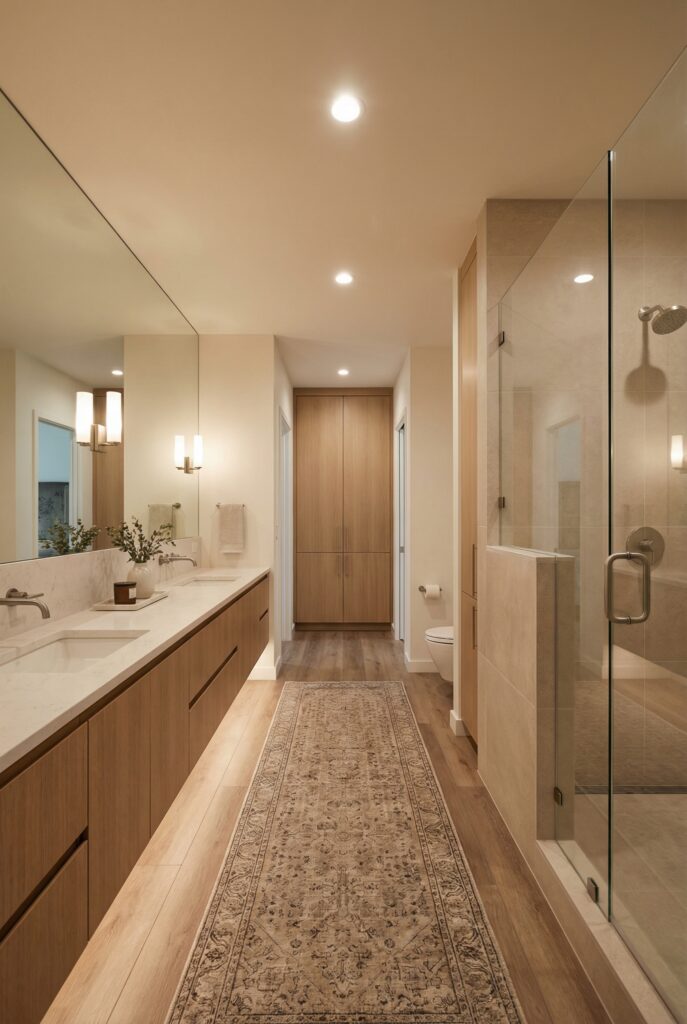
Best for: Long, narrow bathrooms, around 5–6 feet wide and 10–14 feet long.
What goes where: Vanity on one side, toilet and shower on the other, usually in a straight line. With enough length, the toilet hides behind a half wall or step-back in the wall.
Why it works: Everything is reachable and there’s a clear walking path, which is peak bathroom space optimization in tricky footprints.
Common mistake + fix: Putting the toilet front and center from the doorway; shift it down the wall or hide it behind a short partition or tall cabinet.
Upgrade idea: Full-height storage at one end and a long runner, plus wall-to-wall mirror above the vanity to bounce light.
4. The L-Shaped Primary Bath
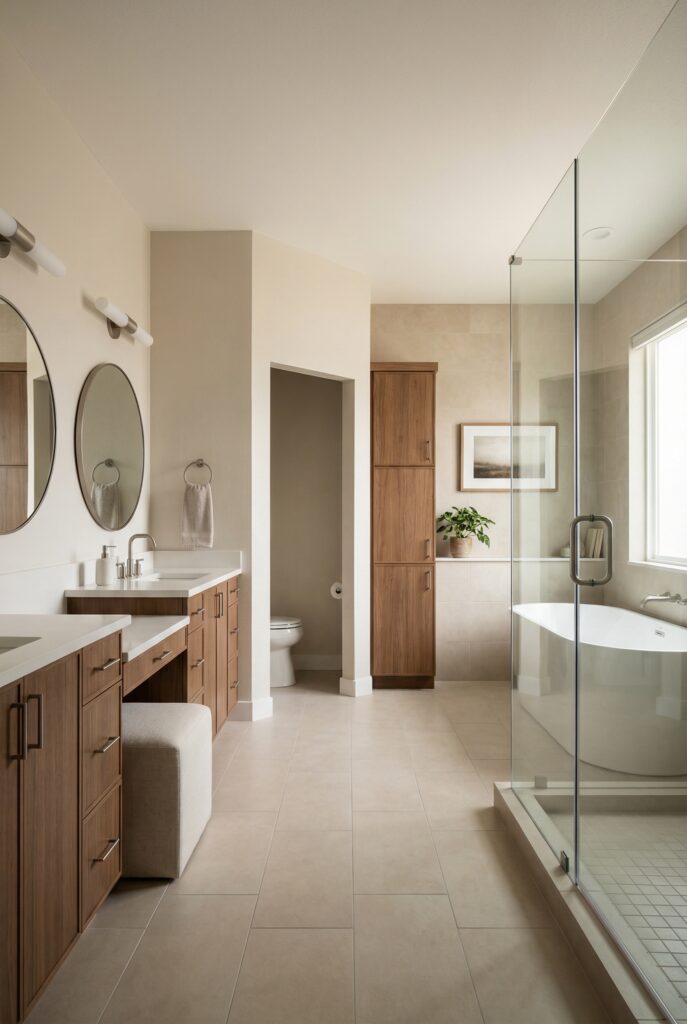
Best for: Rooms that jog around a closet or window, or where one side is deeper.
What goes where: Vanity sits on the short leg of the L near the door; shower and/or tub live around the corner on the longer leg; toilet tucks near the elbow or behind the shower so messier bits are hidden.
Why it works: You get natural zones without building extra walls and keep the hallway view prettier.
Common mistake + fix: Ignoring the dark corner and letting it become a dumping ground; give it lighting and maybe a tall cabinet or art so it feels intentional.
Upgrade idea: A seated vanity on the short leg and a little shelf or plant moment right where the L turns.
5. The U-Shaped Luxury Layout
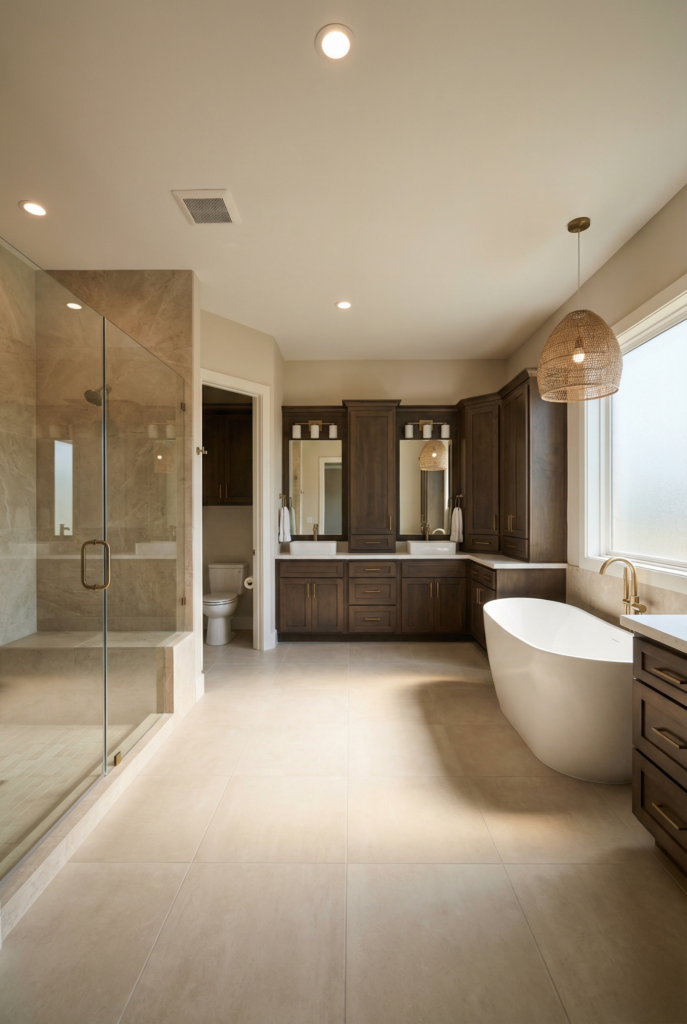
Best for: Big bathrooms, usually 120+ sq ft, often in new builds or full guts.
What goes where: Vanity along the base of the U, shower on one arm, tub on the other, and a toilet tucked in a nook or water closet. You usually keep open floor in the center.
Why it works: You get clear zones and multiple focal points so it reads like a true primary retreat.
Common mistake + fix: Putting something on every wall just because you can; pick a couple of hero features and let some walls or floor breathe.
Upgrade idea: Center a tub under a window, run radiant floors, and add a statement light where it meets code.
6. Double Vanity Wall + Separate Shower/Tub
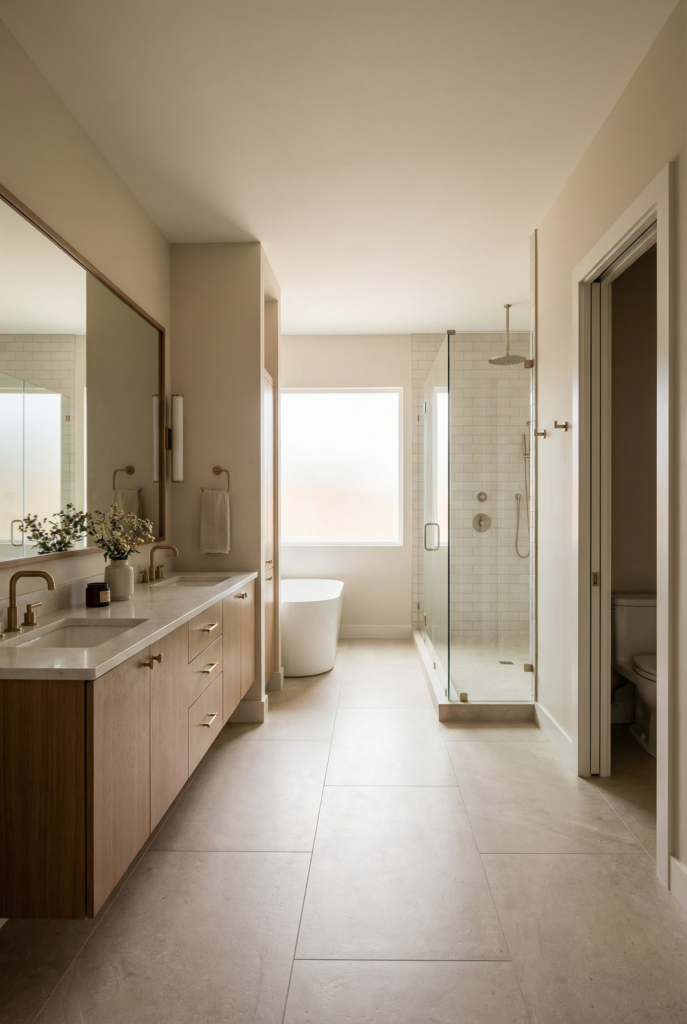
Best for: 90–120 sq ft rectangles where you want both a solid vanity and a good-sized shower.
What goes where: One long wall becomes a 60–72″+ double vanity with big mirror. Opposite or adjacent, you place the shower and either a compact tub or storage, with the toilet tucked to one side.
Why it works: Grouping water-hungry fixtures simplifies plumbing and ventilation and keeps the room feeling tidy.
Common mistake + fix: Two tiny sinks with no counter space; shrink bowls if you must and protect counter room for real life.
Upgrade idea: Furniture-style vanity with recessed medicine cabinets and pretty bathroom hardware that feels like jewelry.
7. “His And Hers” Separate Vanities
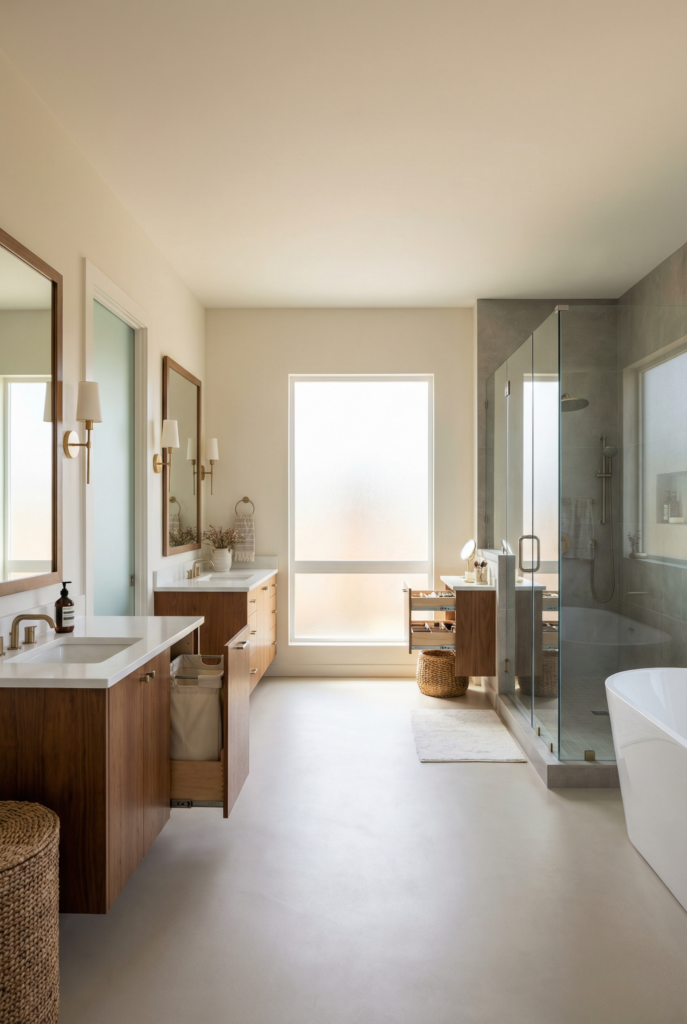
Best for: 100+ sq ft and couples who truly share mornings.
What goes where: Each person has their own vanity on opposite walls or flanking a center window or door; shower and tub share another wall; toilet tucks where privacy is easiest.
Why it works: Everyone gets their own landing zone, mirror, and outlets, which cuts down on cord chaos.
Common mistake + fix: Making one vanity clearly better; keep size, storage, and lighting balanced or resentment will be real.
Upgrade idea: Laundry hamper pull-out in one vanity, dedicated makeup drawer in the other, and coordinated but not identical sconces.
8. Double Vanity + Private Toilet Room
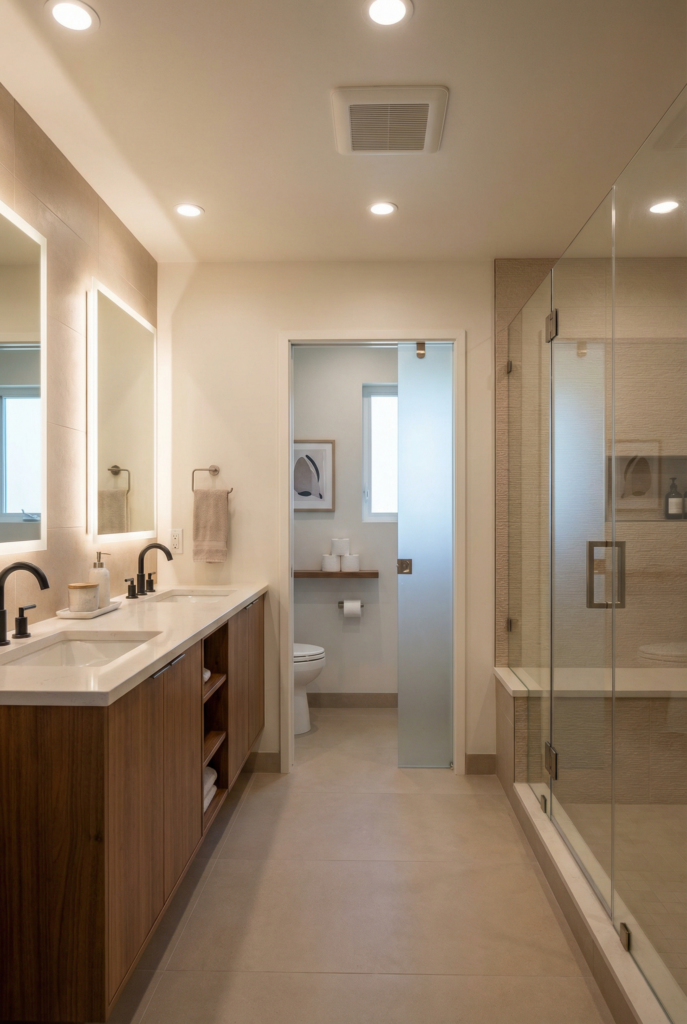
Best for: People who really value privacy and families with kids who wander in mid-brush.
What goes where: A generous double vanity and shower live in the main space. The toilet is in a small room (around 3×5 ft or more) with its own fan and maybe a tiny window.
Why it works: Someone can use the toilet with more dignity while another person uses the sink or shower.
Common mistake + fix: Making the toilet room too tiny or forgetting an exhaust fan; give it reasonable width and real ventilation so it feels like a mini room, not a closet.
Upgrade idea: Narrow shelf for extra paper, a bit of art, and a soft-close door latch so it doesn’t slam at midnight.
9. Wet Room Spa Layout
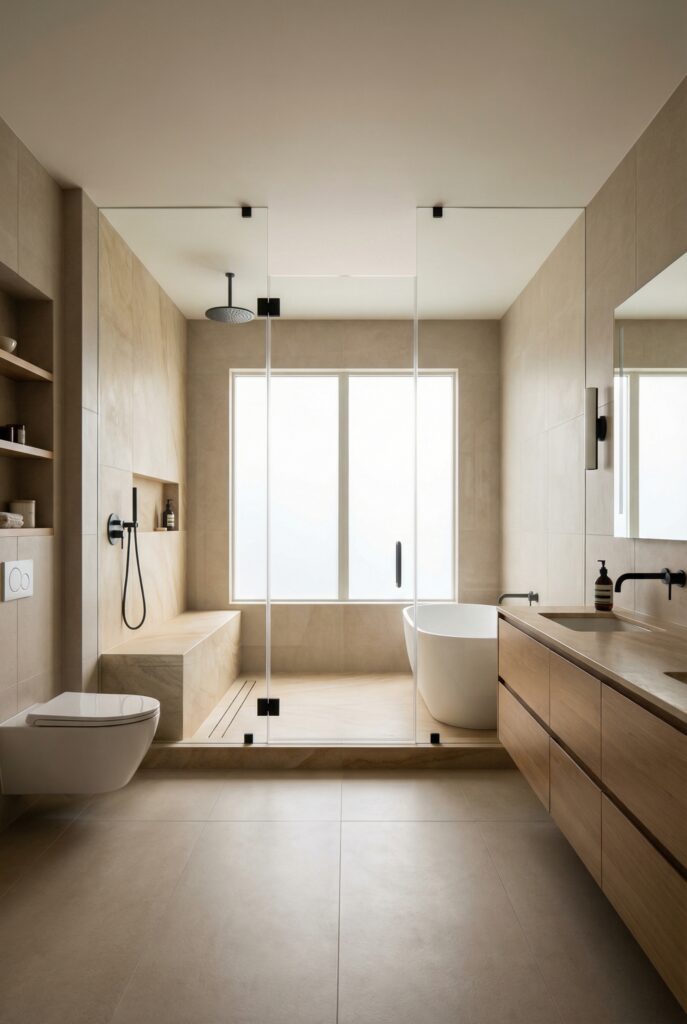
Best for: Larger spaces and anyone who wants a modern, minimal look with big shower energy.
What goes where: Shower and sometimes tub share one fully waterproofed wet area with a slight floor slope and a central or linear drain. Vanity and toilet live in the dry zone outside.
Why it works: It looks calm and streamlined and can make good use of space for people who want one big bathing zone.
Common mistake + fix: Aiming the shower head toward the opening so your bath mat is always soaked; aim sprays toward solid walls and keep a generous splash zone inside.
Upgrade idea: Built-in bench, ceiling rain head, and large-format tile or slabs to reduce grout lines.
10. Walk-In Shower Priority (No Tub)
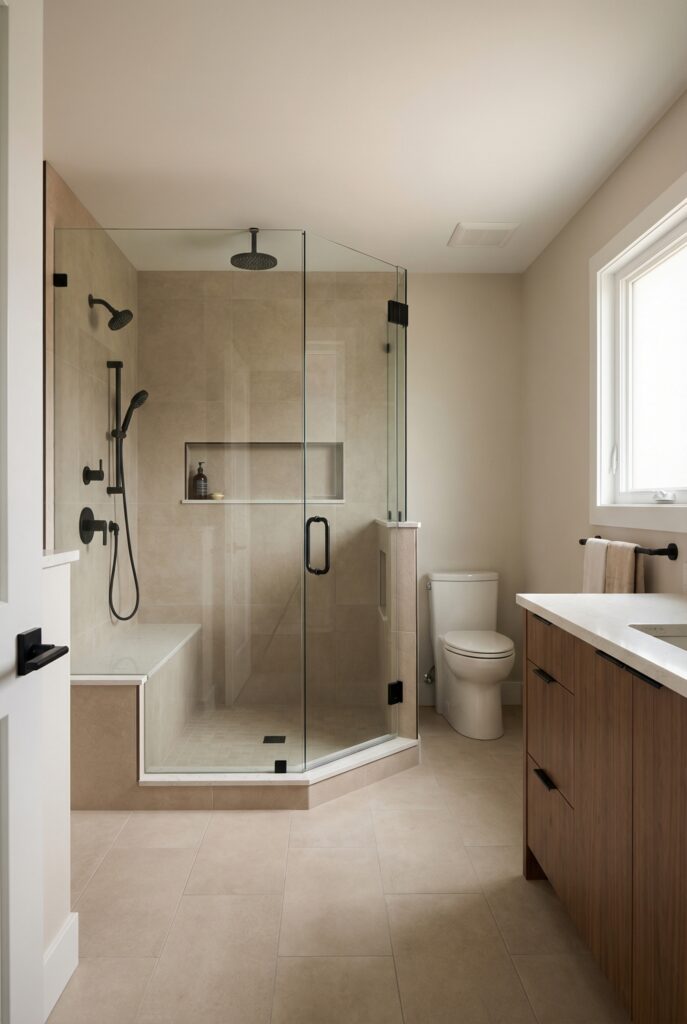
Best for: Small to medium rooms where you don’t really use a tub and want one great shower.
What goes where: The star is a walk-in shower (often around 3×5 ft or more) with a niche and bench, paired with a sensibly sized vanity and clear storage plan. The toilet lives in a corner or short nook, out of direct view from the door.
Why it works: If baths are rare, this is usually the most functional use of space and a strong choice for aging in place.
Common mistake + fix: Forgetting resale if there’s no other tub in the house; keep at least one tub in a secondary bath for families with kids.
Upgrade idea: Combine a handheld with a fixed head and maybe simple steam features if you want a mini spa without a separate tub.
11. Tub-Centered Soaking Layout
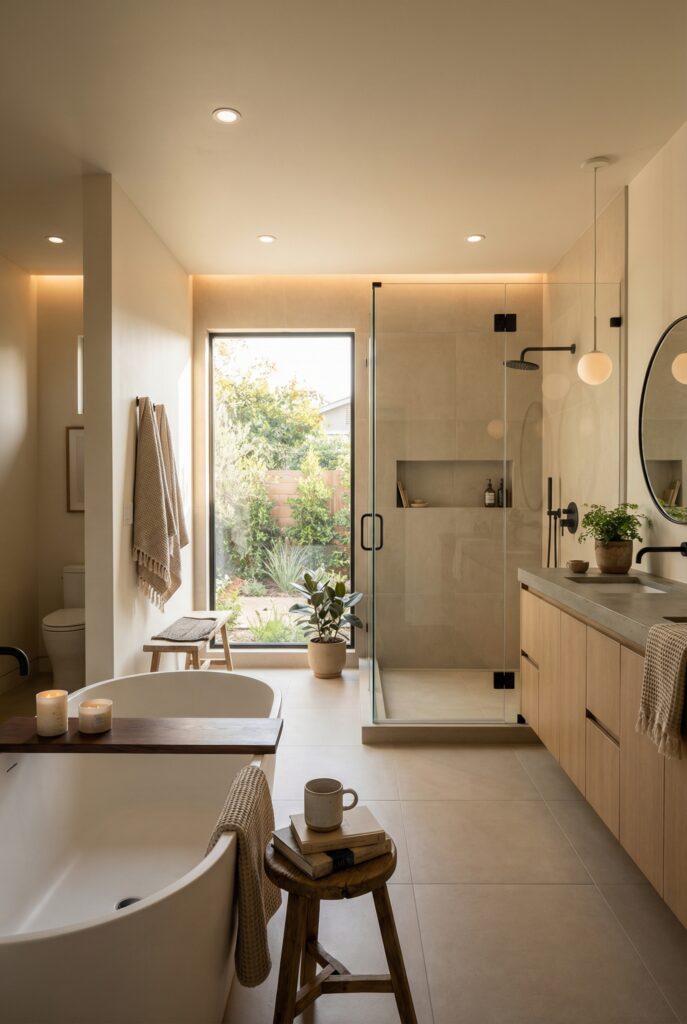
Best for: People who actually take baths and want the tub to be “the moment.”
What goes where: The tub gets prime real estate under a window or on the back wall; the shower is either adjacent or a bit smaller; vanity wraps the remaining wall; toilet finds the least visible corner.
Why it works: You get a strong focal point and a soothing, magazine-y vibe every time you walk in.
Common mistake + fix: Choosing a huge tub you never use while the shower feels cramped; right-size the tub and give the shower enough room for daily comfort.
Upgrade idea: Niche shelves, dimmable lighting, and a ledge or tiny table for candles and tea.
12. Storage-Integrated Layout
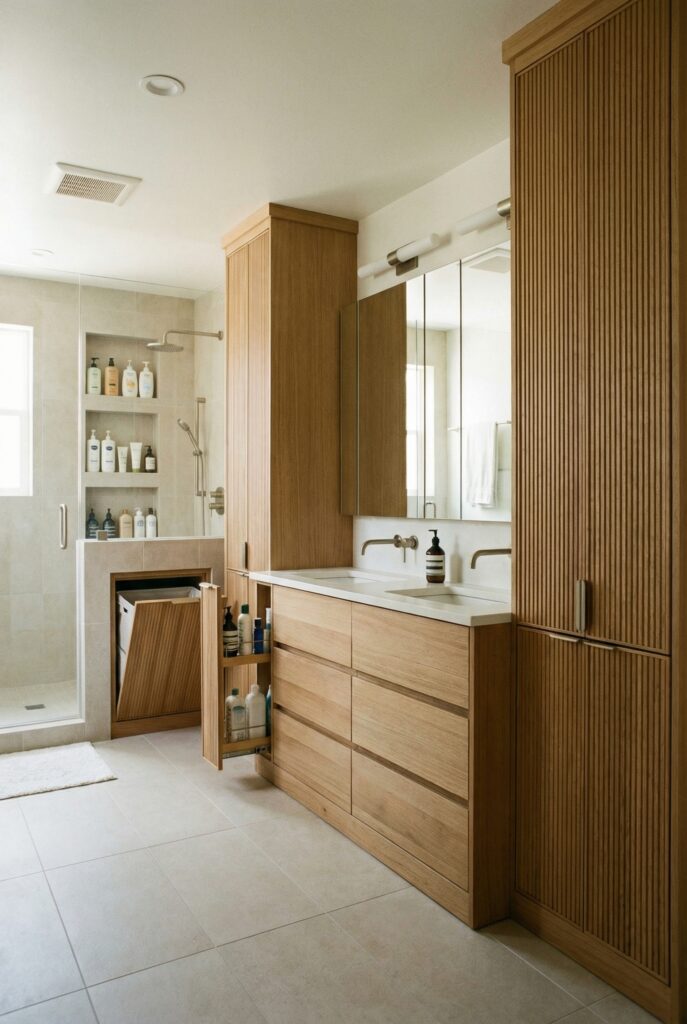
Best for: Any size where clutter is your mortal enemy.
What goes where: You build storage into every zone: tall linen cabinets flanking the vanity, recessed medicine cabinets, shower niches sized for real bottles, toe-kick drawers, and built-in hampers. Fixture positions follow whichever layout style fits your room, but storage is baked into the plan.
Why it works: Counters stay clearer and cleaning is easier, so the whole room feels calmer even with kids and real life.
Common mistake + fix: Treating storage as an afterthought and ending up with random carts and baskets; literally label where towels, toiletries, and cleaning stuff go on your floor plan.
Upgrade idea: Hidden electrical in a cabinet for toothbrushes and shavers, plus a narrow pull-out for tall bottles that makes you feel like the main character.
Quick win: once you see which layout “family” feels right, circle it and ignore the others. Decision made. You can refine inside that lane instead of starting from scratch every night at 11.
Double Vanity Configurations That Actually Work On Busy Mornings
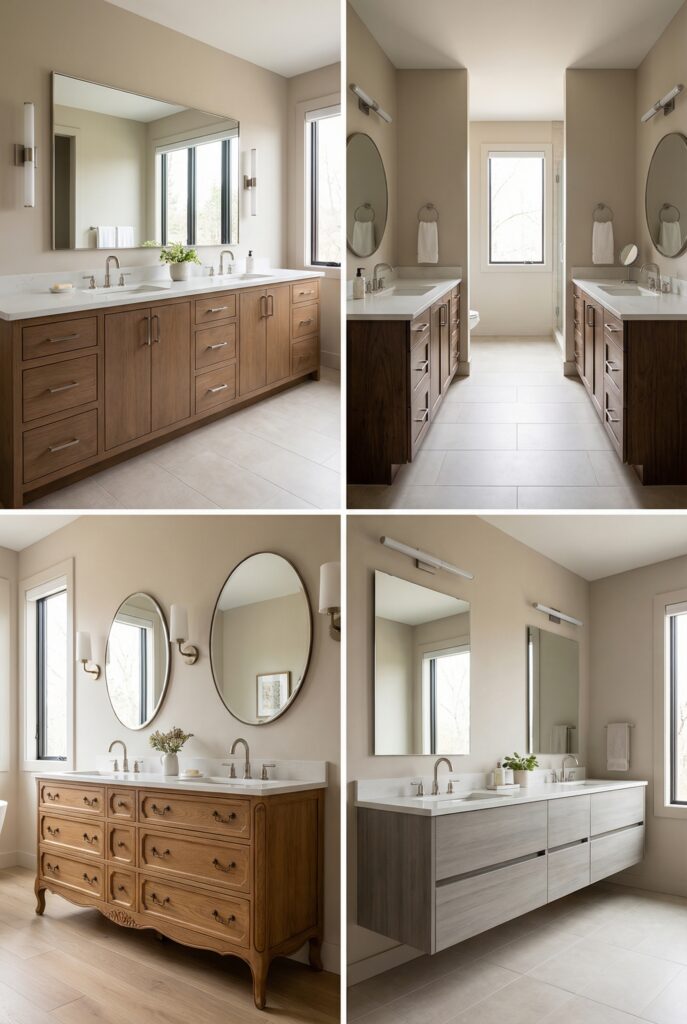
Double sinks sound glamorous until two people are shoulder-checking each other trying to spit. The trick is not just “two bowls,” it’s how they’re arranged.
A few classic setups:
- Side-by-side, one long run. The classic. Works if each person gets at least 24 inches of counter.
- Separated vanities. On opposite walls or with space between. Great if you really do share mornings.
- Furniture style. Looks like a dresser; lovely in traditional or cottage spaces.
- Floating. Off the floor so the room feels bigger, but you lose some closed storage.
Lighting matters as much as layout. Try a sconce on each side of the mirror or vertical light bars, not just one overhead light that gives you weird shadows.
Unresolved annoyance from my own house: our current vanity only has drawers on one side, and I regret it every single morning when I’m digging in the one shared cabinet.
Still deciding if I’m too scared to replace it because I’d have to drill into the tile backsplash and you know my whole thing about drilling tile.
Walk-In Shower Vs Soaking Tub (And A Quick Resale Mini-Box)
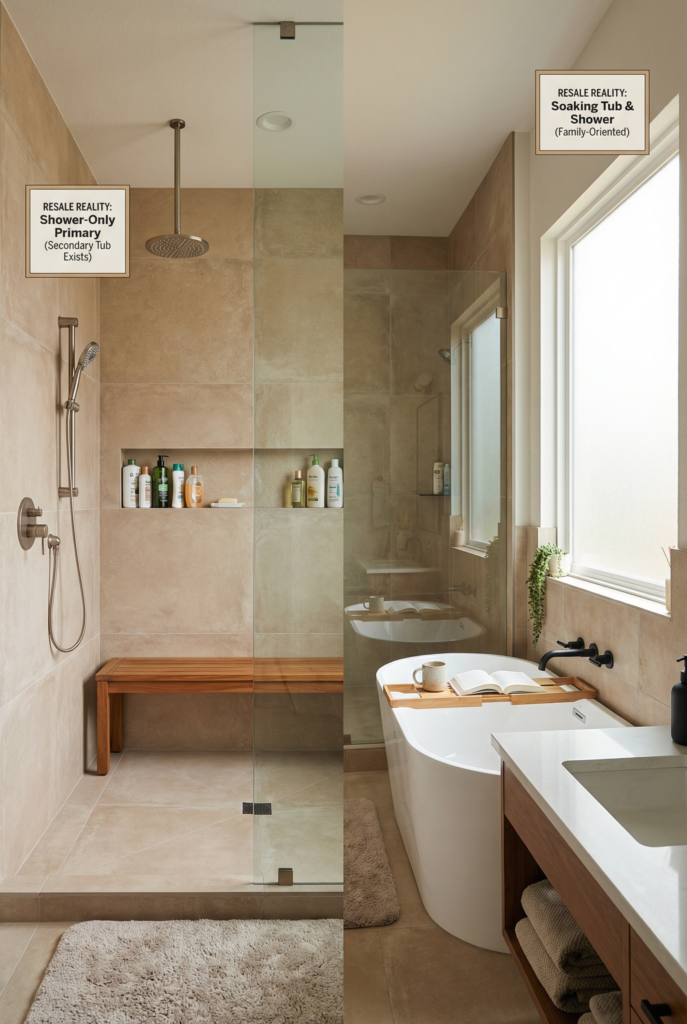
Okay, the eternal question. If you have space and budget for both, great. If not, here’s the short version.
When a walk-in shower wins
- You shower daily and almost never take baths.
- You want easier entry now or later.
- The room is smaller and a tub would dominate.
- There’s already at least one tub elsewhere in the house.
When a tub is worth it
- You or your kids use a tub at least weekly.
- You genuinely love long soaks and will actually take them.
- There is no other tub in the house and you’re thinking about future buyers with young kids.
A comfortable walk-in shower usually feels good around 3×5 feet or a bit larger, with a niche and bench. Doorless? Aim spray away from the opening, add a fixed glass panel, and slope the floor so water behaves.
Resale + tub mini-box
- No tub anywhere in the house? Think hard before going shower-only.
- At least one tub in another bath? Shower-only primary is usually fine, especially for buyers who care more about daily function than baths.
- Always ask a local agent what buyers expect in your neighborhood.
Chaotic tangent: I stayed in a hotel where the doorless shower sprayed directly toward the only towel hook. Every shower, the towel was damp before I even touched it. I still think about that any time I place hooks.
Storage-Integrated Layouts That Hide The Chaos
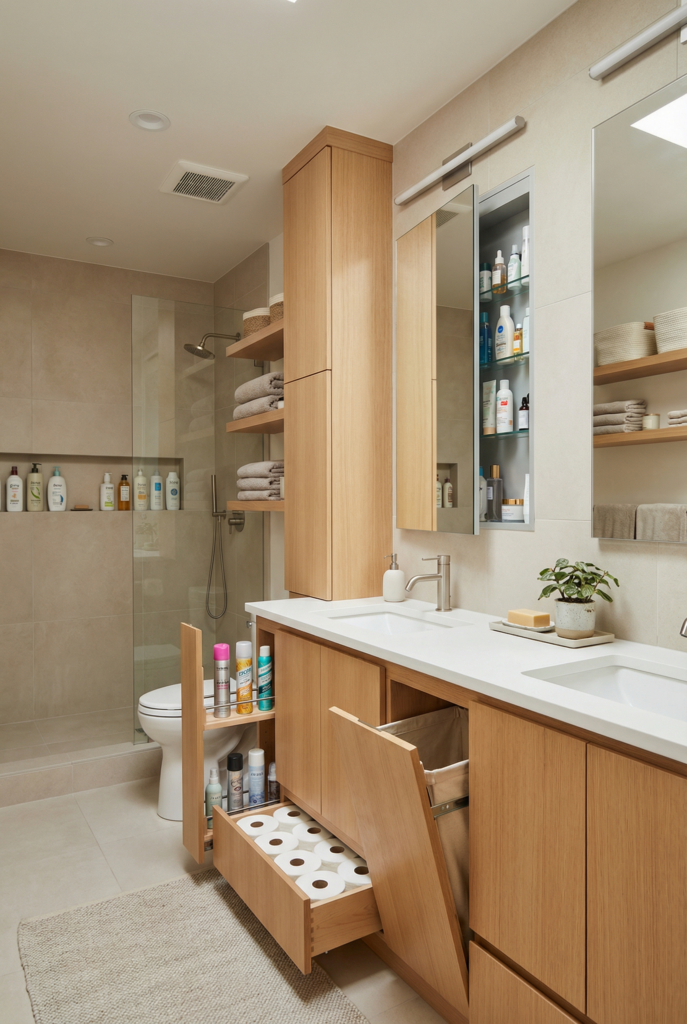
If you walk into your bathroom and think “why are there 19 bottles out,” that’s a layout problem as much as a personality one. Storage should be integrated into the bones of the room.
Some favorite moves:
- Recessed medicine cabinets that look like pretty mirrors.
- Tall linen towers at one end of the vanity or in corners.
- In-wall niches sized for real bottles, not just cute minis.
- Toe-kick drawers for extra toilet paper or flat things.
- Built-in hampers so clothes do not live on the floor.
- Shallow shelves above the toilet in small spaces.
When you design the layout, literally label where towels, extra toiletries, cleaning products, and kids’ bath toys will go. That’s functional bathroom space planning, not just vibes.
Lighting For That Quiet Luxury Bathroom Glow
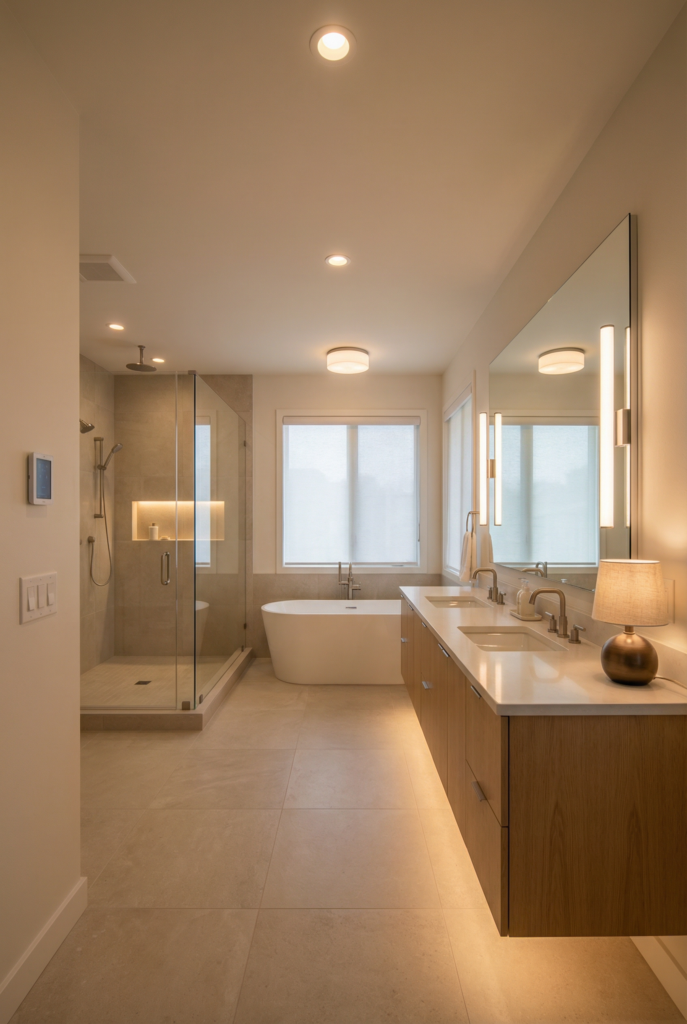
You know how hotel bathrooms sometimes feel aggressively bright at 6 a.m.? We are not doing that.
The goal is layers so you can go from “find the splinter in a kid’s foot” to “fake spa night” with one dimmer.
Three layers:
- Ambient – ceiling lights or a small flush mount.
- Task – at the mirror, ideally sconces or vertical bars at eye level.
- Accent – toe-kick LEDs, a lit niche, or a tiny shaded lamp on the counter.
To get that elegant bathroom ambiance:
- Put vanity lights around eye level.
- Put almost everything on dimmers.
- Add a nightlight mode or tiny strip under the vanity for late-night trips.
- Avoid the single bright “boob light” in the middle of the room if you can help it.
Materials + Hardware Cheat Sheet (So You Don’t Spiral)
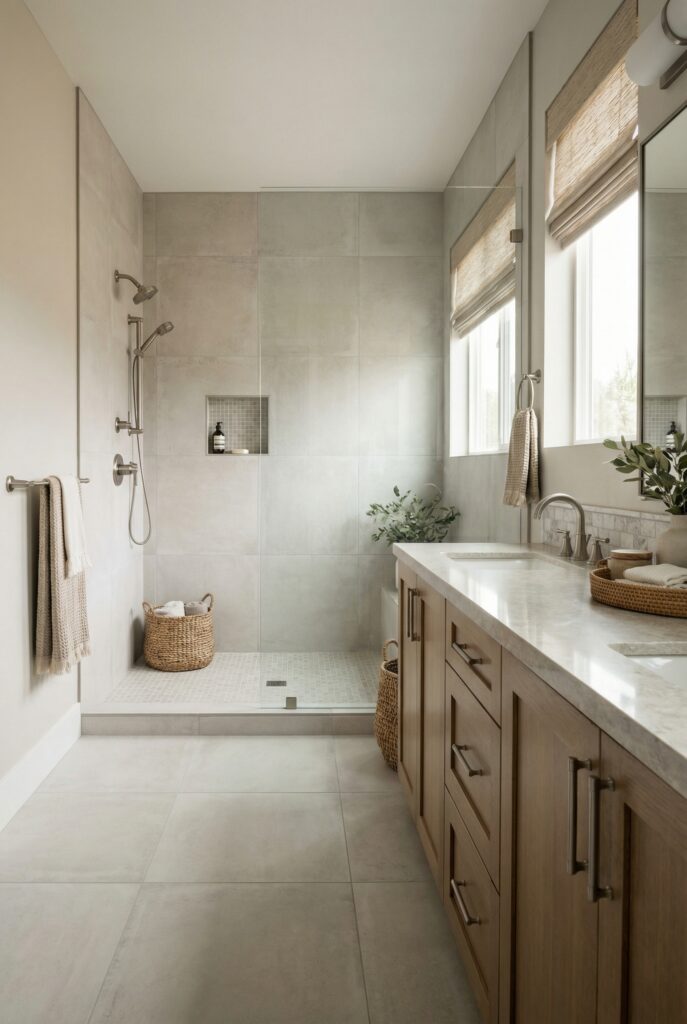
Very quick:
- Tile: Porcelain is my default. It’s tough, low-maintenance, and comes in a million looks. Natural stone is gorgeous but usually needs more sealing and care.
- Counters: Quartz is easy and forgiving. Marble is beautiful and develops patina, but it will etch and stain, so you have to like the lived-in thing.
- Metals: Matte black feels modern and graphic. Brushed nickel, chrome, or brass are softer and often hide water spots better. Try to keep metals to one or two families so it feels intentional.
- Grout and scale: Larger tiles and fewer grout lines make bathrooms feel calmer and are easier to clean. Save tiny mosaics for special spots, not every wall and floor.
You can use the same logic in a future guest bath or hall bathroom remodel, just scaled down.
Master Bathroom FAQs (Grouped For Easy Skimming)
Layout Rules & Sizes
How should a master bathroom be laid out?
Start from the door. Ideally you see a vanity or pretty tub first, not the toilet. Group shower and tub together, keep around 21–24 inches of clear space in front of each major fixture, and choose a layout family that matches your room shape instead of inventing something wild from scratch.
What is the golden rule for bathroom layouts?
Clearances. If you can’t comfortably stand, bend, and turn around in front of fixtures, the layout will feel bad no matter how pretty it is. Aim for around 30 inches of open space in front of sinks, toilets, and tubs when you can, and only dip closer to minimums when space is truly tight.
What is a nice size for a master bathroom?
Many primary baths land in the 80–120 sq ft range. Under 80 can still be great with smart planning, but it will feel efficient more than spa-like. Over 120 starts to feel like a retreat, especially if you want separate vanities, a big shower, and a soaking tub.
Is 40 sq ft enough for a bathroom?
Yes, for a secondary bath with a shower, toilet, and compact vanity. For a primary suite it will feel more like a very efficient 3/4 bath. Not bad, just not the dreamy Pinterest room in your head.
Showers & Wet Rooms
What is a good size for a walk-in shower?
I like starting around 3×5 feet. You can go smaller, but you lose some comfort and bench options. Bigger is lovely as long as you plan the drain, slope, and shower head locations so water stays where it should.
How do you keep water in a doorless shower?
Aim the water away from the opening, use a fixed glass panel to block spray, and slope the floor toward the drain. Also make sure there’s enough depth between the shower head and the opening so water doesn’t bounce right out onto your mat.
Do doorless showers or wet rooms need special drains?
Not always “special,” but larger wet areas often use linear drains or multiple drains so water moves away quickly. The key is planning the drain layout with the tile and slopes, not assuming you can fix it with a bigger mat.
Resale & Value
Does not having a tub in the primary bath hurt resale?
It can, especially if there’s no other tub in the house and a lot of buyers in your area have young kids. If you keep at least one tub elsewhere, many people are thrilled with a big, beautiful shower in the primary. Ask a local agent what buyers actually expect.
How much does bathroom size affect resale?
Size matters, but so does layout and condition. A slightly smaller but well-planned, updated bath often feels more valuable than a big, dated one. Appraisers and buyers look at the whole picture: bed/bath count, finishes, and how you compare to nearby homes.
What color bathroom increases home value?
No magic color, but calmer palettes usually photograph and show better. Warm whites, soft beiges, and gentle gray-greens feel current and move-in ready. You can always add personality with towels and art instead of tiling your walls hot pink. Related: 12 Bathroom Decor Color Ideas in 2026: The Shades I Keep Seeing (and saving)
What is the 30% rule for renovations?
Some people say not to spend more than about 30 percent of your home’s value on all renovations combined. It’s just a guideline, not a law. What matters more is your market, how long you’ll stay, and how much your remodel genuinely improves your daily life.
Costs & Permits
Can you remodel a bathroom for $5,000?
Yes, if you treat it as a refresh. Think paint, new faucet, possibly a stock vanity, updated lights, and hardware. Once you start redoing showers, moving walls, or choosing fancy tile, the number climbs fast.
What is the most expensive part of a bathroom remodel?
Labor, especially tile work and plumbing. Custom showers with lots of glass and waterproofing, moving plumbing, and high-end stone or cabinetry are usually where budgets blow up.
Do I need a permit for a walk-in shower or layout change?
Very likely if you’re moving plumbing, changing electrical, or touching structural walls. Rules are hyper local, so the safest move is to ask your building department or have your contractor pull permits when required. Future-you (and your insurance) will be glad you did.
Wrapping It Up In Real Life
If you’re still here, you’re in deep with this project. Take a breath. You don’t need a perfect, once-in-a-lifetime design on the first try. You just need a layout that supports your mornings and feels like a place you actually want to be.
Sketch your room. Use the 60-second picker to choose one layout “family.” Then walk through it in your head: where the towel goes, where the kids drop their pajamas, where you hide the ugly electric toothbrush charger. If you solve for those tiny, mundane moments, the whole space feels different.
And if your future shower niche ends up one shampoo bottle too shallow, I promise you’ll still love the room. You’ll just complain about it to the internet with me, and then go back to your warm floor and pretty lights.