If you’ve been hunting for decorating ideas for playroom activity zones, this post is basically my “why are the blocks in the reading chair again?” survival guide — how to carve out little areas for reading, crafts, and building without turning your house into a tiny toy warehouse. I’m walking you through the simple stuff that actually works (rugs like invisible walls, storage by activity, and cleanup shortcuts that don’t require a full personality transplant).
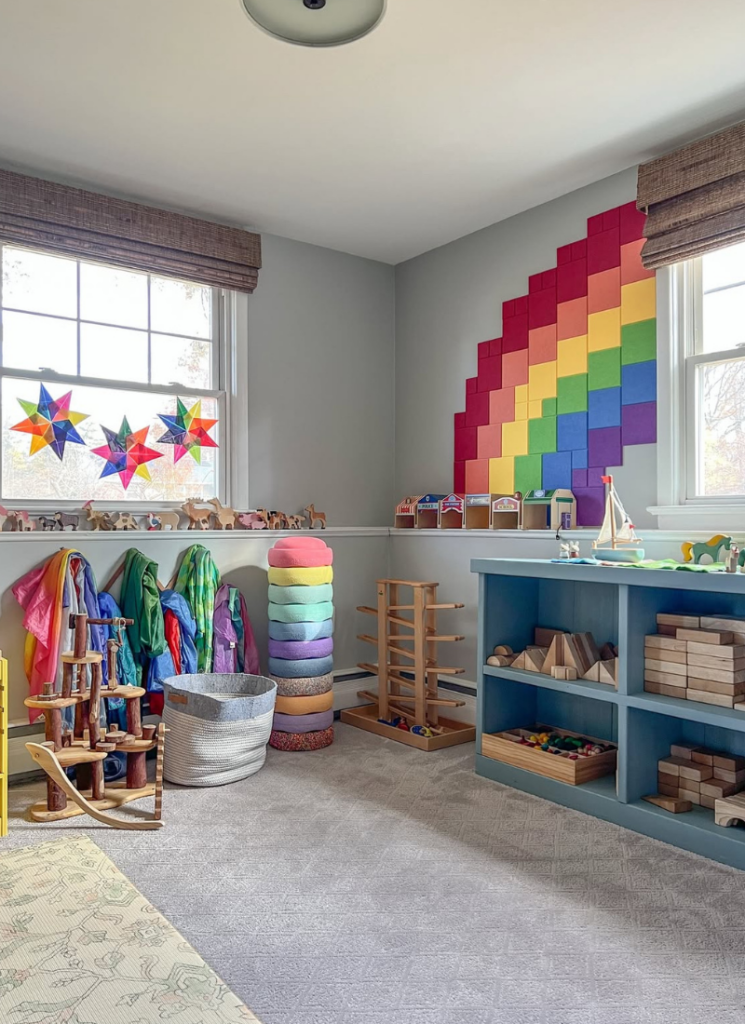
If you’re looking for decorating ideas for playroom activity zones, I want you to picture this: you finally make a cute little reading nook… and then a tidal wave of blocks shows up in it by 4:12pm. Like, why is the entire Magna-Tile economy always migrating??
And yes, the secret isn’t more storage (I mean… it is, but also no). It’s giving the room a few “invisible boundaries” so each activity has a home — and the whole space feels calmer, even when it’s colorful and lived-in and someone is definitely chewing on a marker cap as we speak.
One of my favorite examples of this is that cheerful, sticker-splashed room with the long low storage run, kids desk, and the little climber/slide situation. Everything has a place, but it still feels whimsical and fun (I first saw it on Abbey Webber-Sloanand immediately wanted to copy the whole vibe, down to the “this is cute but also clearly survives real children” energy).
And I keep coming back to the more “living-room playroom” setup where the rug + low storage line creates zones without making the room feel chopped up. It’s so practical for shared spaces — and honestly it’s kind of a masterclass in “kid stuff, but make it breathable” (that layout from Chelsea is doing a lot of quiet heavy lifting).
Rugs That Define Space
If you do one thing for playroom zones, make it this: use rugs like they’re painter’s tape. Not precious “don’t step on it” rugs — more like “this is where books live” / “this is where blocks belong” / “this is where we craft (and also spill)” rugs.
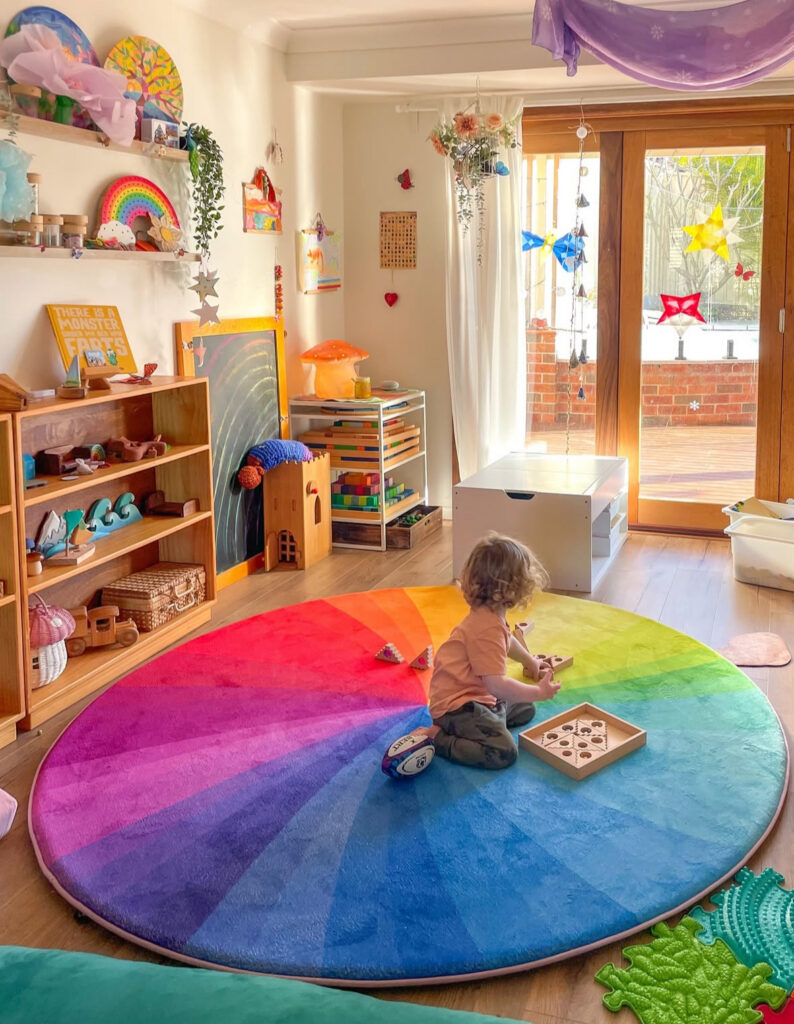
That giant round rainbow rug is the happiest little boundary line I’ve ever seen. It basically tells kids, “play right here” without you saying a word, which is the dream. The saturated color wheel makes the whole room feel like a creative playroom on purpose (not “random toys landed here”), and I love how it anchors the open floor (I spotted this one via @meha_creative_days + @funsquare_aus and it’s still living rent-free in my brain).
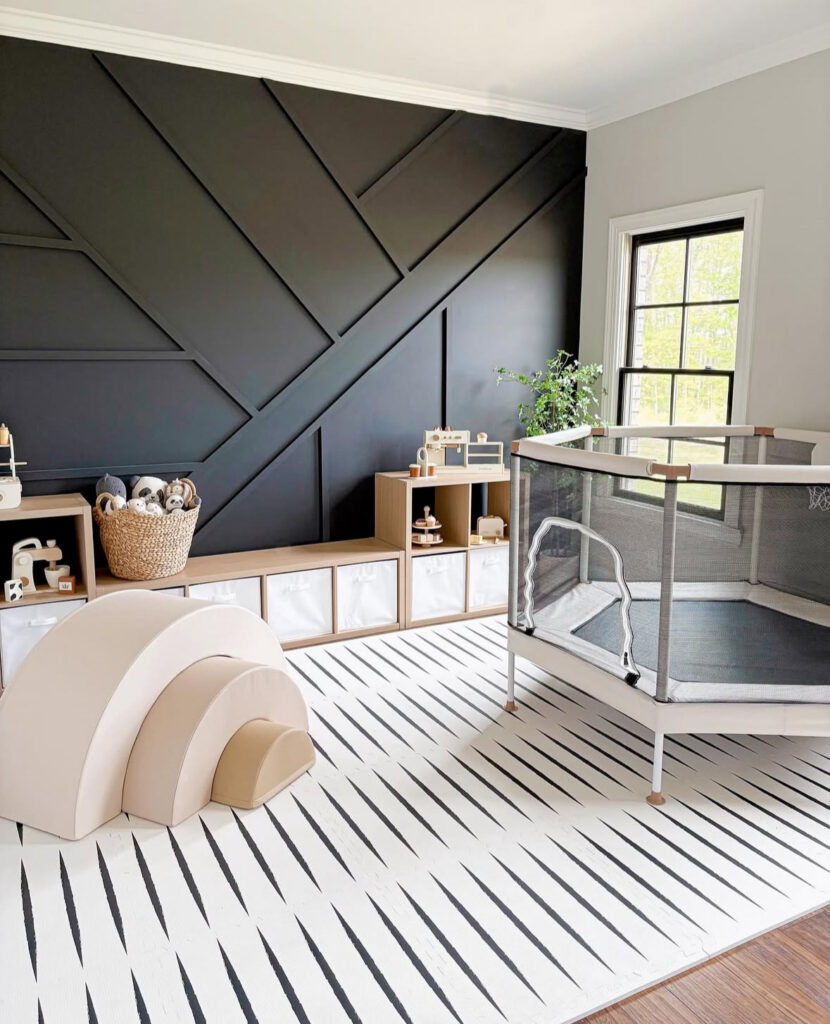
On the flip side, the modern room with the bold black wall and that graphic black-and-white play mat proves you can go “modern playroom” and still have kid energy. The high-contrast floor pattern does the zoning work (especially for building + gross-motor play), while the neutral base keeps the visual noise down (this one popped up from @_squarehouse and I’m into how clean it feels without being sterile).
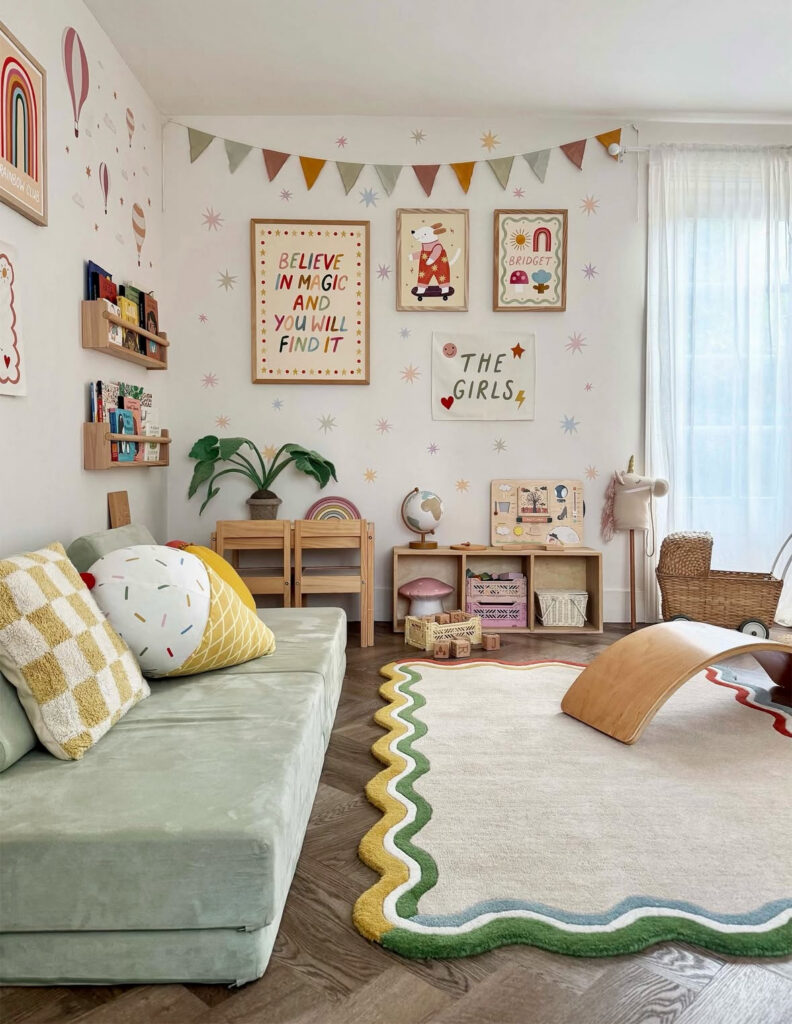
And then there’s the playroom with the bunting + star wall decals and that scalloped, wavy-edged rug… which is basically what happens when “whimsical playroom” gets it right. The rug edge alone makes the zone feel like a special little stage for pretend play or reading — I love it, though I’d personally keep the rest of the zone super simple so the rug can be the star (this one came from Kid of the village and it’s very “magic, but still livable”).
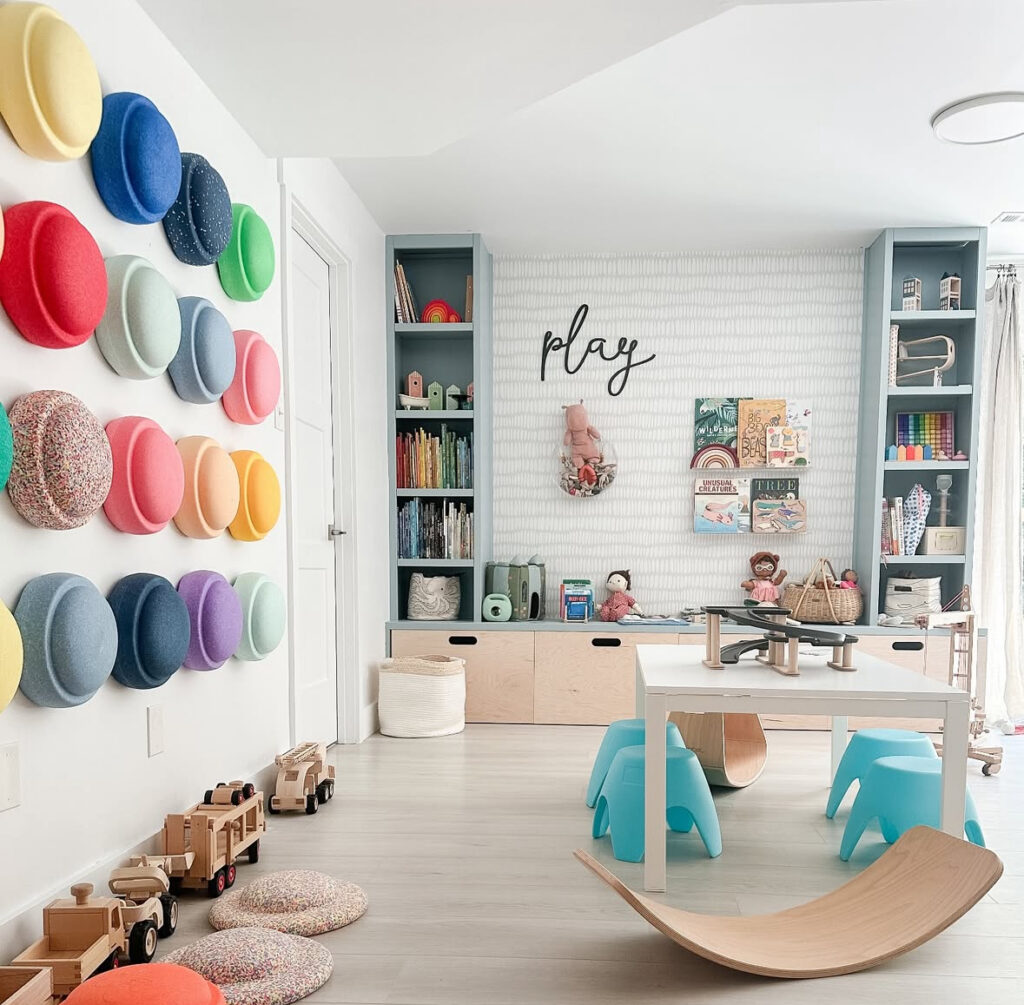
One more rug-adjacent thing I’m obsessed with: the “open play” room with the hat wall and the balance board. It’s proof that leaving floor space empty is also a design choice — especially when the floor zone is clearly defined for movement and big building projects (I first saw this setup on Our modern playroom and it feels airy in the best way).
Related posts: 30 Best Baby Girl Nursery Ideas for 2026
Storage by Function
I know “playroom storage” is the least glamorous phrase on earth, but it’s also the difference between a functional playroom and a daily emotional spiral. The trick is storing by activity, not by item type. So instead of “all toys,” you get “reading,” “craft,” “blocks/building,” “pretend,” and “rotation.”
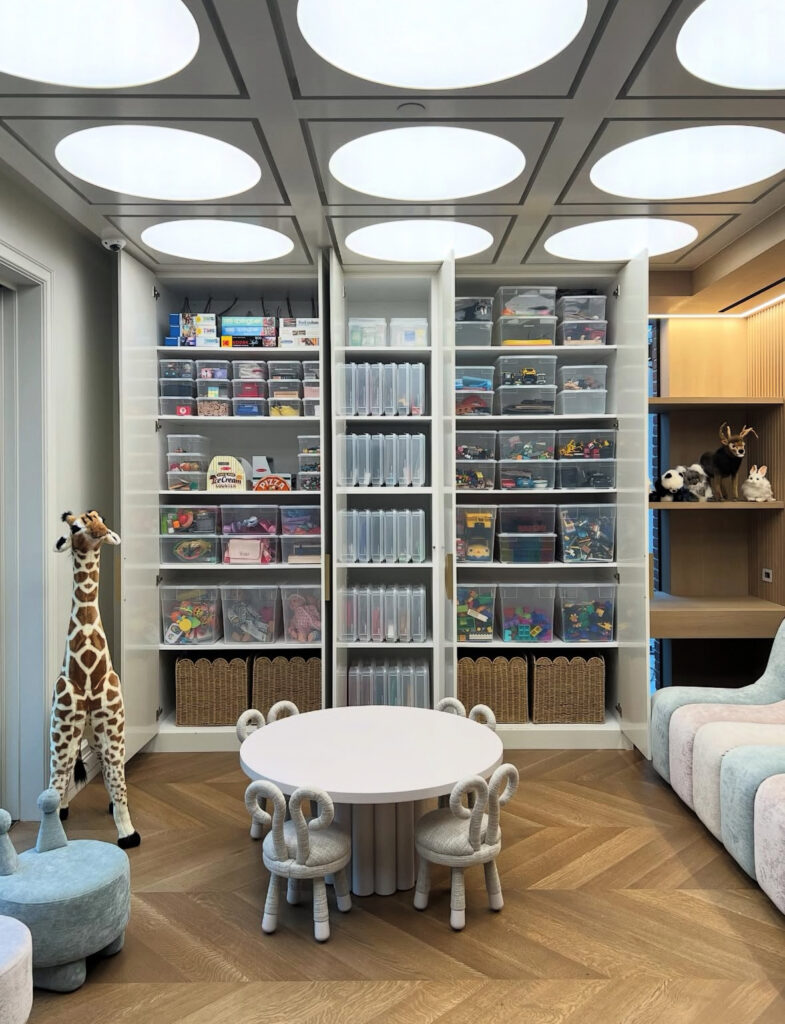
The wall-to-wall organized closet with the clear bins is the clearest example of this: it’s basically a playroom organization system disguised as a beautiful cabinet moment. I love the visibility (kids can actually find things), and the fact that the bins are uniform makes the whole room feel calmer — like your brain isn’t sorting 900 shapes at once (I saw that dream setup via Penina S. and yes, I would like that level of control).
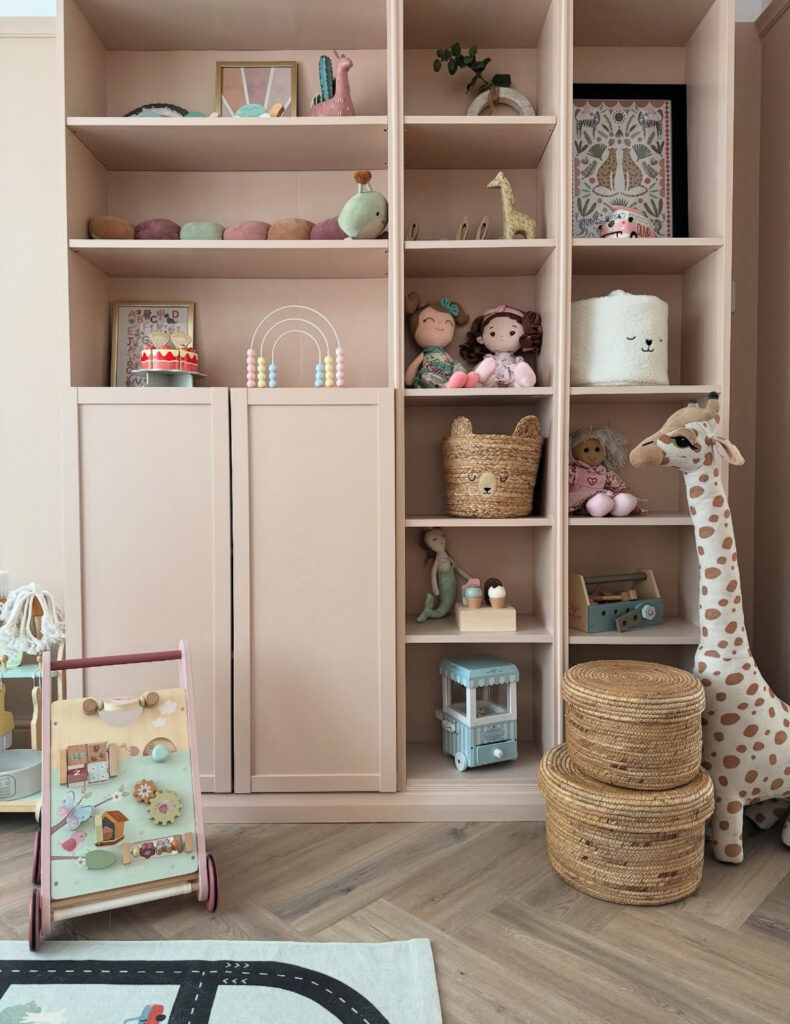
The painted IKEA Billy bookcase hack is such a good reminder that you don’t need custom millwork to get a “built-in” look. The paint color makes it feel intentional, and the open shelving at kid height turns storage into decor — I just wouldn’t overload the shelves, because the magic is in the breathing room (this one came from Rachel and it’s such a solid budget-friendly playroom storage move).
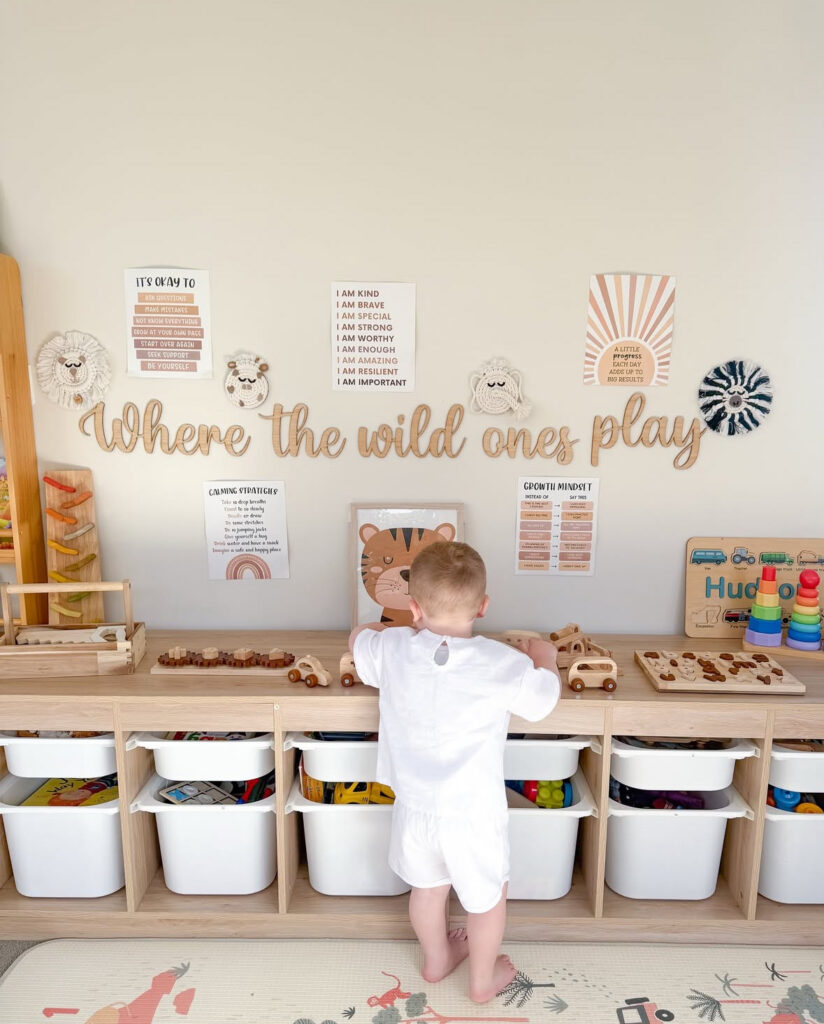
Then there’s the long run of low cubbies with bins under a counter — the “everything has a drawer” approach — and I will forever love this for toddlers. It keeps toys accessible, it hides visual clutter fast, and the countertop becomes a landing zone for rotations or “today’s activity” (that “Where the wild ones play” wall moment from Tamara Smithis exactly the kind of cozy-but-practical playroom decor I mean).
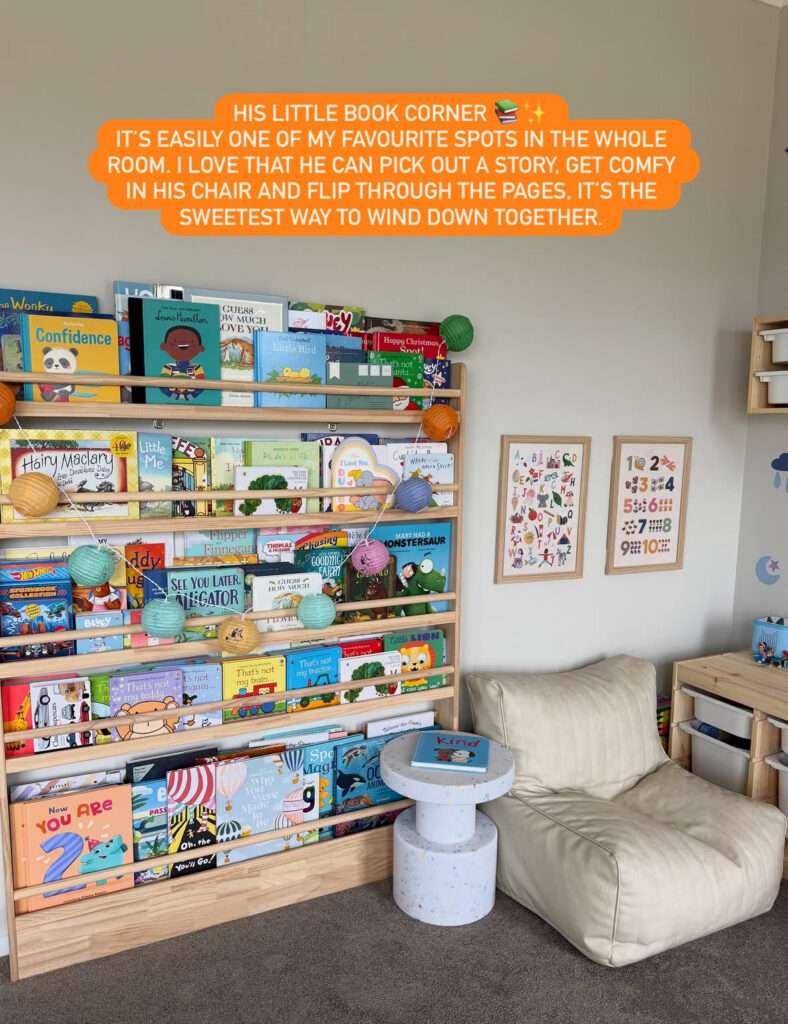
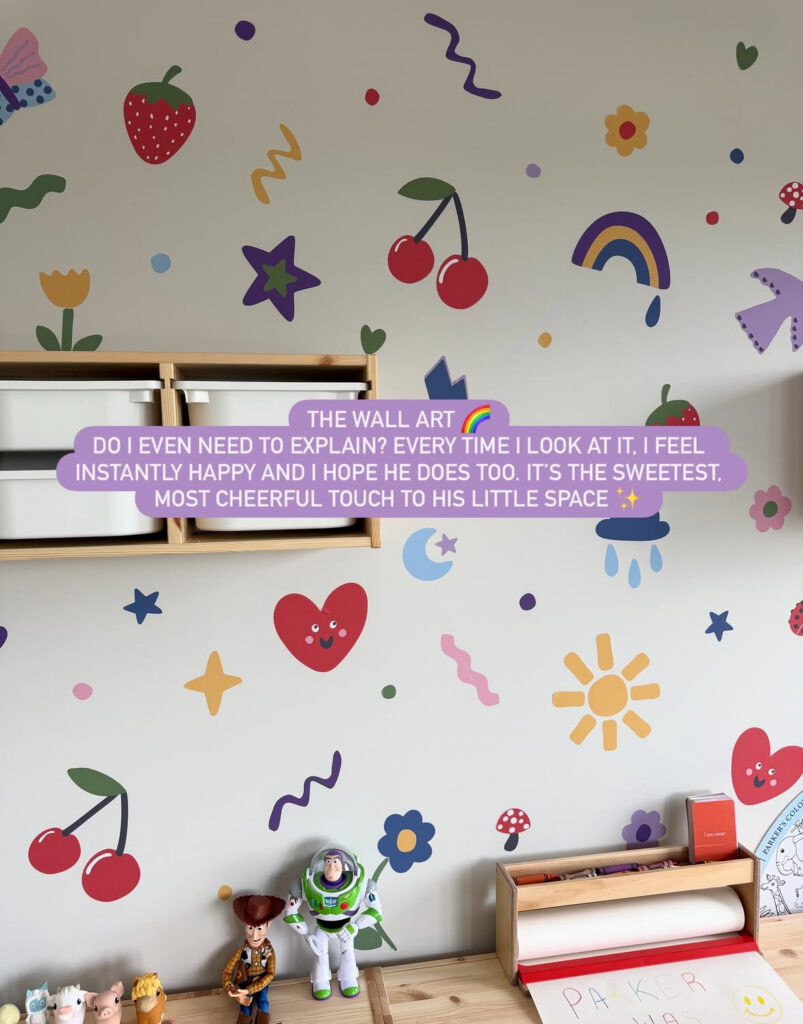
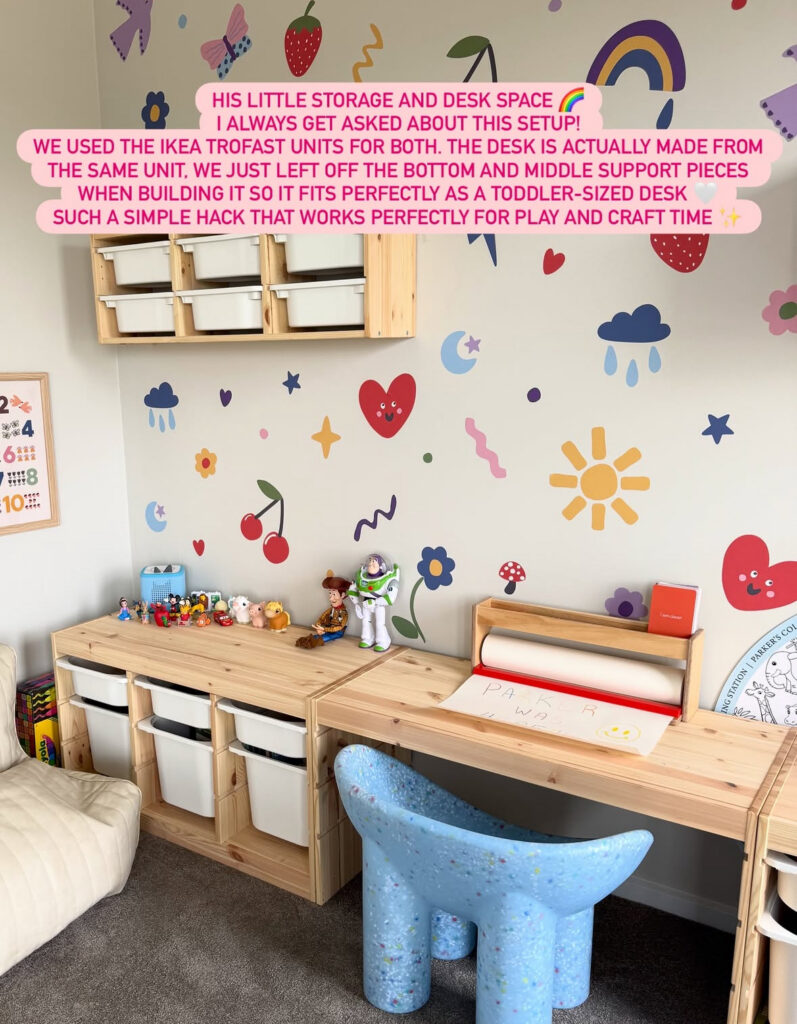
The book corner close-up is another perfect “store by function” example: books are forward-facing, the chair is right there, and the whole thing feels like a tiny ritual space instead of just a shelf. I love the soft lighting vibe and the little styling touches, but the real win is that it makes reading the default activity in that corner (I saw this little nook on Abbey and it’s genuinely sweet).
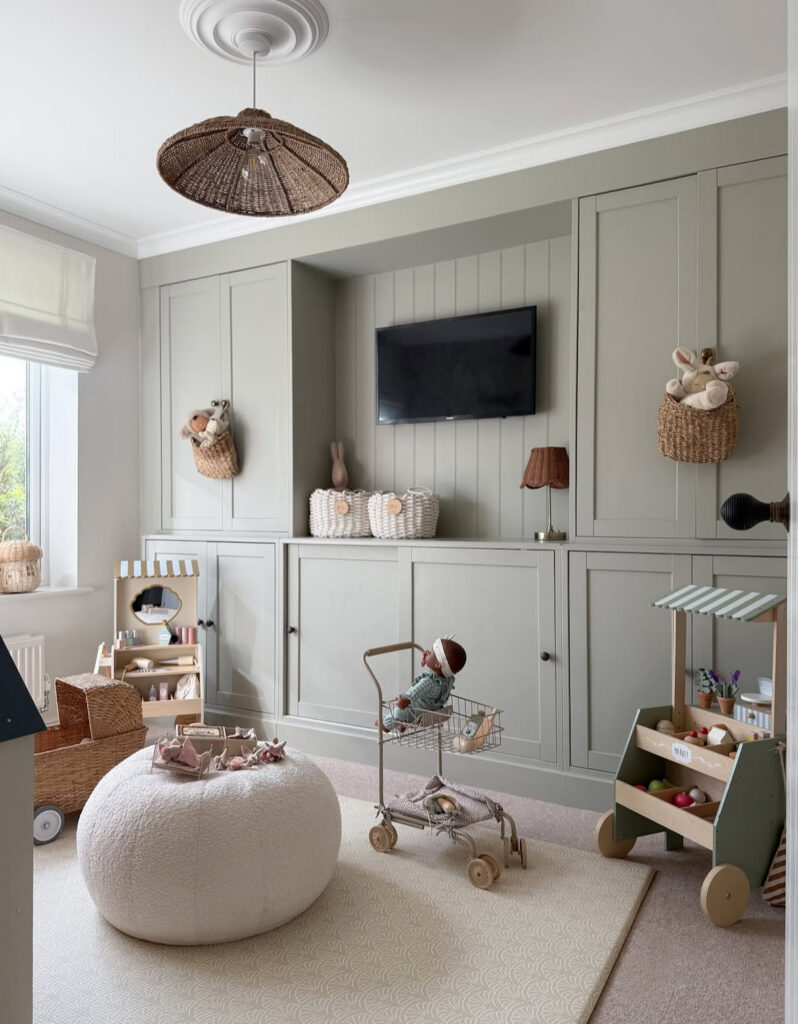
And if your playroom includes a TV (no judgment — sometimes you need 22 minutes of peace), the sage built-in wall is so good at hiding the mess while still looking like a proper room. The closed cabinetry keeps the clutter invisible, the open shelves keep it styled, and the whole thing reads more “kids room design” than “toy explosion” (this came from Hannah Jones and it’s a great example of playroom functionality meeting grown-up aesthetics).
Easy Cleanup Strategies
Cleanup is the make-or-break part of playroom zones. Because if it’s hard to reset, the zones collapse… and then you’re back to blocks in the reading chair. (Ask me how I know.)
My favorite “easy cleanup” trick is giving every zone a catch-all that’s acceptable. For building zones, that might be one deep bin labeled “blocks” (not five tiny categories you will never maintain). For crafts, it might be a tray + one drawer for “current supplies,” and everything else lives higher up.
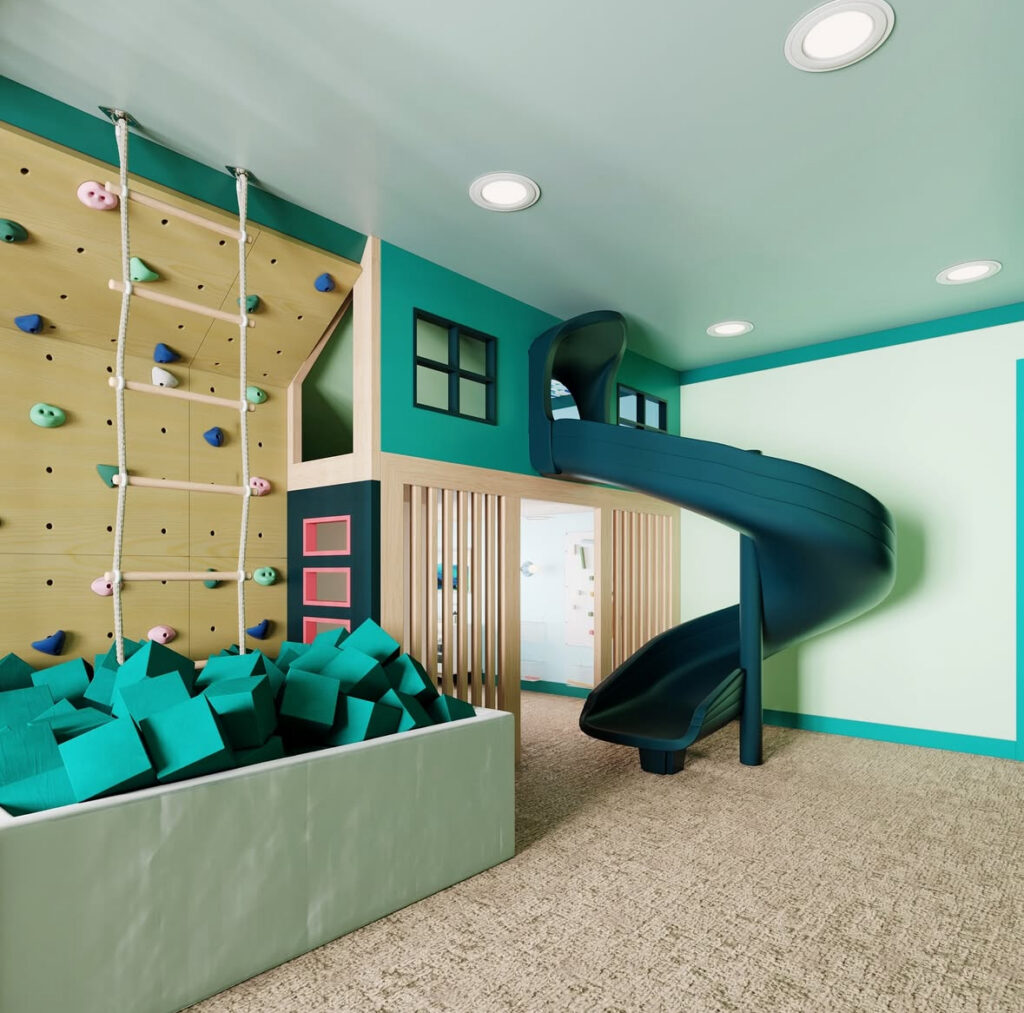
The indoor-playroom foam pit setup is the extreme version of “contain the chaos,” and honestly? It’s genius. Foam blocks everywhere sounds like a nightmare until you realize they’re all the same material, the pit contains them, and the whole area becomes a safe gross-motor zone (I saw this from Groh playrooms and while it’s aspirational, the principle is very stealable).
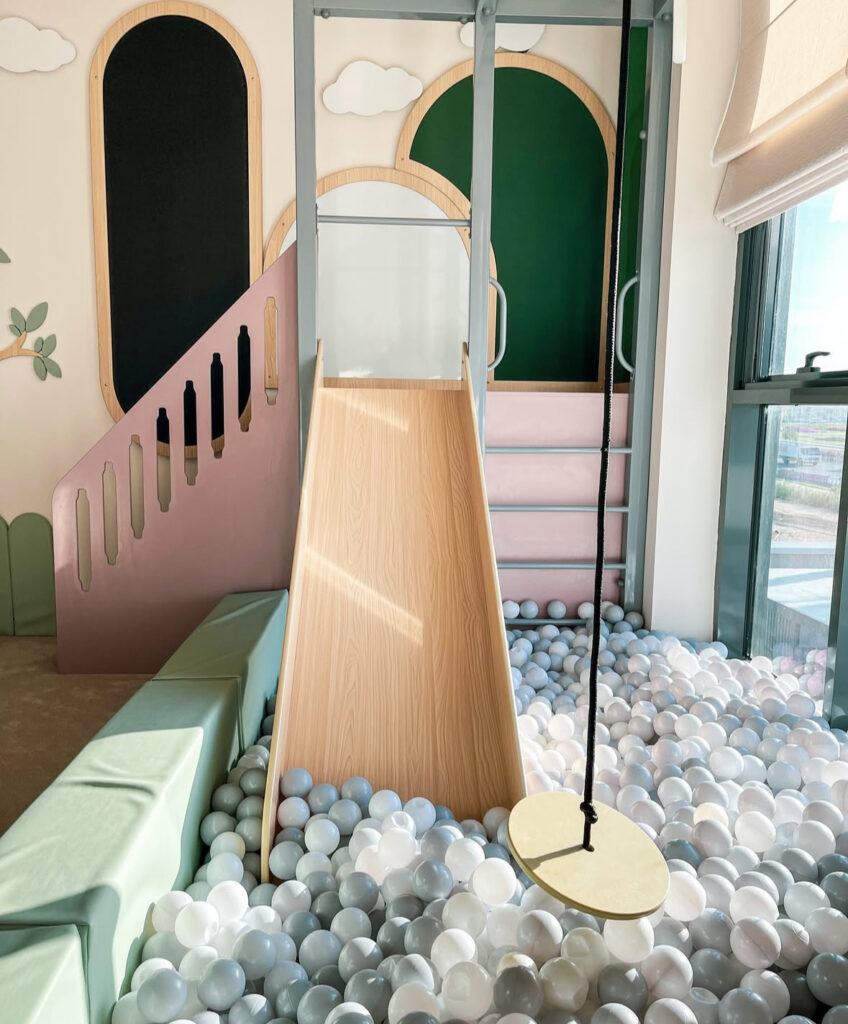
Same with the ball-pit + slide setup: it’s obviously over-the-top in the best way, but it’s also a perfect example of zoning by flooring + containment. The balls stay in the ball zone, the soft perimeter keeps it safer, and cleanup is basically “shove balls back toward their homeland” (this one came from @ralee.me and it’s pure indoor playroom joy).
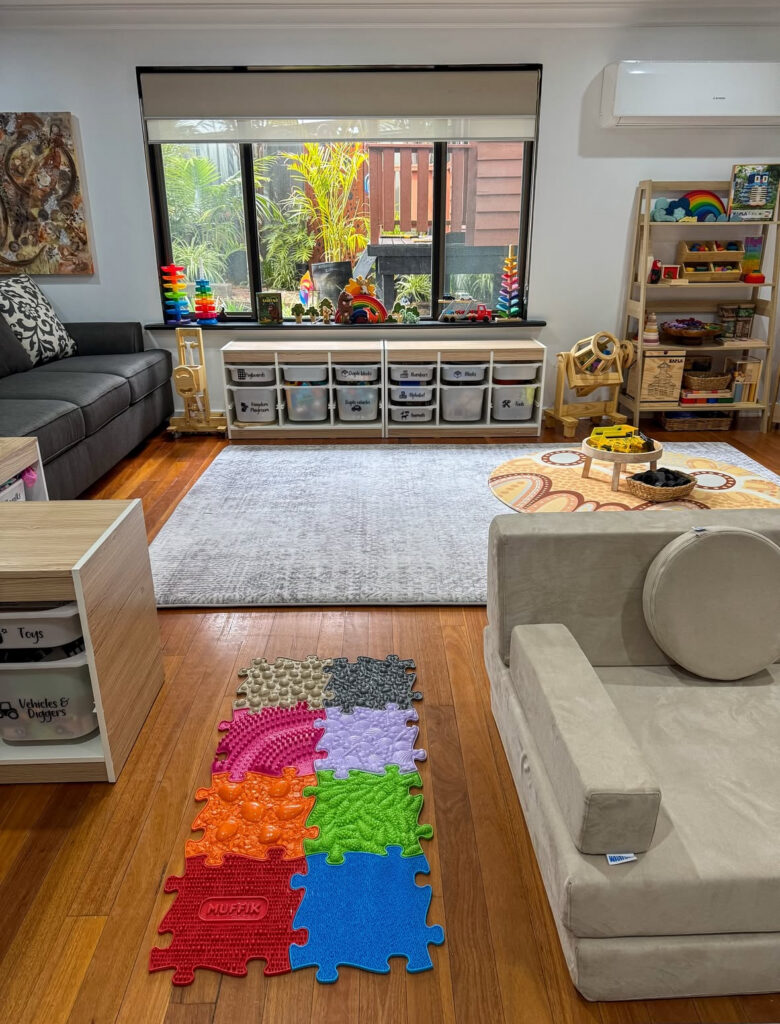
And in the shared living-room playroom layout, the best cleanup strategy is the simplest: keep the biggest storage closest to the biggest mess. Blocks near the open floor, books near the seat, crafts near the table — so you’re not carrying tiny pieces across the room like a stressed-out librarian (that’s the quiet brilliance of the Chelsea’s setup).
A Reading Zone that Stays Cozy
A reading zone needs three things: a soft landing (rug or cushion), a “grab-and-go” book display, and a seat that makes you want to flop down. That’s it. Anything extra becomes a dumping ground. (Why are kids so talented at turning baskets into chaos portals?)
The book corner with the comfy chair + forward-facing shelves is basically the blueprint. It feels warm and inviting, and I love how it’s styled without being fussy — just enough cute to feel special, not so much that it’s annoying to maintain (that close-up from Abbey is exactly what I’d copy).
Also if you want to make reading feel like its own “little world,” the star-sticker wall + bunting moment does that instantly. It’s like visual permission to slow down — I’d just keep the book storage super tight (one shelf, one basket) so the vibe stays calm (that playful wall from @kidofthevillage is very “storybook corner”).
A Craft Zone that Won’t Ruin Your Whole Day
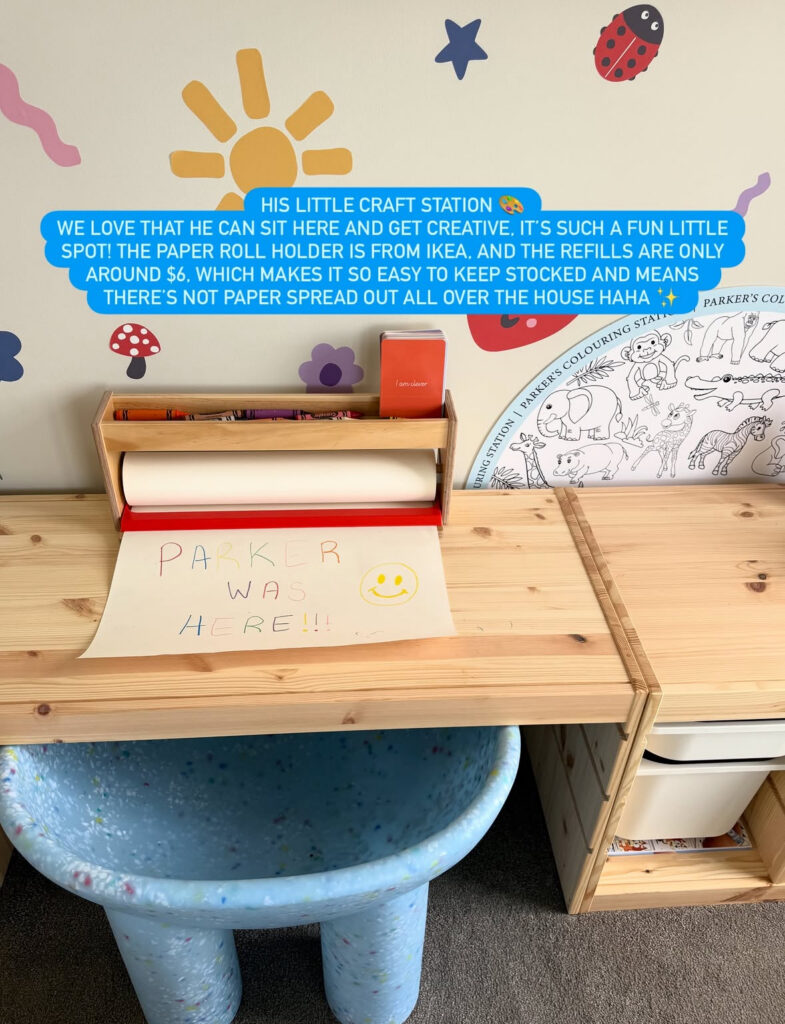
A kids art space should be easy to start and easy to stop. Meaning: supplies live in the craft zone, surfaces wipe clean, and you have a “current project” container so half-finished masterpieces don’t migrate to the sofa. (Because they will. They always do.)
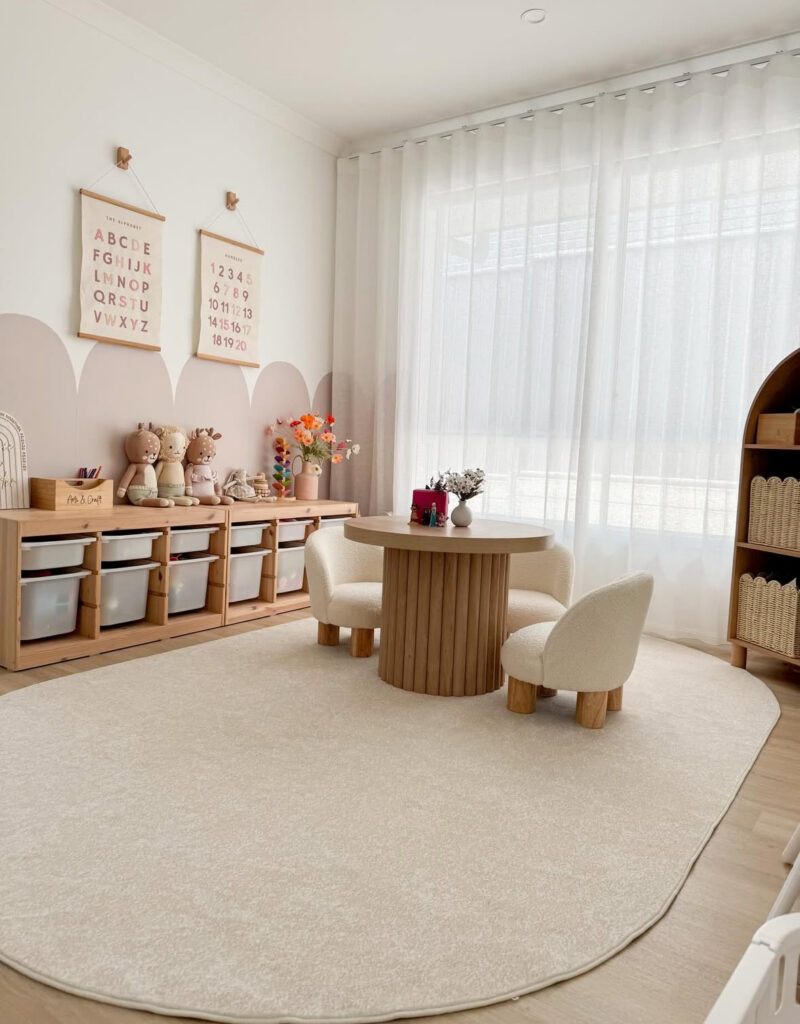
That little table-and-chairs zone on the soft oval rug is such a good craft/puzzle setup because it feels like a real workstation. The light is gorgeous, the scale is right for kids, and the rug makes the zone feel intentional — like “this is where we do things” (I keep thinking about that calm corner from Coastal_luxury).
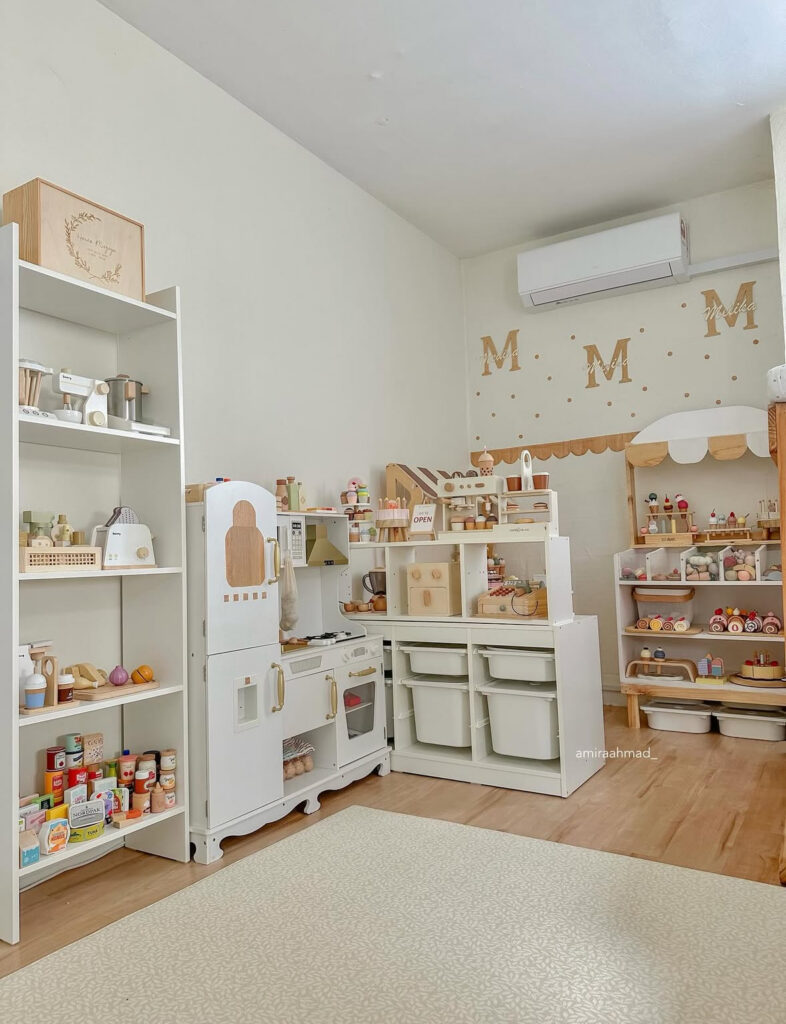
And yes, the pretend café setup counts as craft-zone adjacent — because it shows how powerful “everything needed for the activity lives right there” can be. The moment your kid can independently set up and pack away their own play, your whole life gets easier (that’s why Amira’s setup is so satisfying).
A Block/Build Zone that Can Handle the Chaos
Blocks want space. They want open floor. They want you to step on them barefoot at least once a week (it’s like a rule). So give them a defined building zone with a big rug or play mat, low storage, and as few obstacles as possible.
The modern black-wall room with the graphic mat is great for this because the floor zone is obvious and uninterrupted. It feels like “this is where big builds happen,” and the rest of the room stays visually quieter (again, @_squarehouse is doing the most with a simple palette).
The hat-wall playroom works for block play because the center of the room is intentionally open — and the storage stays on the perimeter. Add one big bin for blocks near the open floor and you’ve basically solved 60% of cleanup friction (I love how @ourmodernplayroom keeps it airy).
And in the shared living-room playroom setup, the best block-zone trick is keeping builds near the storage line and away from the main walkway. If the “build zone” is always where people walk, you’ll forever be negotiating tiny construction sites.
Related: 10 Ideas For Children’s Room You Will Want to Copy
Walls + Lighting that Make Zones Feel Intentional
Walls are honestly the most underrated “zone tool” because they do the separating for you without adding another piece of furniture to trip over. And when the lighting is good (read: bright, warm, and not giving dentist office), each corner starts to feel like it has a job.
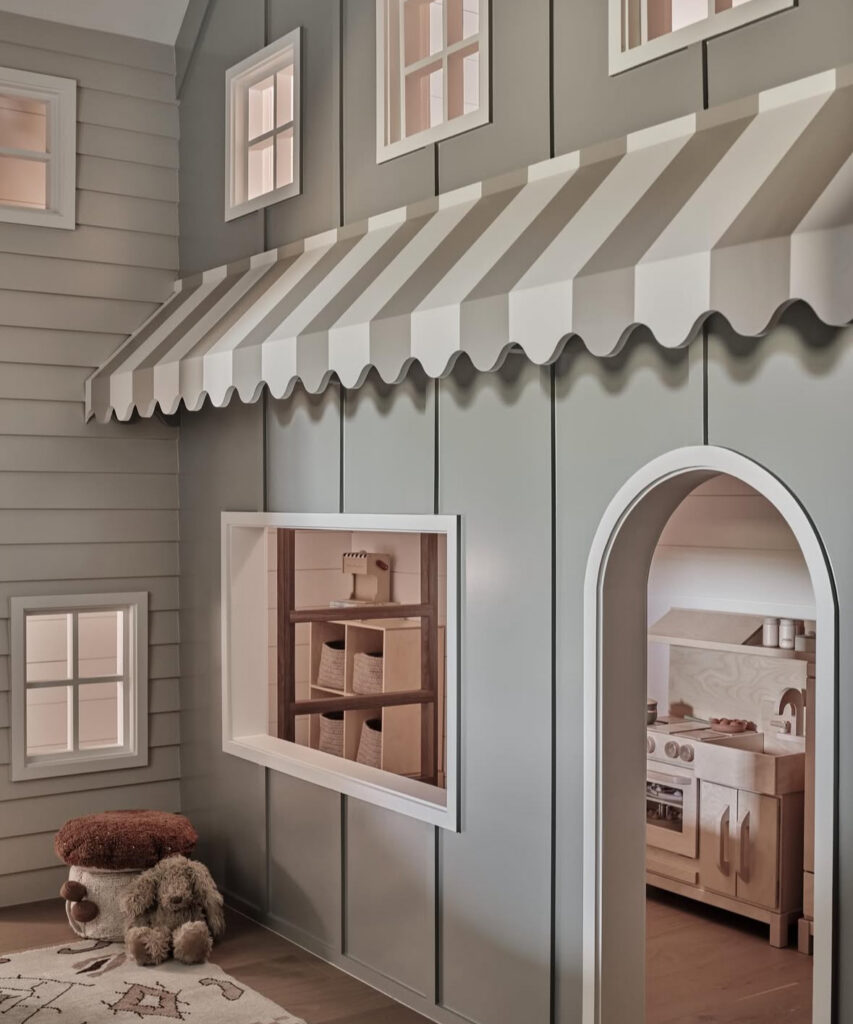
That sweet little storefront wall with the striped awning is basically zoning on easy mode: the minute you see the arched doorway and tiny windows, you get that this corner is for pretend play (no signage required). I love how the muted gray-green keeps it calm and elevated—even with all the whimsy—and the built-in cubbies are doing that quiet “cleanup won’t ruin your night” thing. This one has Clare Kennedy Interiors energy all over it… like it’s playful, but still feels like it belongs in the rest of the house.
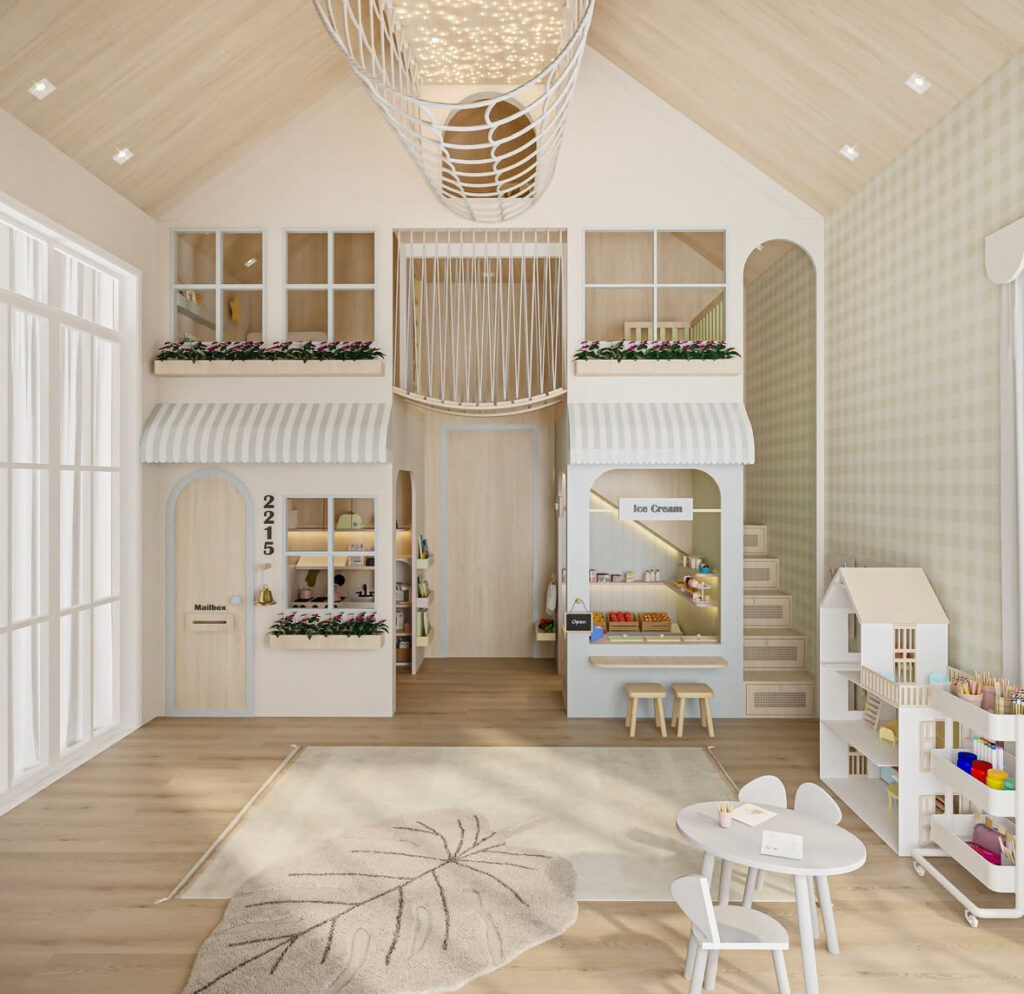
The big airy playroom with the two storefronts feels like a tiny village and a functional layout, which is honestly rare. The walls create a whole “main street” pretend-play zone, and then the giant open rug area stays clear for blocks or crafts without being swallowed by the theme (also: that hanging net/statement light is such a clever way to make the room feel special without adding clutter). You can tell @fourlittlepigs_kids_interiors planned the sightlines here—everything feels open and bright, but still organized.
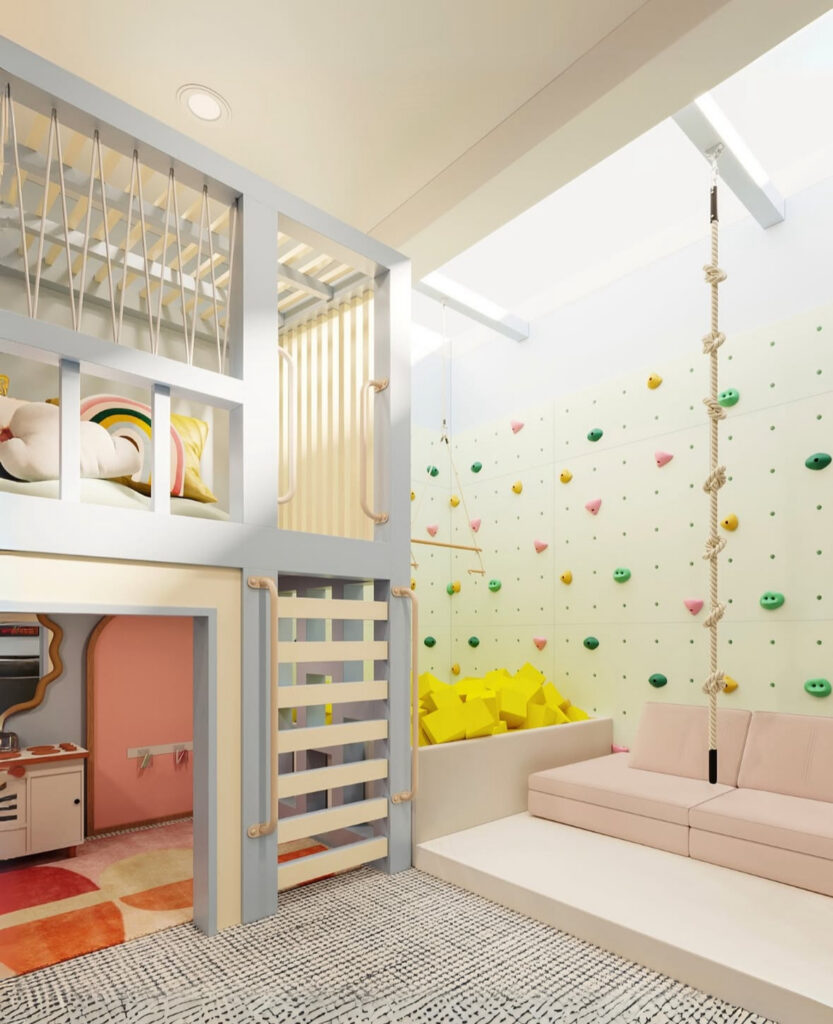
And then the climbing wall + loft setup is proof that an “active zone” can look designed and not like a neon plastic gym exploded. The skylight light floods the space, the pastel holds add color without chaos, and the foam pit + soft seating platform makes the whole thing feel contained (aka: you can actually supervise without pacing like security). I’m obsessed with how the wall becomes the boundary—no extra furniture needed—and @grohplayrooms clearly understands the art of making big kid energy feel… oddly chic.
Playroom Seating that Supports Zones (instead of eating them)
Seating is the quiet hero of playroom layout. If there’s a comfy seat near books, reading happens. If there’s a stool near crafts, kids settle in. If there’s no landing spot at all… toys just spread.
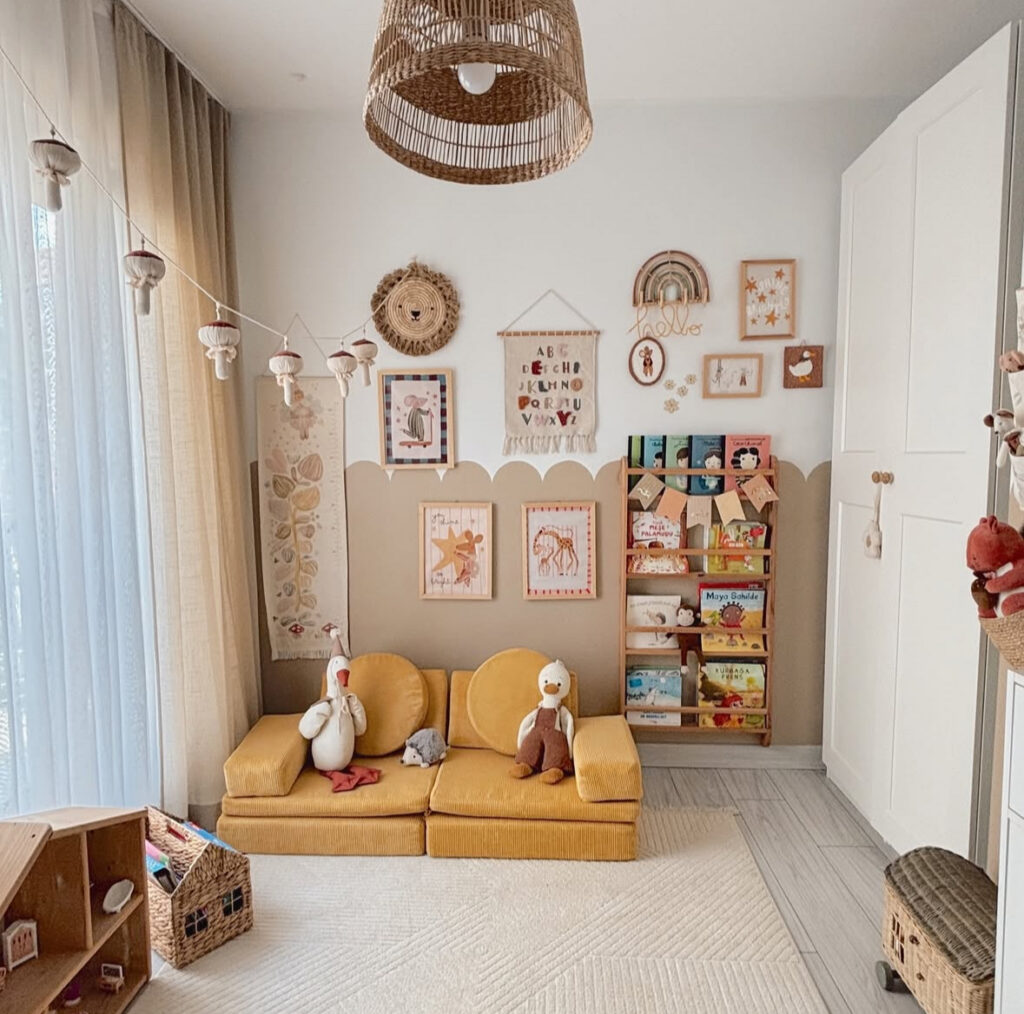
The little chair in the book corner is such a good example of “right seat, right place.” It’s not a giant adult chair swallowing the room; it’s a kid-friendly perch that makes the corner feel like it belongs to them.
The round table with cozy chairs is the craft-zone equivalent — it’s inviting, it’s scaled right, and it gives structure to the activity. I also love the big pouf moment in the sage built-in room because it’s flexible: reading, lounging, or just a soft spot to crash during play.
And for big-movement zones (slides, foam pits, ball pits), the best “seating” is really soft perimeter pieces and clear sightlines — so you can supervise without hovering and kids can move safely.
Quick Conclusion: the zone formula I’d actually use
If you’re overthinking your playroom (same), here’s what I’d do:
- Define zones with rugs or mats.
- Store by activity, not by “stuff.”
- Make cleanup possible in under five minutes (or at least less than a full episode of Bluey).
- Keep the floor open where big play happens.
- Let the walls help you — decals, murals, art, even color.
The goal isn’t perfection. It’s a playroom that feels fun, functional, and a little bit like you can breathe again (even if there’s a single rogue Duplo under the sofa… because there will be).
Quick FAQs
How do I create separate activity zones in a playroom?
Use rugs/mats + furniture placement to “draw lines” in the room: books near seating, crafts near a table, blocks near open floor and low storage.
What does a reading zone need to feel cozy and inviting?
A soft spot (rug/cushion), a kid-friendly seat, and visible books (forward-facing shelves or one book basket).
How do I set up a craft area that stays organized?
Keep supplies in the craft zone only, limit “daily access” to a small set (tray/bin), and store the rest higher up for rotation.
How can I divide zones without permanent walls?
Rugs, lighting, wall decor, low shelving, and even paint or decals can create separation without closing the room in.
What storage works best for different types of activities?
Deep bins for blocks, shallow drawers for art supplies, forward-facing shelves for books, and closed cabinets when you need visual calm fast.
How do I design zones for children of different ages?
Give each age group one “home base” zone (toddler-safe low toys, older-kid table activities higher), and keep shared zones (reading/pretend) flexible.