
Hey all! My name is Julia, former college student and a home decor enthusiast who loves DIY home improvement projects and finding creative ways to decorate any living spaces on a budget. Recently moved from my dorm to my new apartment which I renovated from scratch and I am here to help you with tips & tricks about home decor/college and more 🙂
If a galley kitchen has ever made you feel like you’re cooking in a hallway, you’re not imagining it. The good news is that learning how to make a galley kitchen look bigger usually comes down to a few smart layout choices, better lighting, and a handful of visual tricks that quietly stretch the space.
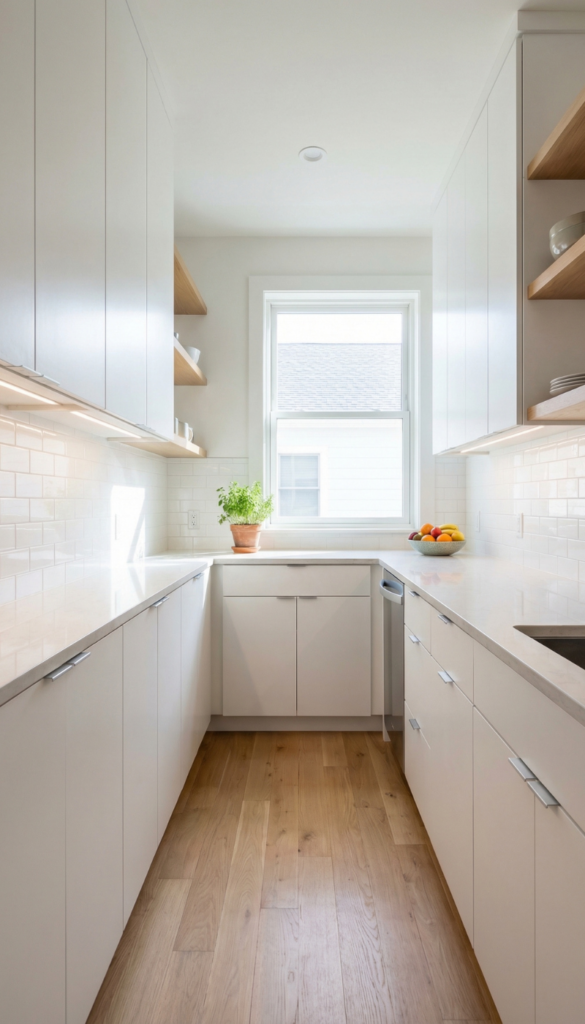
Galley kitchens are funny little spaces.
On paper, they’re incredibly efficient. Everything is close. You can pivot from the sink to the stove in two steps. There’s a reason restaurants love them. But in real homes, when the spacing or lighting isn’t quite right, they can start to feel less like a kitchen and more like… a hallway that accidentally picked up a fridge and a stove along the way.
And once that cramped feeling settles in, it’s hard to ignore. The counters feel tighter. Two people cooking becomes a choreography exercise. Someone opens the fridge and suddenly the entire walkway disappears.
The good news is that most galley kitchens don’t actually need structural renovations to feel bigger. What they need are a few layout adjustments, some smarter lighting, and a couple visual tricks that designers rely on constantly.
So if the goal is to make a galley kitchen look bigger without knocking down walls, here’s where to start.
If you only do three things:
- Protect the walkway width so people can move comfortably
- Remove the biggest traffic bottleneck (usually the refrigerator)
- Use light colors and reflective surfaces to bounce light through the space
Those three alone can dramatically change how the room feels.
Start With the 5-Minute Galley Kitchen “Space Audit”
Before thinking about tile or paint or cabinet colors, it helps to pause and look at the kitchen objectively.
A quick space audit often reveals that the issue isn’t square footage at all. It’s usually circulation.
Stand at one end of the kitchen and look straight down the aisle. Open the refrigerator door. Then open the dishwasher. Then imagine two people trying to pass each other while someone is cooking.
Where does everything stop working?
In most galley kitchens, there’s one section where movement collapses. A tight turn near the fridge. A dishwasher door blocking the walkway. A prep area squeezed into the narrowest part of the room.
Finding that bottleneck is step one.
Because once circulation improves, the kitchen often feels larger immediately.
Measure Your Aisle First (Or Nothing Else Works)
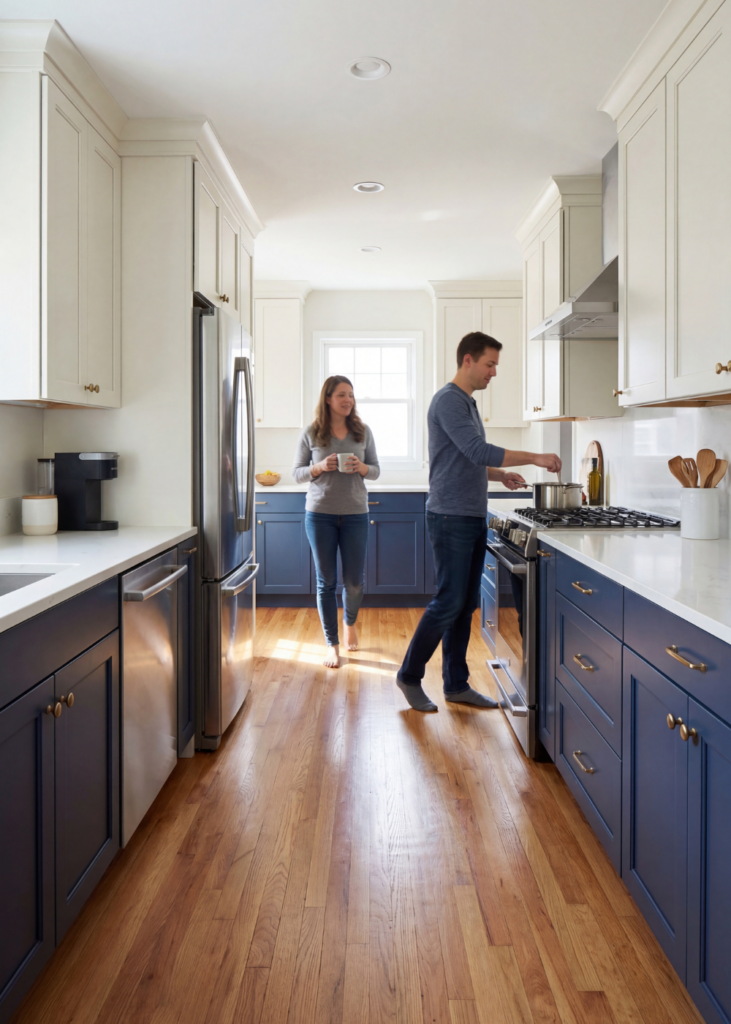
This part might feel a little technical, but it matters.
Interior designers rely on a few key measurements for galley kitchens:
- Minimum walkway: 36 inches (about 91 cm)
- Work aisle for one cook: 42 inches (about 107 cm)
- Work aisle for two cooks: 48 inches (about 122 cm)
Below those numbers, things start to feel uncomfortable. People turn sideways. Appliance doors block the walkway. The space feels tighter than it actually is.
And once that happens, no backsplash or cabinet paint color can really fix the problem.
Good circulation is the foundation for everything else.
Fix the Layout Bottleneck (The Galley’s #1 Space Killer)
Almost every galley kitchen has a traffic magnet.
It’s usually the refrigerator.
Because everyone uses it. Constantly. Drinks, snacks, ingredients, leftovers. It’s the appliance that pulls people into the same spot again and again.
And if that fridge sits in the narrowest section of the kitchen, the entire layout starts to struggle.
Move the “Space Bully” Out of the Aisle
Large appliances tend to dominate circulation, which is why some designers jokingly call them “space bullies.”
If possible, place the refrigerator slightly deeper into the kitchen rather than directly at the entrance. That allows someone to stand with the door open while another person walks past behind them.
Even small adjustments like this can change how the entire room flows.
When appliances stop blocking the walkway, the kitchen suddenly feels calmer and more usable.
Use the “One Side Slim” Cabinet Trick
Here’s a trick designers quietly use all the time in narrow kitchens.
Standard base cabinets are about 600 mm deep. When both sides of a galley use that full depth, the walkway shrinks quickly.
But not every cabinet actually needs that much depth.
Standard Depth on One Side, Shallow on the Other
One common strategy is keeping full-depth cabinets on the main cooking wall and using shallower storage on the opposite side.
For example:
- Cooking wall: sink, stove, full-depth cabinets
- Opposite wall: shallow cabinets or shelves around 300 mm deep
This gives the cooking zone the space it needs while widening the walkway.
And those shallower cabinets still work beautifully for things like:
- pantry storage
- dish storage
- coffee stations
- glassware
It’s a subtle shift, but one that can make a narrow kitchen feel significantly more comfortable.
Reduce Visual Clutter Without Losing Storage
Even when the measurements are correct, a galley kitchen can still feel tight if there’s too much visual activity happening.
Remember, the walls are close together. Which means patterns, cabinet doors, and color changes all appear more intense.
The goal isn’t to remove personality from the space.
It’s to let the room breathe a little.
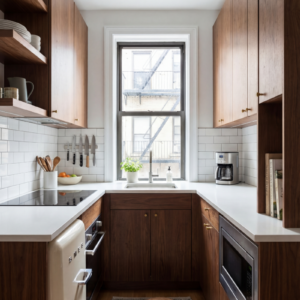
Swap Some Uppers for Open Shelving or Glass Fronts
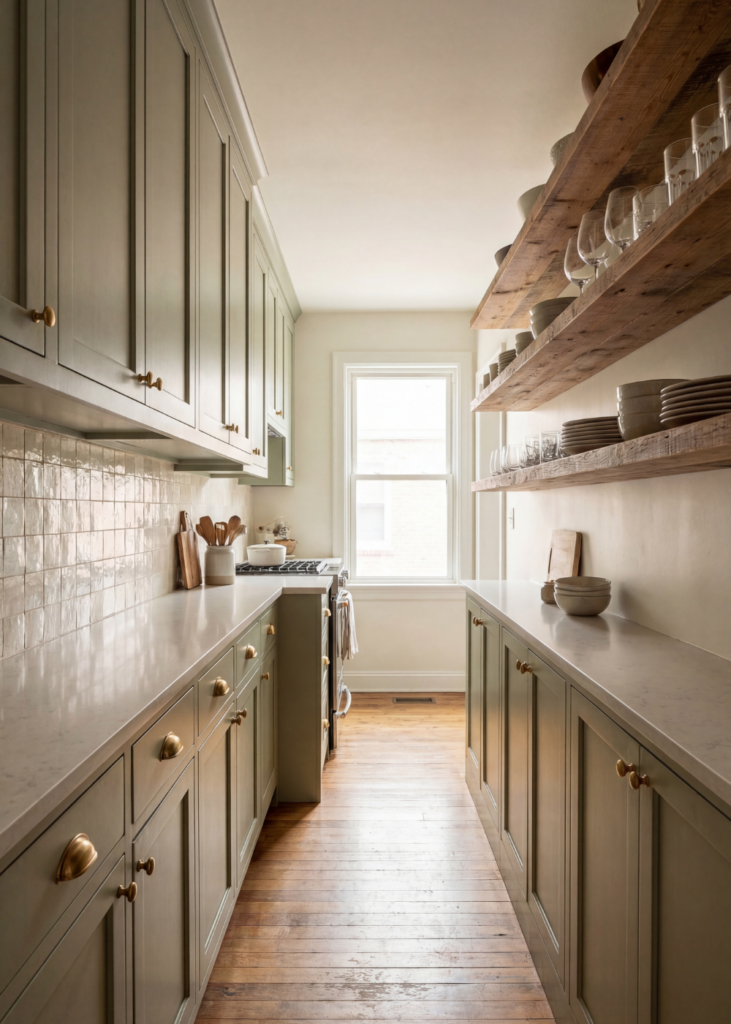
Wall-to-wall upper cabinets on both sides can create a strong tunnel effect.
Removing just a small section of them and replacing it with open shelving or glass-front cabinets introduces breathing room.
Open shelves work particularly well for everyday items like:
- plates
- bowls
- glasses
The key is keeping them simple and uncluttered so they lighten the wall rather than overwhelm it.
Go Full Height Strategically
Interestingly, sometimes the opposite strategy works too.
Full-height cabinets that reach the ceiling can make a kitchen feel taller and more intentional. They remove the dusty gap above cabinets and create a strong vertical line that visually stretches the room.
When done in lighter tones or with glass elements, tall cabinets can actually help a galley kitchen feel more spacious.
Light and Reflection Are Your Best Friends
Lighting might be the most underrated tool in small kitchens.
Many galley kitchens rely on a single ceiling fixture. Which means shadows collect along the counters and corners.
And shadows shrink a room faster than almost anything else.
Layered lighting fixes that.
Layer Lighting (Ceiling + Under-Cabinet + Task)
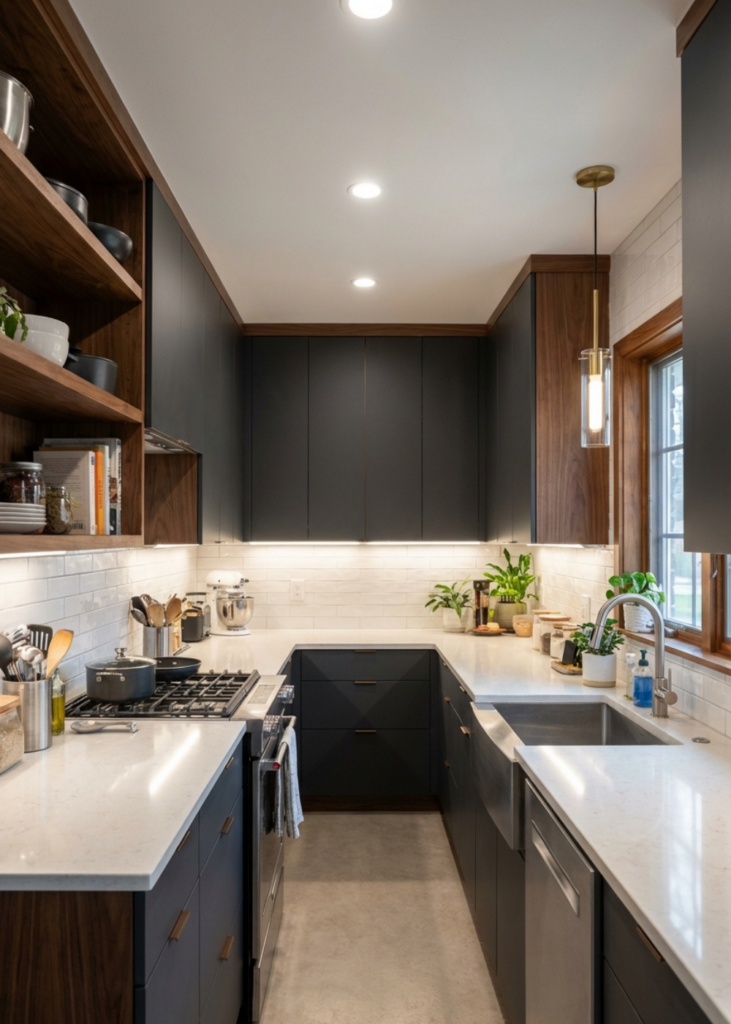
A well-lit galley kitchen usually combines three types of lighting:
- Ceiling lighting for overall brightness
- Under-cabinet lighting for countertops
- Task lighting like pendants or small lamps
Once those layers work together, the room feels dramatically more open.
No more dark corners. No more shadowy prep areas.
Just light moving through the space.
Add One Reflective Surface
Another powerful trick is reflection.
Glossy surfaces bounce light deeper into the kitchen, creating the illusion of extra depth.
This is where backsplash choices really matter.
Gloss tile, mirrored backsplash panels, or polished metal accents all reflect light and visually expand the room.
Even subtle vertical tile layouts can help by pulling the eye upward instead of across the narrow walls.
Choose Colors That Let the Kitchen Breathe
Color matters. But not always in the way people think.
A galley kitchen doesn’t necessarily need to be bright white to feel larger.
What it needs is fewer hard visual breaks.
One Dominant Light Tone
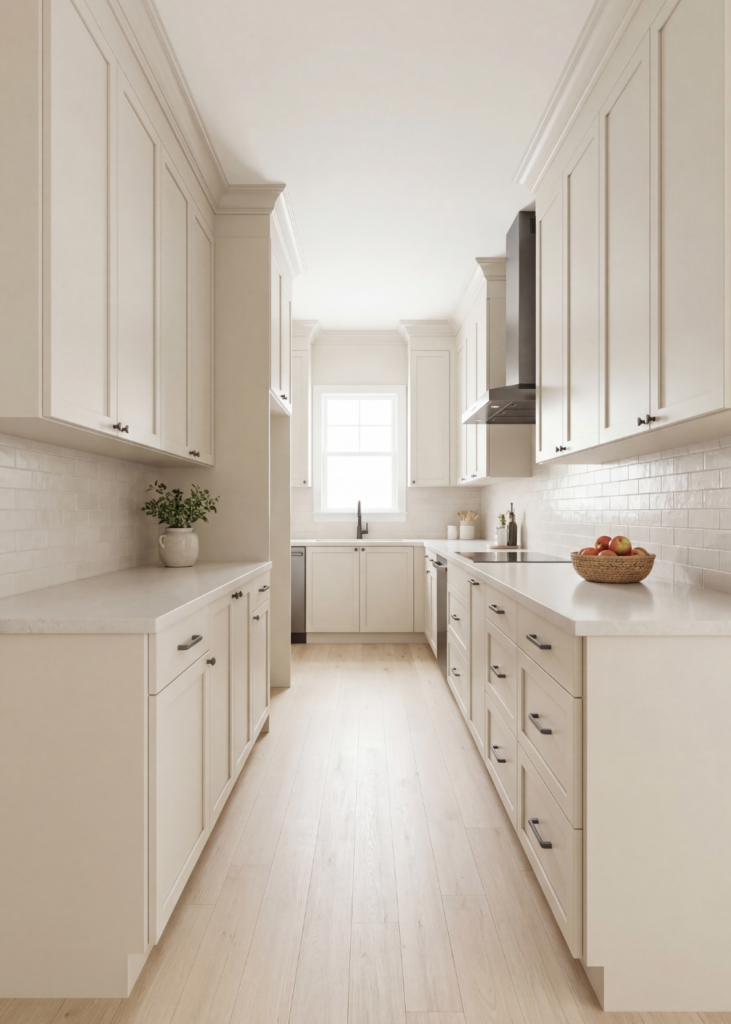
When cabinets, walls, and trim share a similar light tone, the eye moves through the room more smoothly.
Popular choices include:
- warm white
- soft greige
- pale neutral tones
Darker colors can still appear, especially on lower cabinets or the far wall. But keeping the palette cohesive helps the room feel calmer and wider.
Too many strong contrasts can chop the kitchen visually into smaller pieces.
Pay Attention to Flooring Direction
Flooring direction is one of those details people rarely notice consciously, but it has a huge effect on how a room feels.
In a galley kitchen, the goal is to guide the eye down the length of the room.
Lay Planks Lengthwise
Installing floor planks along the length of the kitchen helps visually stretch the space.
Planks running across the width can do the opposite, making the room feel shorter and more boxed in.
Also try to avoid overly busy floor patterns. Strong contrasts can visually chop the floor into smaller sections.
Simpler floors tend to make narrow spaces feel more open.
Rethink Appliance Placement
Large appliances can quickly dominate a galley kitchen.
Even when the walkway measurements are correct, too many bulky appliances clustered together can make the space feel crowded.
Don’t Park the Fridge at the Pinch Point
If there’s one appliance placement rule worth remembering, it’s this one.
Avoid putting the refrigerator in the narrowest part of the kitchen.
Because once the door opens, the entire walkway disappears.
Placing the fridge slightly deeper into the layout allows circulation to continue around it.
Integrated Appliances Reduce Visual Bulk
Panel-ready or integrated appliances blend into cabinetry and create smoother wall lines.
Even small details like aligning cabinet heights or matching appliance finishes can reduce visual noise.
And when visual noise drops, the room automatically feels calmer.
And bigger.
The 3 Design Mistakes That Make Galley Kitchens Feel Smaller
A few design habits consistently make narrow kitchens feel tighter than they actually are.
Avoid these when possible.
Too many competing patterns
Bold floors, dramatic counters, and busy backsplashes all fighting for attention.
Too many upper cabinets
Storage covering every inch of both walls creates a tunnel effect.
Furniture in the walkway
Carts, stools, and bins placed in the aisle shrink the usable space immediately.
Fixing even one of these can make a noticeable difference.
The Takeaway
When a galley kitchen feels small, the issue is rarely the size of the room.
More often, it’s circulation, lighting, and visual clutter working against each other.
Improve the walkway width. Remove the biggest bottleneck. Add layered lighting. Simplify the visual palette.
Do those things, and suddenly the same kitchen that once felt cramped starts to feel calm, functional, and surprisingly spacious.
No walls required.
FAQs
How wide should a galley kitchen aisle be?
A minimum walkway is 36 inches (91 cm). For cooking areas, aim for 42 inches (107 cm) for one cook or 48 inches (122 cm) for two.
What makes a galley kitchen feel cramped?
Usually a narrow aisle, excessive upper cabinets, and poor lighting.
Should a galley kitchen have cabinets on both sides?
Not always. Removing some uppers or using open shelving can reduce the tunnel effect.
What colors make a galley kitchen look bigger?
Light cohesive tones like warm white, greige, or pale neutrals.
Do mirrors help in a galley kitchen?
Yes. Reflective surfaces bounce light and increase perceived depth.
Which flooring direction works best?
Lengthwise planks visually stretch the kitchen.
Can a galley kitchen feel bigger without renovation?
Yes. Better lighting, decluttering, and cohesive colors can make a big difference.
Is open shelving a good idea in a galley kitchen?
Yes, when kept minimal and organized.
Where should the fridge go in a galley kitchen?
Avoid placing it in the narrowest section of the walkway.
Can renters use the shallow cabinet trick?
Yes. Slim carts or shallow shelving can mimic the same effect.


Leave a Reply