
Okay, so I have a confession – I’ve been obsessing over rug layering for months without actually having floors to put rugs on yet, which is either very Type A or just what happens when you’re building a house from scratch and have nothing but decisions to make. Our ground floor is going to be tile throughout. Warm gray porcelain (or beige), which I love, and yes we’re doing underfloor heating so the cold argument is technically off the table – but tile is still hard and does not invite you to sit on the floor with a coffee. So rugs. Obviously rugs.
But here’s the thing – one rug in a large open living room feels like giving up. It’s fine. Fine is not what I want. I want that room where you walk in and your whole body just… relaxes because the floor looks SO good. You know the rooms. You’ve saved them on Pinterest. I’ve saved approximately four hundred of them.
So I’ve done the research. A lot of it. In the name of transparency, I’ve also made some expensive mistakes in previous apartments that taught me things I wish someone had just told me directly. Which is what I’m going to do for you now.
The short version: layering rugs without it looking terrible comes down to three things – the base rug needs to be larger than you think, the top rug needs to cover about two-thirds of it, and the textures need to actually contrast. That’s it. That’s the formula. The rest is just understanding why those rules exist, which I will explain by telling you about the times I broke them.
ANYWAY. Let’s get into it.
Why I Kept Getting the Base Rug Size Wrong (And Why You Will Too)
Here’s what getting the size right actually looks like – notice how the chair legs sit directly on the rug, not beside it:
In my last apartment I had an 8 by 10 foot rug in a 12 by 14 foot living room. I measured. I calculated the border of floor I’d leave showing around the edges. The internet told me this was correct and I believed it, which is the first mistake.
Here’s what happens when your base rug is too small – everything floats. The furniture just sits there. The room feels like a showroom where pieces have been placed rather than a home where people live. I lived with it for two months before I admitted it wasn’t working, which, honestly, I don’t know why I waited that long except that I’d already committed to the size in my head and changing it felt like defeat.
(It was defeat. I lost that round to an 8 by 10 rug. These things happen.)
The rule that actually works: the front legs of all your main seating need to sit on the base rug. Not beside it. ON it. When you calculate that out – sofa, chairs, the whole seating arrangement – you almost always need a 9 by 12 foot minimum for a normal living room. Sometimes bigger. The rug looks enormous in the store and then you get it home and it looks exactly right, and this is the only time in home decor where that surprise is a good one.
For material I would always choose natural fiber for a base layer – jute, sisal, or a jute-cotton blend if you want it to feel less like walking on straw (and you do, trust me on this). Pure jute is beautiful and also feels like the floor grew a layer of straw for some reason. The blend is more expensive and SO much more livable. Apartment Therapy has a genuinely useful breakdown of natural fiber rug types if you’re trying to decide between jute, sisal, and seagrass – worth reading before you commit to anything.
The specific thing nobody tells you about natural fiber: it sheds for the first month. Like, a lot. You’ll vacuum twice a week and wonder if the rug is disintegrating. It’s not. It’s just becoming itself. After about six weeks it mostly stops and you’ll forget this phase ever happened.
Color should be neutral. Not because I’m advocating for boring – because a neutral base gives your top rug room to be the interesting one, and the interesting one is where your whole personality goes, so you want that real estate available.
The Top Rug Is Where Things Get Fun (With Rules)
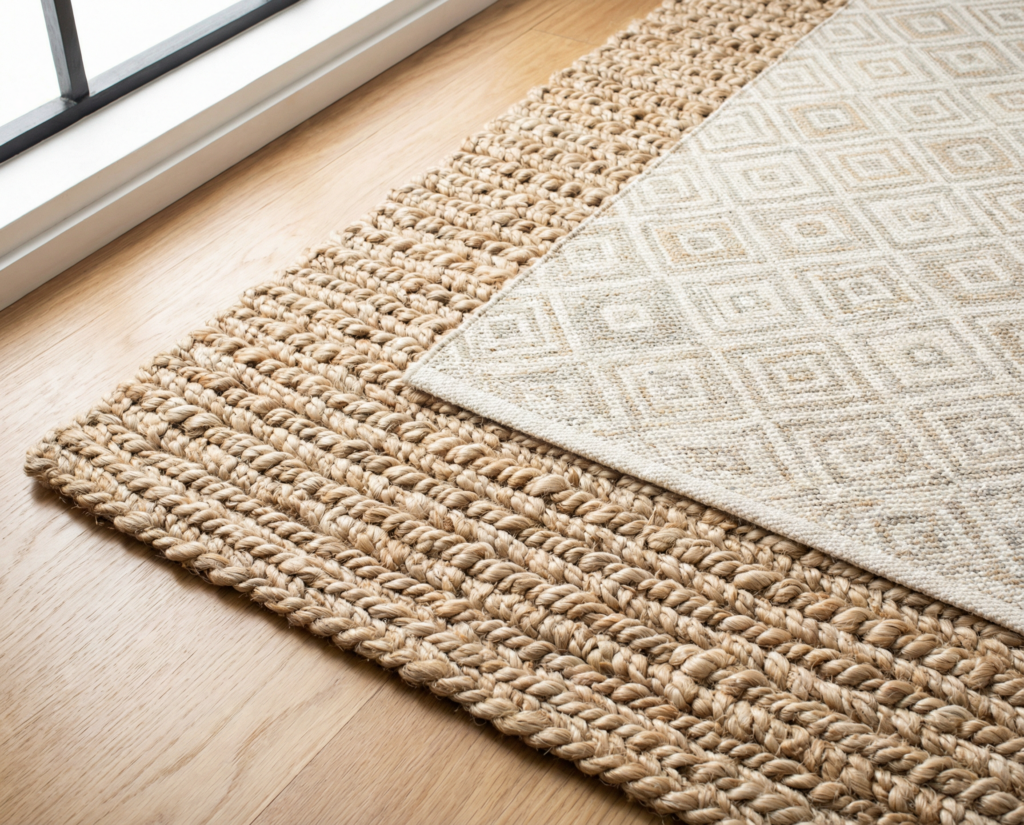
This is the formula working exactly as it should – one patterned rug, one neutral jute base, texture contrast that reads as intentional
The proportion that I keep coming back to: the top rug covers roughly two-thirds of the base. If your base is 9 by 12, your top layer wants to be around 5 by 7 or 6 by 9. This gives both rugs visual presence without making either feel like an afterthought. The top rug sits slightly off-center toward where people actually sit – in front of the sofa, under the coffee table, where feet land.
Texture contrast is non-negotiable and I cannot stress this enough. Rough natural fiber base, softer wool or cotton top. This is what makes the whole thing look intentional. I tried layering two wool rugs once (I was going through a phase) and they just blurred into each other. The contrast is the signal to anyone’s eye that this was a choice, not an accident. You want the choice to be obvious.
Patterns are where people overthink it, so here is the simple version: one rug gets to have a pattern. The other one doesn’t. Base rug is all texture, no pattern. Top rug can be Persian, geometric, abstract, whatever works for your space. If both have strong patterns they’re fighting, and the room loses that fight even if you paid a lot of money for both rugs. (I know. I’ve been there. The geometric wool rug from the flash sale site at 11pm that I kept for three weeks pretending I liked it. I did not like it. It went back.)
The best top rugs for layering, in my genuine opinion, are vintage. A worn Persian with fringe and slight color variation looks better layered than a perfect new rug because it reads as collected rather than coordinated. It also means you don’t panic when someone spills something, which is worth approximately as much as the price difference between new and vintage.
The Mistakes That Make It Look Terrible
Two statement rugs sharing a floor. One has to be the quiet one. This is the most common mistake and the hardest to fix once you’ve committed to two expensive rugs that both want to be the main character.
Base rug that’s too small. I’ve already covered this but I’m saying it again because it’s THAT important. Everything floats. The whole room looks unresolved. No amount of perfect top rug choice fixes a base rug that isn’t doing its job.
Similar textures. Jute on jute, wool on wool – it looks like a mistake not a choice. The contrast is the whole point.
Dramatic angling of the top rug. This was everywhere on interior design Instagram for a while and I understand the impulse but it mostly looks like the rug shifted during a party and nobody straightened it. Parallel placement looks more settled. Like someone lives there on purpose.
Layering where you don’t need zones. Bedrooms want soft and wall-to-wall, not defined seating areas. Small rooms get cluttered not layered. Know when one good rug is actually the right answer.
Sizing Reference Because I Wish Someone Had Given Me This
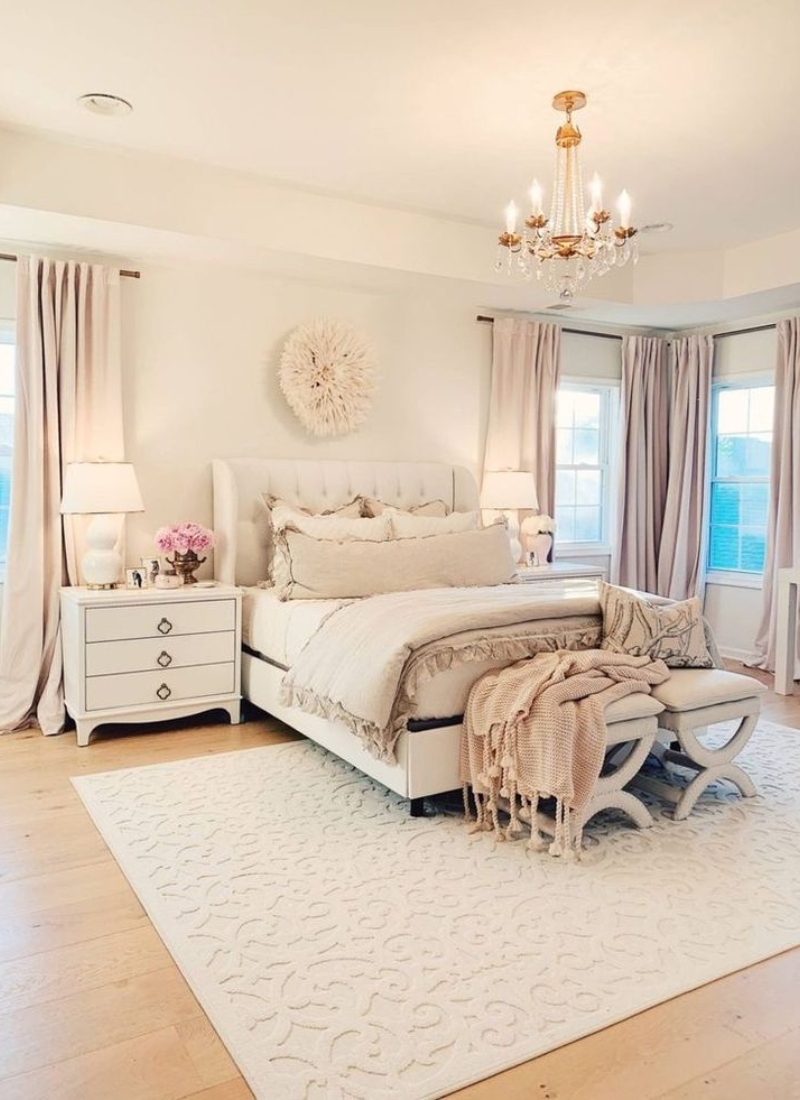
Here’s what correct sizing actually looks like in a real room – notice how the base rug is large enough that the furniture anchors to it, and the top rug sits centered under the coffee table:
| Room Size | Base Rug | Top Rug | The Rule |
|---|---|---|---|
| 10 x 12 ft | 8 x 10 ft | 5 x 7 ft | Front legs of all seating on base |
| 12 x 14 ft | 9 x 12 ft | 5 x 7 or 6 x 9 ft | Front legs on base, coffee table entirely on top |
| 14 x 18 ft | 10 x 14 ft | 6 x 9 or 8 x 10 ft | Scale up proportionally, same rules apply |
| Open plan | Defines the seating zone | Two-thirds of base | Layering creates a room within a room |
The Maintenance Part Nobody Mentions
Vacuum base rug first. Lift top rug and vacuum underneath – dust collects between the layers faster than you’d expect. Vacuum top rug separately. Five minutes, once a week. Every few weeks, roll both up and vacuum the floor underneath. This is not glamorous information but the alternative is a rug sandwich full of dust and I don’t want that for you.
Rug pad under the base layer on hard floors – prevents slipping and adds a tiny bit of cushion. Thin non-slip liner between base and top – keeps the top layer from shifting. Both are cheap. Both matter, especially if you have cats who view rugs as launching pads. (Not speaking from experience. Speaking ENTIRELY from experience.)
Spills – blot immediately, never rub, club soda for wool. Natural fiber is less forgiving for liquids which is worth knowing before you commit to a room that sees a lot of glasses of wine. This Old House has a detailed cleaning guide by rug material type that’s genuinely worth bookmarking before you need it rather than after.
The Honest Conclusion
I really love the idea of this – genuinely, not just as a design blogger thing to say. A room with hard floors and layered rugs done right feels grounded and finished in a way that’s hard to name but immediately obvious when you walk in. It looks like a design choice and functions like a comfort choice and those two things don’t always overlap, so when they do it’s worth paying attention to.
The formula one more time because I find repetition helpful when I’m actually trying to implement something: base rug larger than you think with front furniture legs on it, top rug covering two-thirds of the base, textures that contrast, patterns that don’t compete. Start there and adjust for your specific room.
I don’t know yet which rugs are going in our new house – that decision is still months away, which is probably why I’ve been researching it for this long. But I like it SO much better as a concept than the alternative, which is cold gray tile and furniture that floats.
What’s your biggest rug mistake? The one you bought and knew immediately was wrong, or the one you kept for three months pretending to like? I’m genuinely asking because I cannot be the only one with a geometric wool rug in my return history.
FAQ
How big does the base rug need to be when layering?
Bigger than whatever size you’re currently thinking. The front legs of all your main seating need to sit on the base rug – not beside it, on it. For a 12 by 14 foot living room that usually means a 9 by 12 minimum. Most people buy an 8 by 10 and wonder why everything looks like it’s floating. The rug feels enormous in the store and exactly right at home, and that’s how you know you got it right.
What’s the best material for a base rug when layering?
Natural fiber – jute, sisal, or a jute-cotton blend. They’re flat enough that adding a second layer on top doesn’t create height issues, and neutral enough in texture that they don’t compete with whatever you put on top. The blend is worth the extra cost because pure jute feels like walking on straw, which is not the cozy living room experience you’re going for. Fair warning – natural fiber sheds for the first month. A lot. This is normal. It stops.
Can layered rugs work on carpet?
They can, with one rule – the top layer needs to be flat weave or very low pile so it doesn’t create a tripping hazard. It works best when the base rug is large enough to read as a defined area rather than just a small rug sitting on carpet. The same proportion rules apply – you’re still creating a zone, just on a softer surface.
How do you keep layered rugs from sliding around?
Rug pad under the base layer on hard floors, thin non-slip liner between base and top layer. Both are inexpensive and genuinely necessary, especially if you have pets or children or both. Without them the whole stack migrates slowly toward one wall and you’ll be straightening it every other day, which is not how I want to spend my time and probably not how you want to spend yours either.



Leave a Reply